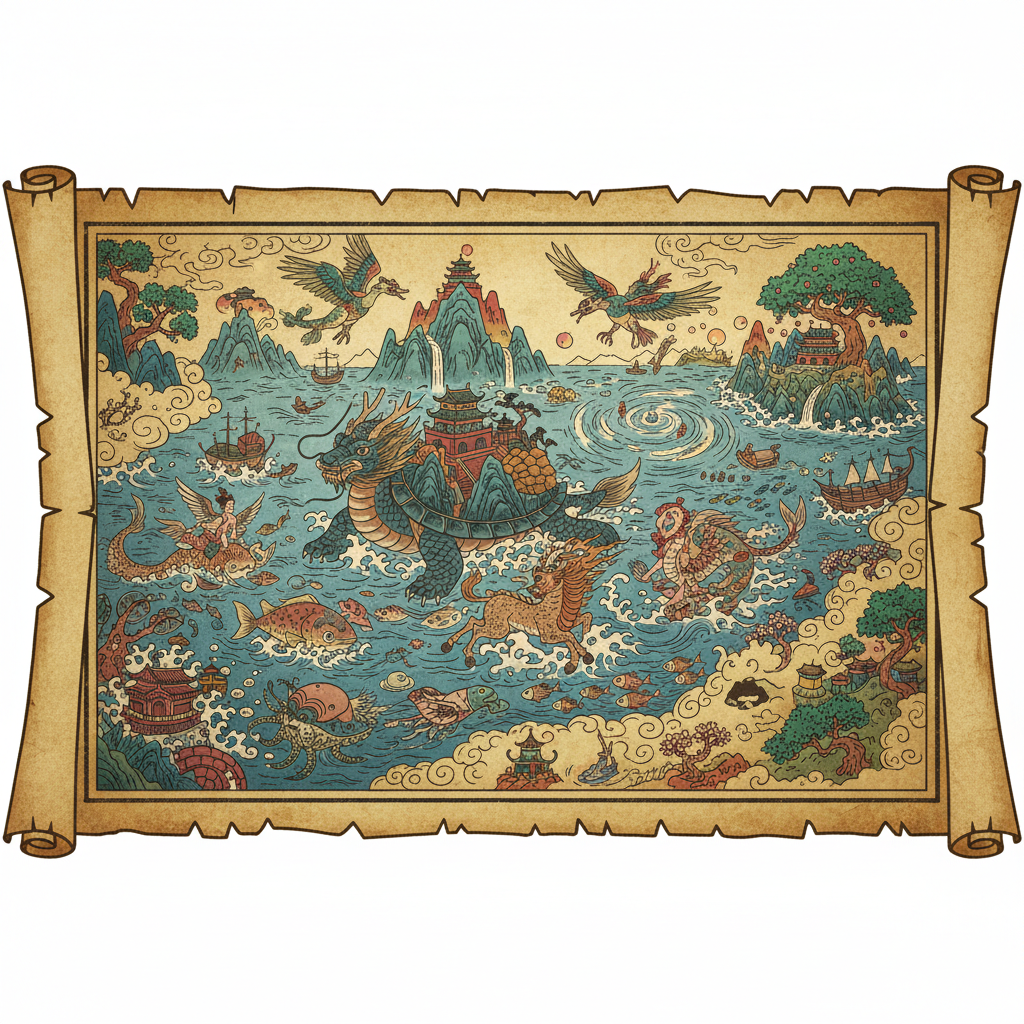
Introduction to the Shanhaijing: A Cultural Treasure
The Shanhaijing, or Classic of Mountains and Seas, is one of ancient China's seminal texts, blending geography and mythology into a captivating tapestry. Compiled during the Warring States period and later added to in the Han Dynasty, this rich compilation maps out mythical lands and creatures across the vastness of ancient China. Here, we delve into its coastal realms and the fantastic beasts that inhabit its seas, illustrating the deeper connections between nature, mysticism, and cultural identity in Chinese thought.
Ancient Maritime Routes and Mythical Landscapes
The seas described in the Shanhaijing are not mere bodies of water; they are realms rife with symbolism and deeper meanings. This ancient text chronicles coastal regions that serve as mythic markers — each harboring its own folklore. The Eastern Sea, for example, is linked with the mythical Daiyu, a pearl that granted wisdom and insight.
Historically, these maritime routes held significant importance in trade and cultural exchange. Coastal trades facilitated the movement of goods as well as ideas, contributing to a shared mythological landscape spanning various peoples. The Shanhaijing effectively becomes a vessel for recording these shared myths, blending historical fact with elemental truths and imaginative fancies.
Legendary Sea Creatures: Guardians and Harbingers
Among the most compelling aspects of the Shanhaijing are its descriptions of fantastical sea creatures. For instance, the Bai Ze, often depicted as a hybrid of lion and fish, embodies protection and wisdom. According to legend, Bai Ze imparted valuable knowledge to the Yellow Emperor regarding celestial occurrences and social order.
Another notable creature is the Qiongqi, a fierce beast believed to inhabit the depths of the sea. This creature represents danger but also serves as a reminder of man's relationship with nature — a theme central to the Shanhaijing. Through these narratives, the ancient Chinese sought to express their reverence for the seas, merging awe with caution, and illustrating a balance of power between humanity and the natural world.
The Role of Water in Chinese Cosmology
Water holds a central role in Chinese cosmology, symbolizing the continuous cycle of life and death. In the Shanhaijing, bodies of water are often depicted as gateways to other dimensions or realms, much like the mythical Lake Kunming, which is said to connect the mortal world with paradisiacal territories inhabited by gods and celestial beings.
This underlying theme of transcendence can be traced back to foundational Chinese beliefs about the harmony of opposites, known as Yin and Yang. The rivers and seas in the Shanhaijing emphasize this balance, reflecting the life-giving force of water while also showcasing its potential for destruction and chaos.
Tales of Transformation and Magic
Narratives in the Shanhaijing often feature magic and transformation, particularly in the context of the sea. For instance, mythical islands such as Penglai are said to be home to immortals who wield the power to alter reality. Stories of these islands inspire concepts of utopia and the search for enlightenment, echoing broader themes found in Daoist philosophy.
Moreover, aquatic transformations are central to many myths in this collection. The sea can metamorphose creatures into formidable protectors or benevolent deities, offering narratives that highlight the fluidity of existence in both a physical and spiritual sense. This fluidity is emblematic of many cultures worldwide, yet the Shanhaijing offers a distinctly Chinese perspective rooted in nature’s duality.
Conclusion: The Shanhaijing's Enduring Legacy
The myriad of mythical seas, creatures, and landscapes in the Shanhaijing reflects the intricate relationship between Chinese culture, nature, and mythology. These tales not only entertain but serve as a lens through which one can explore ancient beliefs concerning the cosmos and humanity's place within it.
Today, the Shanhaijing remains an essential work, providing insight into how ancient Chinese societies conceived of their world, addressing themes of creation, chaos, and the interconnectedness of life. The seas depicted in this classic not only harbor mythical creatures and lands but also continue to inspire modern cultural expressions, ensuring that the wisdom of the ancients remains woven into the fabric of contemporary thought.