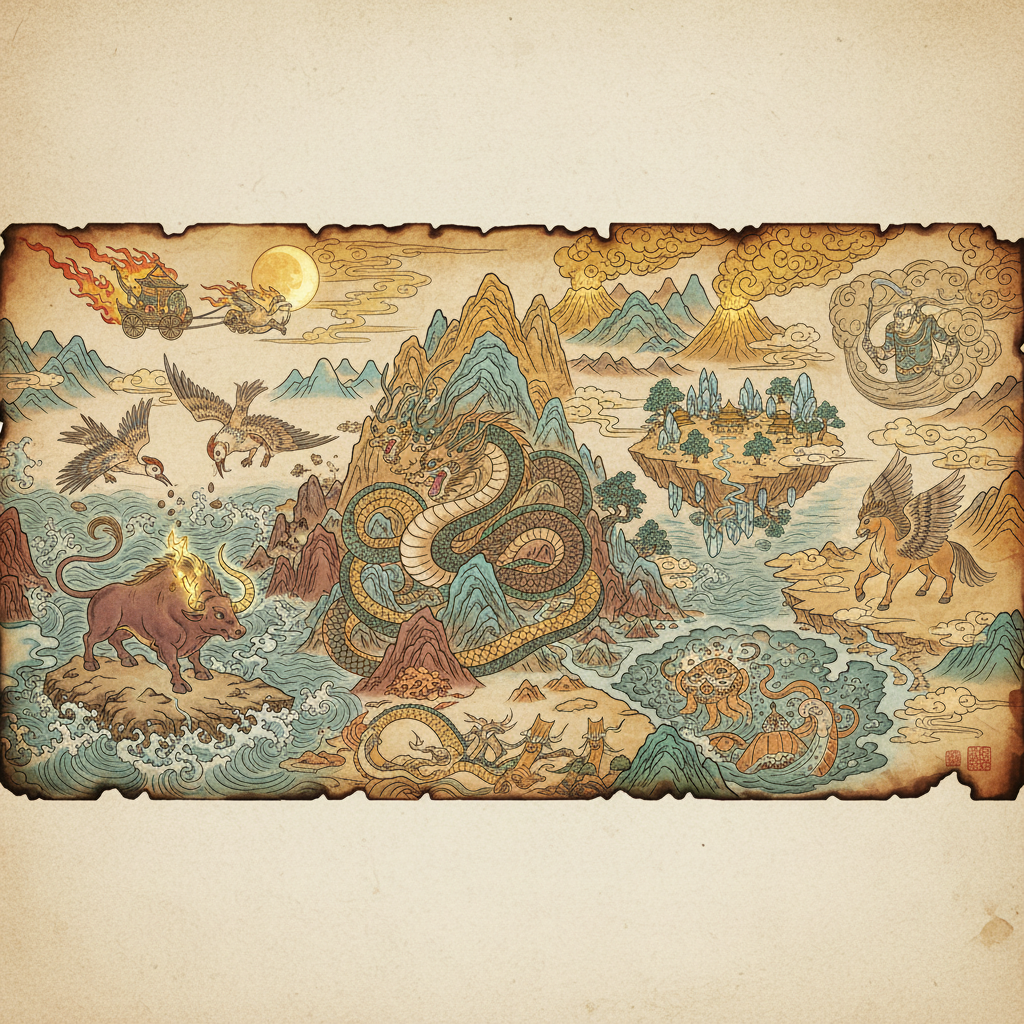
Introduction to Shanhaijing: Ancient Chinese Myth and Geography
The Shanhaijing, often translated as the Classic of Mountains and Seas, is an ancient Chinese text composed over many centuries, possibly from the Warring States period through the early Han dynasty (roughly 4th century BCE to 1st century CE). This rich compendium blends geography, mythology, folklore, and ethnography, offering a fascinating glimpse into early Chinese cosmology and imagination. The book catalogs myriad mythical creatures, strange peoples, and exotic lands believed to exist in the vast and mysterious world beyond early Chinese frontiers.
More than a simple geographic or mythological text, the Shanhaijing serves as a cultural map that reflects the worldview and spiritual beliefs of ancient China, providing insights into how nature, morality, and the supernatural intertwined. Its strange creatures and lands have captivated scholars, artists, and storytellers for centuries.
Mythical Creatures of the Shanhaijing: Beyond Ordinary Beasts
The Shanhaijing contains some of the most bizarre and captivating mythical beings in Chinese lore. Unlike typical dragons or phoenix myths, many creatures here are hybrids or possess extraordinary features symbolizing various cosmic principles.
One well-known creature is the Zouwu, described as a giant beast with incredible speed—it can traverse thousands of miles in a single day. It resembles a massive feline with multicolored fur and is said to bring luck to the region it inhabits. Interestingly, this creature symbolizes agility and protection and has appeared in modern popular culture, including video games and fantasy novels.
Another striking being is the Jiuwei Hu, the nine-tailed fox. While the fox is often a symbol of trickery in Chinese myth, the Shanhaijing version portrays it as a powerful and auspicious creature capable of both benevolence and malevolence, depending on the context. Its multiple tails emphasize its longevity and mystical powers.
There is also the Shenxiang, a creature with the body of a tiger but with a human face. Considered a mountain guardian spirit, it reflects the ancient Chinese belief in anthropomorphic supernatural beings tasked with protecting natural domains.
Mythical Lands and Topography: A Cartography of Mystery
The Shanhaijing describes a complex topography filled with enchanted mountains, rivers of strange quality, and remote islands inhabited by fantastic creatures and peoples. It is divided into sections that correspond to the four cardinal directions and the central regions, each brimming with unique mythic geographies.
For instance, the Endless Mountains (无尽山), featured in several chapters, are home to terrifying beasts and spirits that are beyond the reach of ordinary humans. These mountains symbolize the boundary between the known world and the mysterious unknown, highlighting ancient ideas about exploring and mapping the edges of civilization and spirit.
There are also islands such as Yuzhou, described as a place where plants and animals differ strikingly from the mainland, serving as a locus for supernatural powers. These distant lands functioned as metaphors for spiritual or transformative journeys, hinting at shamanistic influences in ancient Chinese culture.
Historical and Cultural Significance of Shanhaijing’s Beasts and Realms
The fantastical creatures and places in the Shanhaijing are not mere flights of fancy; they hold deep cultural and symbolic meanings. Many reflect early Chinese attempts to understand and categorize the natural world and its dangers. Mythical beasts often represented the forces of nature, morality, or political ideology—such as loyalty, wisdom, or ferocity.
Additionally, the Shanhaijing influenced religious and philosophical traditions, including Daoism and early Chinese cosmology. The detailed cataloging of spirits and creatures reminded readers of the unseen world teeming with forces that demanded respect and ritual. This relationship between humans and the natural-spiritual world formed the ethical framework of many ancient Chinese communities.
The text also functioned as a proto-encyclopedia, influencing later literature, art, and folklore. Countless Chinese painters, poets, and storytellers drew inspiration from its vivid descriptions, adapting and reinterpreting these beings and places through time.
Interesting Details: From Exotic Fauna to Cultural Metaphors
An intriguing aspect of the Shanhaijing is its inclusion of creatures that resemble animals known today but infused with layers of myth. For example, some descriptions likely allude to creatures such as giant pandas or ostriches; however, their enhanced attributes—multiple heads, magical abilities—elevate them to divine or spiritual status.
Furthermore, the text often assigns moral qualities to these creatures and lands—beauty hides danger, isolation breeds wisdom or madness, and natural cycles reflect cosmic balance. These motifs resonate with universal themes found in mythologies worldwide, bridging Chinese myth with broader human storytelling traditions.
Conclusion: The Enduring Legacy of Shanhaijing’s Mythical Menagerie
The Shanhaijing remains a vital source for understanding ancient Chinese myth, cosmology, and cultural identity. Its mythical creatures and enigmatic lands are not just curiosities but windows into how early societies negotiated the unknown, expressed wonder, and grappled with existential questions.
Today, the Shanhaijing continues to inspire scholars, artists, and fans of mythology alike, inviting us to explore a world where mountains breathe, beasts talk, and the boundaries between reality and myth blur. As a foundation of Chinese cultural heritage, its creatures and realms remain timeless symbols of imagination and mystery.