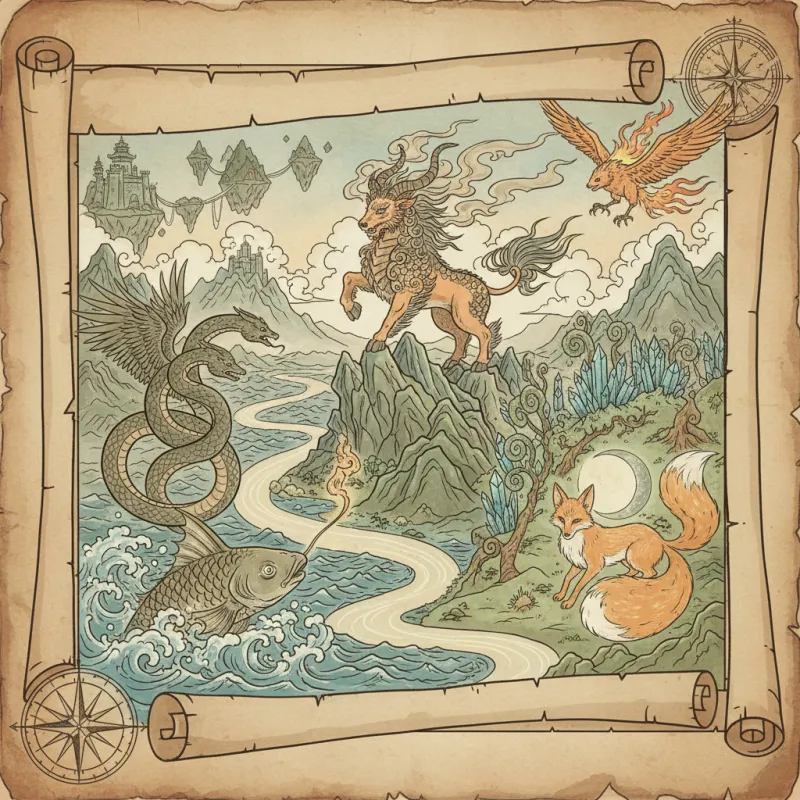
Picture this: a nine-tailed fox prowling through bamboo forests, its crimson fur shimmering like liquid fire. A bird with three heads screeching warnings of impending floods. A fish with human hands swimming through mountain streams. These aren't fever dreams or modern fantasy—they're meticulous entries from the Shanhaijing 山海经 (Shānhǎijīng, Classic of Mountains and Seas), a text so strange that scholars still debate whether its authors were documenting real expeditions, recording shamanic visions, or simply letting their imaginations run wild across silk scrolls.
Compiled somewhere between the 4th century BCE and the 1st century CE, this enigmatic compendium reads like an ancient field guide to the impossible. Its pages catalog over 200 creatures and describe 550 mountains, 300 waterways, and countless kingdoms that may or may not have existed. What makes the Shanhaijing truly remarkable isn't just its bestiary of the bizarre—it's how seriously it presents everything, with the same matter-of-fact tone you'd use to describe a house cat or a river trout.
The Nine-Tailed Fox and Creatures of Omen
The jiuwei hu 九尾狐 (jiǔwěi hú, nine-tailed fox) stands as perhaps the most famous creature from the Shanhaijing, though its reputation has evolved dramatically over millennia. In the original text's "Nanshan jing" 南山经 (Southern Mountain Classic) section, this fox appears on Qingqiu Mountain, and its appearance signals prosperity and peace—a far cry from the seductive demon-fox of later folklore and K-dramas.
The text describes it with characteristic brevity: "There is a beast here whose form resembles a fox with nine tails. It makes a sound like a baby and eats people. Those who eat it will be protected from insect-poison." This dual nature—both auspicious and dangerous—typifies many Shanhaijing creatures. They're not simply good or evil; they're forces of nature that humans must learn to navigate, much like the divine guardians that protected sacred mountains.
The bifang 毕方 (bìfāng), a one-legged bird wreathed in flames, serves a similar omen function. Appearing in the "Xishan jing" 西山经 (Western Mountain Classic), this crane-like creature with green feathers and a red beak supposedly heralded fires wherever it landed. Ancient Chinese communities would perform rituals to ward off the bifang, treating the text not as mythology but as practical disaster preparedness.
Geography as Fantasy: The Mystical Lands
The Shanhaijing doesn't just catalog creatures—it maps an entire cosmology of impossible places. The "Haiwai jing" 海外经 (Classic of Regions Beyond the Seas) sections describe kingdoms where people have holes through their chests, nations where residents live for 800 years, and islands inhabited entirely by women who conceive children by bathing in sacred pools.
Take the country of Xuanyuan 轩辕之国 (Xuānyuán zhī guó), located somewhere beyond the northwestern seas. Its inhabitants supposedly lived for 800 years, never experiencing illness, and spent their days riding elephants and taming tigers. The text places this paradise with the same geographical precision it uses for real mountains: "Beyond the Northwest Sea, north of the Red River, before the Flowing Sands." It's as if the compilers believed that if you just walked far enough, you'd eventually stumble into immortality.
The land of the changren 长人 (chángrén, long people) presents another fascinating case. These giants, standing over thirty feet tall, lived in the far northeast and left footprints that became lakes. Archaeological discoveries of dinosaur fossils in China have led some scholars to wonder if ancient peoples interpreted these massive bones as evidence of giant humans, weaving geological reality into mythological narrative.
Hybrid Creatures and Biological Impossibilities
The Shanhaijing has a particular fondness for chimeric beasts that blend multiple animals into single, unsettling packages. The lushu 鹿蜀 (lùshǔ) combines a horse's body with an ox's tail, a white head, and tiger stripes—and supposedly its appearance warned of major epidemics. The zhuyin 烛阴 (zhúyīn), described in the "Haiwai jing," takes the concept even further: a thousand-mile-long serpent with a human face whose opened eyes created daylight and whose closed eyes brought night.
These aren't random mashups. Many scholars believe these hybrid descriptions reflect actual animals misremembered through oral tradition or glimpsed briefly by travelers. The qilin 麒麟 (qílín), often translated as "unicorn," might have originated from giraffe sightings—when a live giraffe was presented to the Ming dynasty court in 1414, officials immediately identified it as the legendary qilin. Similarly, the Shanhaijing's description of the feilian 飞廉 (fēilián)—a creature with a deer's body, bird's head, and serpent's tail—might represent a confused account of an ostrich or cassowary.
But here's what makes the text fascinating: it doesn't care about biological plausibility. The Shanhaijing operates on dream logic, where a fish can have human hands (renyu 人鱼, rényú) or a bird can have three heads (sanshouniao 三首鸟, sānshǒuniǎo) simply because the world is vast and strange enough to contain such wonders.
Medicinal Beasts and Practical Magic
One of the most overlooked aspects of the Shanhaijing is its pharmaceutical dimension. Nearly every creature entry includes notes on its medicinal or magical properties, transforming the text into an ancient materia medica of the impossible. Eat the danghu 当扈 (dānghù) bird, and you'll cure madness. Consume the flesh of the zhuhuai 朱獳 (zhūhuái), and you'll become immune to fire. Wear the skin of the jiaotu 狡兔 (jiǎotù), and you'll run faster.
This practical approach reveals how the ancient Chinese viewed the natural world: everything had potential use if you understood its properties. The text describes the bingyi 冰夷 (bīngyí), a human-faced fish living in the Yellow River, noting that eating it would prevent swelling. Whether anyone actually tried this recipe is lost to history, but the recommendation sits alongside genuine medicinal advice about herbs and minerals, suggesting the compilers saw no hard boundary between the real and the mythical.
The pharmacological traditions that emerged from texts like these would influence Chinese medicine for millennia, even as physicians gradually separated verifiable treatments from legendary ones.
Cultural Legacy and Modern Interpretations
The Shanhaijing never disappeared from Chinese consciousness—it just shape-shifted, much like its own creatures. During the Tang dynasty (618-907 CE), poets referenced its beasts as metaphors for political chaos or personal transformation. Ming dynasty (1368-1644 CE) encyclopedists tried to rationalize its contents, proposing that the nine-tailed fox was actually a rare fox species or that the one-legged kui 夔 (kuí) was a misidentified crane.
Modern Chinese fantasy literature and gaming have embraced the Shanhaijing with enthusiasm. The text provides an inexhaustible bestiary for everything from mobile games to web novels, with creatures like the taotie 饕餮 (tāotiè)—a gluttonous monster whose face adorns ancient bronzes—appearing as raid bosses and antagonists. The 2016 film "The Great Wall" loosely adapted the taotie myth, though it took considerable liberties with the source material.
What's remarkable is how the text continues to generate new interpretations. Some scholars read it as an early attempt at ethnography, documenting foreign peoples through a Chinese cultural lens. Others see it as shamanic literature, recording spirit journeys rather than physical geography. A few bold theorists have even proposed it describes prehistoric megafauna or documents ancient contact with other continents—though these ideas remain firmly in the speculative realm.
Why the Shanhaijing Still Matters
In an age of satellite mapping and genetic sequencing, why should we care about a 2,000-year-old catalog of impossible animals? Because the Shanhaijing represents something more than bad zoology—it's a window into how ancient peoples made sense of a world far larger and stranger than their direct experience. Every bizarre creature and impossible kingdom reflects genuine wonder at the diversity of life and landscape.
The text also reminds us that the line between "real" and "mythical" has always been blurrier than we'd like to admit. Those Tang dynasty readers who referenced the nine-tailed fox weren't necessarily being superstitious—they were using a shared cultural vocabulary to discuss complex ideas about power, transformation, and the natural world. When we dismiss the Shanhaijing as mere fantasy, we miss how it functioned as philosophy, geography, medicine, and entertainment all at once.
Today, as we catalog Earth's biodiversity before it vanishes, there's something poignant about this ancient attempt to document every strange creature under heaven. The Shanhaijing authors couldn't have known that real animals—baiji dolphins, South China tigers, Yangtze giant softshell turtles—would become as mythical as their nine-tailed foxes, surviving only in records and memories. Perhaps that's the text's final lesson: the line between the living and the legendary is thinner than we think, and what seems impossible today might be tomorrow's extinction, while what we consider extinct might be waiting in some unmapped valley, ready to surprise us one more time.
Related Reading
- Exploring Shanhaijing’s Most Enigmatic Mythical Creatures and Mysterious Lands
- Modern Artists Reimagining the Classic of Mountains and Seas
- Sacred Mountains: The Five Great Peaks
- Exploring the Enigmatic Mountains and Creatures of the Shanhaijing