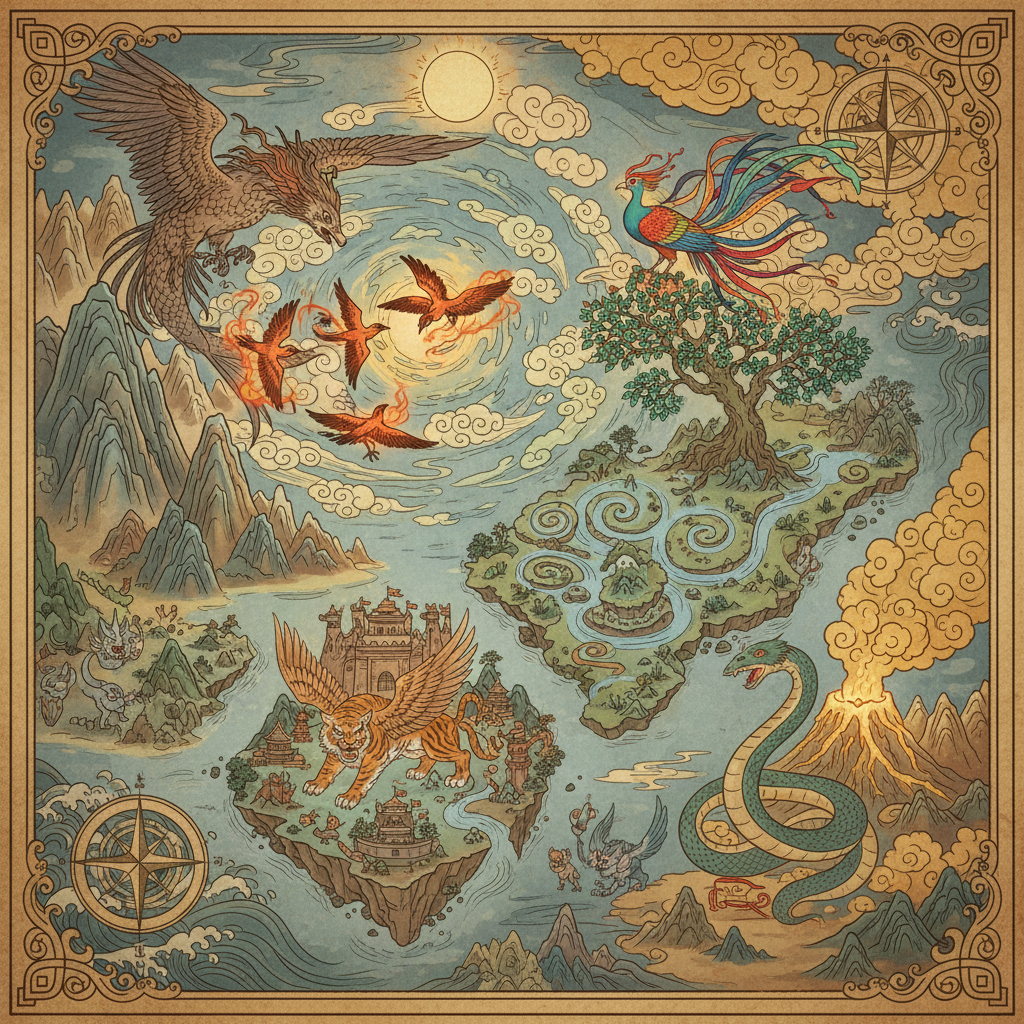
Unveiling the Shanhaijing: An Ancient Chinese Treasure
The Shanhaijing, or Classic of Mountains and Seas, is a monumental ancient text that offers a rich tapestry of mythical lands, creatures, and folklore from Chinese antiquity. Compiled over centuries, possibly during the Warring States period and later, the text is a vital source for understanding the complexities of ancient Chinese thought, belief systems, and the symbiotic relationship between nature and mythology. Among its various fascinating aspects, the Shanhaijing features a plethora of mythical birds that invoke intrigue and wonder, embodying both beauty and caution.
The Enigmatic Realm of Mythical Birds
In the vast narratives of the Shanhaijing, birds are not merely creatures of the air; they are symbols of transformation, omens of change, and harbingers of fate. Each bird detailed within this classic carries its own story and significance, reflecting the cultural values and beliefs of ancient Chinese society. For instance, the Qilin, often associated with auspicious events and virtuous beings, has sometimes been depicted with avian attributes, showcasing the interconnectedness of life forms in this rich tapestry.
Celestial Birds: The Messengers of the Divine
Among the fascinating avian beings mentioned in the Shanhaijing, celestial birds often function as messengers between heaven and earth. One notable creature is the Jingwei, a mythical bird that embodies resilience and determination. According to legends, Jingwei was transformed from the spirit of a girl who drowned in the sea, determined to fill the depths with stones, symbolizing the relentless human spirit against the odds. This bird not only signifies the importance of perseverance but also represents a profound connection to the waters, illustrating the cyclical nature of life, death, and rebirth.
Symbolism of Birds in Shanhaijing Mythology
Birds in the Shanhaijing often symbolize various aspects of human experiences, reflective of the ancient Chinese worldview. For instance, the famed Fenghuang, frequently referred to as the Chinese phoenix, embodies the balance of Yin and Yang and is often associated with virtuous rulers and peace. This duality signifies harmony and the cyclical aspect of existence, noting how life and death are interwoven.
The text also includes the Xuanniao, a bird described as having the ability to fly between realms, illustrating the threshold between the known and unknown, the physical and metaphysical. Such symbolism emphasizes the cultural importance of birds as not just living beings but as conduits for deeper existential themes.
The Cultural Landscape: Birds and Their Edens
The landscapes described in the Shanhaijing are as captivating as the creatures that dwell within them. Each region mentioned in the text is imbued with distinct characteristics, often tied to the birds that inhabit them. The Heavenly Mountains, for instance, are said to house numerous avian species, serving as sanctuaries for these mystical beings. Such detailed geographical narratives reflect humanity's attempts to categorize and understand the natural world, highlighting the deep connections ancient Chinese culture made with the environment.
Moreover, the classification of these landscapes is not merely topographical; each holds a spiritual significance that informs societal beliefs and practices. The mountains and rivers are depicted as residing before the celestial domains, acting as realms where mythical birds flutter in ethereal spaces, seamlessly linking the spiritual, natural, and human worlds.
Legacy of the Shanhaijing's Mythical Birds
The enduring legacy of the Shanhaijing is evident today in various cultural expressions, from literature and art to popular media. As modern interpretations and adaptations surface, the mythical birds continue to inspire contemporary audiences, inviting them to explore the intricate narratives and rich symbolism embedded in these ancient tales.
The stories of these avian creatures have transcended the ages, influencing countless artistic representations, from traditional Chinese paintings to modern-day interpretations in animation and literature. They serve not only as enchanting subjects but also provide insights into the cultural psyche and the values cherished by ancient Chinese civilization.
Conclusion: A World Beyond Imagination
The Shanhaijing encapsulates an extraordinary realm where mythical birds soar amidst enchanted landscapes, offering a glimpse into a rich cultural heritage. Through its narratives, we encounter timeless themes of resilience, harmony, and the interconnectedness of all life forms. As we delve into the symbolic significance of these creatures, we are reminded of the profound relationship between humanity, nature, and the mysteries of existence woven throughout this timeless classic. Whether through poetry, art, or scholarly research, the Shanhaijing and its mythical birds continue to evoke wonder—an evergreen testament to human imagination and cultural legacy.