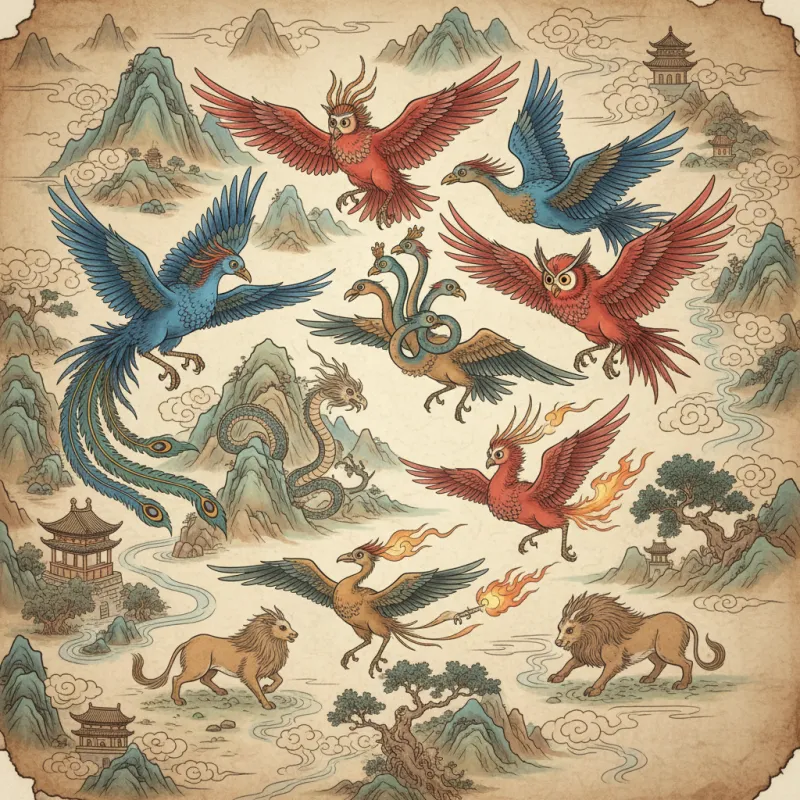
A three-legged crow circles the sun, its feathers blazing with celestial fire. Somewhere in the southern mountains, a bird with a human face weeps tears that become pearls. In the western wilderness, a creature that looks like an owl but wears human clothing brings drought wherever it flies. These aren't fever dreams—they're meticulous entries from the Shanhaijing (山海经, Shānhǎijīng), the "Classic of Mountains and Seas," a text that reads like a field guide written by someone who wandered too far into the spirit world and came back with notes.
Why Birds? The Feathered Messengers Between Worlds
The Shanhaijing catalogs hundreds of creatures, but birds dominate its pages with peculiar intensity. This isn't accidental. In early Chinese cosmology, birds served as intermediaries between heaven and earth—they could touch the sky yet return to the mortal realm. The text, compiled roughly between the 4th and 1st centuries BCE during the Warring States period and early Han dynasty, reflects a worldview where the boundaries between natural and supernatural were porous, and birds were the creatures most likely to slip through the cracks.
Unlike the dragons and phoenixes that would later dominate imperial symbolism, the birds of the Shanhaijing are wonderfully strange and specific. They're not generic symbols of good fortune—they're individuals with particular habits, diets, and effects on human affairs. The Bifang (毕方, Bìfāng), for instance, is described as a one-legged crane-like bird with a blue body and red markings. Its appearance doesn't herald prosperity; it signals fire. Ancient communities would have recognized this as practical information, not just mythology.
The Jingwei: Vengeance in Feathered Form
Perhaps no bird in the Shanhaijing carries more emotional weight than the Jingwei (精卫, Jīngwèi). The text tells us she was once Nüwa, the youngest daughter of the Flame Emperor Yandi (炎帝, Yándì). She drowned in the Eastern Sea, and her grief-stricken spirit transformed into a small bird with a white beak, red claws, and a striped head. But here's where the story transcends typical transformation myths: the Jingwei doesn't accept her fate. She spends eternity carrying twigs and pebbles from the western mountains, dropping them into the Eastern Sea in a futile attempt to fill it.
The Chinese idiom jingwei tian hai (精卫填海)—"the Jingwei fills the sea"—has become synonymous with persistent, even impossible, determination. But I'd argue the original story is darker and more interesting than the sanitized moral lesson suggests. This isn't about noble perseverance; it's about rage that won't die, about a child's fury at the universe that took her life. The Jingwei doesn't inspire—she haunts. She's a reminder that some injustices are so profound that even transformation into another form of existence can't extinguish the desire for revenge.
The Sanzu Wu: Solar Mythology Gets Specific
The Sanzu Wu (三足乌, Sānzú Wū), or three-legged crow, appears in the Shanhaijing as an inhabitant of the sun itself. Later texts would elaborate on the myth—the Huainanzi tells of ten suns (each containing a three-legged crow) that once scorched the earth until the archer Yi shot down nine. But the Shanhaijing gives us the raw material: a crow with three legs living in solar fire.
Why three legs? Scholars have proposed everything from solar symbolism (three representing the phases of the sun's daily journey) to shamanic trance visions. I suspect the answer is simpler and stranger: the compilers of the Shanhaijing were trying to describe something they'd actually seen—perhaps a crow silhouetted against the sun with one leg tucked up and its tail creating a third "leg" in shadow. Ancient observers, lacking our modern distinction between optical illusion and reality, recorded what they witnessed. The mythological elaborations came later.
The three-legged crow connects to broader patterns in Chinese solar mythology, but the Shanhaijing version is refreshingly free of moral lessons. It's just there, in the sun, being weird. That's the text's peculiar charm.
Birds of Omen: The Practical Bestiary
The Shanhaijing functions partly as a survival guide for a world where the supernatural is simply natural. Many bird entries include practical information about what their appearance means for human communities. The Qinyuan (钦原, Qīnyuán) is described as a bird resembling a bee, about the size of a mandarin duck, with a sting that kills trees and can be fatal to humans. Its appearance signals widespread death and destruction. This isn't poetry—it's a warning system.
The Shang Yang (商羊, Shāngyáng) is a one-legged bird whose appearance predicts rain and floods. The Zhuyu (朱鹬, Zhūyù) looks like an owl but has human hands instead of talons; seeing it means drought is coming. These descriptions suggest a worldview where careful observation of unusual birds could provide advance warning of natural disasters. Whether these birds "really" existed matters less than the fact that communities used such sightings as part of their environmental monitoring systems.
This practical dimension separates the Shanhaijing from purely literary mythology. It's a text that expects to be used, not just read. The bird entries often include details about habitat, behavior, and the specific mountains or regions where they appear—information that would be useless in pure fiction but essential in a text meant to guide travelers through dangerous territory, both physical and spiritual.
Human-Faced Birds: The Uncanny Valley of Ancient China
The Shanhaijing has a particular fascination with birds that have human faces. The Qingniao (青鸟, Qīngniǎo), or blue bird, serves as a messenger for the Queen Mother of the West Xiwangmu (西王母, Xīwángmǔ). The Manman (蛮蛮, Mánmán) is described as having a human face and only one foot, appearing in winter and hibernating in summer—its cry sounds like its own name.
These hybrid creatures occupy an uncomfortable space in our imagination. They're not quite human enough to empathize with, not quite animal enough to dismiss. Modern horror understands this—think of the unsettling effect of giving animals human features. The Shanhaijing compilers were working with the same psychological territory two millennia ago.
The human-faced birds might represent shamanic transformation experiences, where practitioners claimed to take on animal forms while retaining human consciousness. Or they might be attempts to describe real birds with facial markings that resembled human features—owls, with their forward-facing eyes and facial discs, are obvious candidates. The text doesn't explain its reasoning, which makes these entries all the more enigmatic. We're left with the image and our own discomfort.
The Fenghuang: Conspicuous by Its Complexity
The Fenghuang (凤凰, Fènghuáng), often translated as "phoenix," appears in the Shanhaijing but not yet in its later imperial form. The text describes it as a bird with multicolored plumage—red, blue, yellow, white, and black—representing the five virtues. Its appearance signals peace and prosperity, but the Shanhaijing version is more zoologically specific than later literary treatments. It has the front of a swan, the hindquarters of a qilin, the throat of a swallow, the bill of a chicken, and the patterns of a dragon.
This composite description suggests the Fenghuang might have originated as an attempt to describe an actual rare bird—perhaps a golden pheasant or a peacock—that was then elaborated into mythology. By the Han dynasty, the Fenghuang would become the empress's symbol, paired with the dragon as the emperor's emblem. But in the Shanhaijing, it's still strange and specific, not yet domesticated into political symbolism.
The evolution of the Fenghuang from the Shanhaijing to later texts shows how mythology gets refined and simplified over time. The weird details get sanded off, the practical information disappears, and what remains is a symbol clean enough for imperial seals. The Shanhaijing preserves the earlier, messier version—and that's precisely what makes it valuable.
Why These Birds Still Matter
The birds of the Shanhaijing resist easy interpretation, which is exactly why they've survived in cultural memory for over two thousand years. They're not simple allegories or moral lessons. They're strange, specific, and often unsettling—qualities that keep them alive in imagination long after more "meaningful" symbols have faded.
Modern Chinese fantasy literature and gaming have rediscovered these creatures, but often in sanitized form. The Jingwei becomes an inspirational figure rather than a portrait of unending rage. The three-legged crow becomes a cool design element rather than a genuinely weird cosmological claim. Something is lost in translation to contemporary media.
The original text's power lies in its refusal to explain itself. It presents these birds as facts, not metaphors. A bird with a human face exists in the southern mountains. A one-legged crane brings fire. A small bird tries to fill the ocean with pebbles. The Shanhaijing doesn't tell you what to think about these things—it just insists they're real, or were real, or are real in some dimension that intersects with ours in ways we've forgotten how to perceive.
That's the gift of the Shanhaijing's enigmatic birds: they remind us that the world was once stranger than we allow it to be now, and that strangeness was recorded with the same matter-of-fact precision we reserve for mundane natural history. In an age of explained mysteries and rationalized wonders, these birds remain defiantly inexplicable—and all the more fascinating for it.
Related Reading
- Immersive Wonders of Shanhaijing: Exploring Mythical Birds and Enchanted Regions
- Discovering the Guardians of Shanhaijing: Mythical Creatures and Legendary Lands
- The Four Guardian Beasts: Azure Dragon, White Tiger, Vermilion Bird, Black Tortoise
- Chinese Dragons vs European Dragons