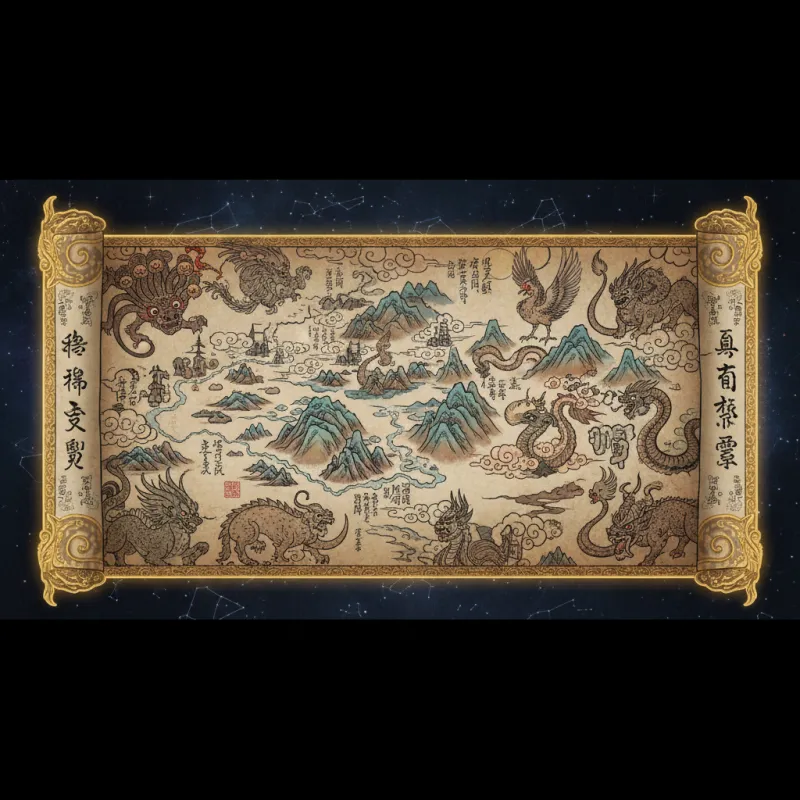
Shanhai Jing in Art: From Ancient Scrolls to Modern Illustration
The Shanhai Jing 山海经 (Shānhǎi Jīng, Classic of Mountains and Seas) stands as one of China's most enigmatic and visually rich ancient texts. Compiled between the 4th century BCE and the 2nd century CE, this extraordinary compendium of mythical geography, strange creatures, and divine beings has captivated artists for over two millennia. Its influence on Chinese visual culture extends from ancient tomb murals to contemporary digital art, making it an enduring wellspring of artistic inspiration that bridges the ancient and modern worlds.
The Visual DNA of Shanhai Jing
What makes the Shanhai Jing so compelling for artists is its vivid, almost hallucinatory catalog of over 400 mythical creatures and deities. The text describes beings like the Jiuwei hu 九尾狐 (nine-tailed fox), the Bifang 毕方 (one-legged fire bird), and the Kaiming shou 开明兽 (enlightened beast with nine heads). These descriptions, though brief, provide just enough detail to spark imagination while leaving ample room for artistic interpretation.
Consider the text's description of the Lushu 鹿蜀: "There is a beast that looks like a horse with a white head, tiger stripes, and a red tail. Its cry sounds like a folk song." This economical description has inspired countless artistic variations across centuries, each artist emphasizing different aspects—some focusing on its equine grace, others on its tiger-like ferocity, still others on the mysterious quality of its musical voice.
Ancient Scrolls and Early Illustrations
The earliest known illustrated versions of the Shanhai Jing emerged during the Han Dynasty (206 BCE–220 CE), though none of these original works survive. Historical records mention that the scholar Guo Pu 郭璞 (276–324 CE) created commentaries and possibly illustrations for the text during the Jin Dynasty. His interpretations became foundational for later artistic traditions.
The oldest extant illustrated Shanhai Jing manuscripts date to the Ming Dynasty (1368–1644). These xiuben 绣本 (embroidered editions) and huaben 画本 (painted editions) established visual conventions that would influence artists for centuries. The creatures were typically rendered in profile, with bold outlines and flat colors characteristic of traditional Chinese painting. Artists employed the gongbi 工笔 (meticulous brush) technique, creating precise, detailed images that emphasized decorative beauty over naturalistic representation.
One particularly influential Ming edition featured illustrations that combined zoological observation with fantastical elements. The Qilin 麒麟, for instance, was depicted with the body of a deer, the tail of an ox, the hooves of a horse, and a single horn—a composite creature that reflected both the text's description and the artist's understanding of real animals. This approach of grounding the fantastic in the familiar became a hallmark of Shanhai Jing illustration.
Qing Dynasty Refinements
The Qing Dynasty (1644–1912) saw a flourishing of Shanhai Jing illustration, with artists bringing new sophistication to the tradition. The most celebrated Qing edition was produced during the Kangxi 康熙 reign (1661–1722), featuring 124 illustrations that demonstrated remarkable technical skill and imaginative power.
Qing artists introduced greater dynamism to their compositions. Rather than static profile views, creatures were shown in action—the Feiyi 飞翼 (flying serpent) coiling through clouds, the Zhuyin 烛阴 (torch shadow dragon) illuminating the darkness with its gaze. These illustrations employed sophisticated techniques like cun 皴 (texture strokes) to suggest scales, fur, and feathers, and ran 染 (color washes) to create atmospheric depth.
The Qing period also saw artists grappling with the text's more bizarre descriptions. The Xingtian 刑天, a headless deity who fights with his nipples as eyes and his navel as a mouth, presented particular challenges. Qing illustrators solved this by emphasizing the figure's martial vigor and defiant posture, transforming what could have been grotesque into something heroically tragic.
Republican Era and Early Modern Interpretations
The fall of the Qing Dynasty and the establishment of the Republic of China (1912–1949) brought new artistic approaches to the Shanhai Jing. Artists trained in both traditional Chinese techniques and Western methods began creating hybrid interpretations that incorporated perspective, shading, and anatomical accuracy while retaining traditional compositional elements.
Jiang Yinghao 蒋应镐, a late Ming artist whose work was rediscovered and republished during this period, became particularly influential. His illustrations struck a balance between scholarly accuracy and artistic license, depicting creatures with careful attention to the text while adding environmental context that brought the mythical geography to life.
The Republican era also saw the first attempts to create children's editions of the Shanhai Jing, with simplified illustrations that made the ancient text accessible to young readers. These editions often emphasized the more whimsical creatures—the Taotie 饕餮 (gluttonous beast) became almost cute, the Bai Ze 白泽 (white marsh creature) appeared wise and benevolent rather than strange and otherworldly.
Contemporary Revival and Digital Art
The late 20th and early 21st centuries have witnessed an extraordinary renaissance in Shanhai Jing illustration, driven by renewed interest in traditional culture, advances in digital art technology, and the global popularity of Chinese fantasy genres like xianxia 仙侠 (immortal heroes) and xuanhuan 玄幻 (mysterious fantasy).
Contemporary artists approach the Shanhai Jing with unprecedented freedom, creating interpretations that range from faithful reconstructions to radical reimaginings. Digital tools allow for effects impossible in traditional media—bioluminescent creatures glowing against dark backgrounds, semi-transparent spirits, dynamic compositions that suggest movement and transformation.
Shazi 杉泽, a prominent contemporary illustrator, has created a widely acclaimed series depicting Shanhai Jing creatures with meticulous detail and dramatic lighting. His Jiuying 九婴 (nine-headed infant monster) combines horror and beauty, each head expressing a different emotion, the creature's body rendered with anatomical precision that makes the impossible seem plausible.
Another notable contemporary artist, Yao Huang 姚黄, takes a more stylized approach, using bold colors and geometric patterns to create creatures that feel both ancient and futuristic. Her interpretation of the Kunpeng 鲲鹏—the massive fish that transforms into an equally massive bird—spans multiple panels, showing the transformation as a cosmic event that warps space and light.
Animation and Gaming: Shanhai Jing in Motion
The Shanhai Jing has found new life in animated films and video games, where its creatures can move, fight, and interact in ways static illustrations never allowed. The 2021 animated film New Gods: Nezha Reborn drew heavily on Shanhai Jing imagery, featuring creatures like the Taowu 梼杌 (chaos beast) rendered with stunning detail in 3D animation.
Video games have become perhaps the most significant contemporary medium for Shanhai Jing art. Games like Honor of Kings and Genshin Impact feature characters and creatures inspired by the text, introducing millions of players worldwide to these ancient myths. The game Tale of Immortal creates an entire playable world based on Shanhai Jing geography, with each region populated by creatures described in the original text.
These digital interpretations often take considerable creative liberties, anthropomorphizing creatures, adding backstories, and creating relationships between beings that never interact in the original text. Yet they maintain a connection to the source material through careful attention to key visual elements—the nine tails of the fox spirit, the single leg of the Bifang, the tiger stripes of the Lushu.
Cross-Cultural Influences and Global Reach
As Chinese culture gains global prominence, Shanhai Jing imagery has begun influencing artists worldwide. Western fantasy artists have discovered the text as a source of fresh mythological material, creating interpretations that blend Chinese and Western artistic traditions.
The Japanese artist Terada Katsuya has created Shanhai Jing-inspired works that combine traditional Japanese yokai 妖怪 (supernatural creatures) aesthetics with Chinese mythological subjects. His creatures feel simultaneously familiar and alien, bridging two related but distinct East Asian artistic traditions.
European and American artists working in the fantasy genre have also begun incorporating Shanhai Jing creatures into their work, though often with significant reinterpretation. These cross-cultural exchanges sometimes produce fascinating hybrids—a nine-tailed fox rendered in the style of medieval European manuscript illumination, or a Kunpeng depicted with the dramatic chiaroscuro of Baroque painting.
Artistic Challenges and Interpretive Choices
Illustrating the Shanhai Jing presents unique challenges. The text's descriptions are often ambiguous or contradictory. The Zhulong 烛龙 (candle dragon), for instance, is described as having a human face and a serpent's body, being thousands of miles long, and creating day and night by opening and closing its eyes. How does one depict such a being in a single image?
Artists must make countless interpretive choices. Should creatures be depicted realistically or stylized? Should they appear threatening or benign? Should illustrations show creatures in isolation or within their described habitats? Each choice reflects not only artistic preference but also cultural context and intended audience.
Some contemporary artists have embraced the text's ambiguity, creating multiple versions of the same creature to show different possible interpretations. Others have taken a more scholarly approach, consulting ancient commentaries and related texts to inform their visual choices.
The Future of Shanhai Jing Art
As technology continues to evolve, so too will artistic interpretations of the Shanhai Jing. Virtual reality experiences could allow viewers to walk through the mythical landscapes described in the text, encountering creatures in three-dimensional space. Artificial intelligence tools might generate infinite variations on traditional themes, though whether such algorithmic creations can capture the imaginative spark of human artistry remains to be seen.
What seems certain is that the Shanhai Jing will continue inspiring artists for generations to come. Its combination of specific detail and imaginative freedom, its catalog of creatures both terrifying and wondrous, and its connection to fundamental questions about the natural world and humanity's place within it ensure its enduring relevance.
From ancient scrolls to digital screens, from imperial workshops to independent studios, artists have found in the Shanhai Jing an inexhaustible source of inspiration. Each generation brings new techniques, new perspectives, and new cultural contexts to these ancient myths, ensuring that the creatures of the Classic of Mountains and Seas remain vibrantly alive in the visual imagination. The text's journey through art history demonstrates not only the enduring power of Chinese mythology but also the universal human need to visualize the invisible, to give form to the fantastic, and to explore the boundaries between the known and the unknown through the transformative power of art.