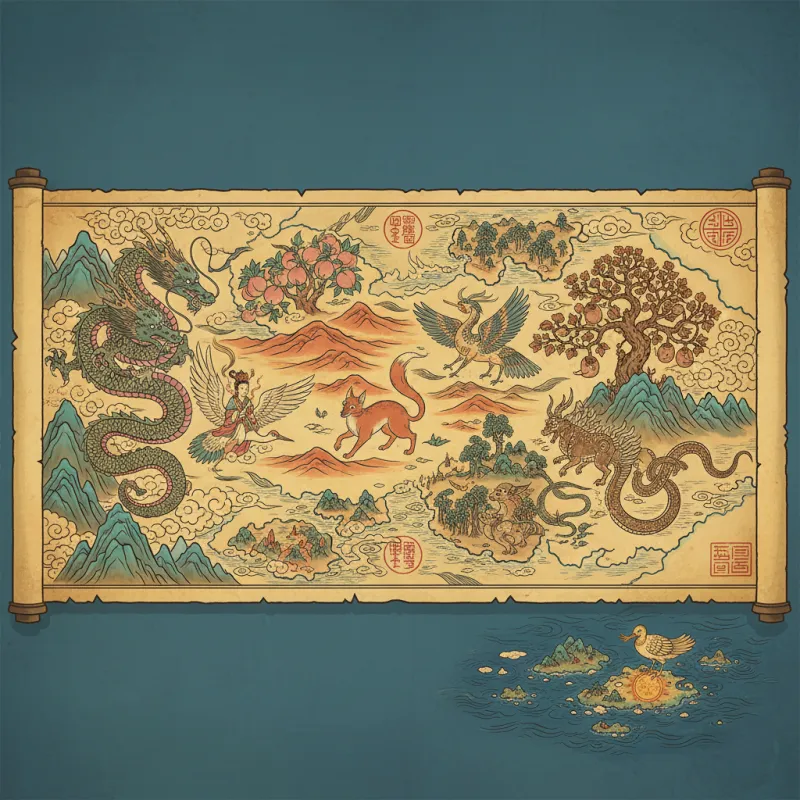
Picture this: a nine-tailed fox prowling through bamboo forests, a bird with three heads singing discordant melodies, mountains that breathe fire and seas that swallow the sun. These aren't fever dreams or modern fantasy—they're meticulous records from the Shanhaijing (山海經, Shānhǎi Jīng), the "Classic of Mountains and Seas," a text so strange that scholars still argue whether it's geography, mythology, or something else entirely. Compiled between the 4th century BCE and 1st century CE, this enigmatic work catalogs over 550 mountains, 300 waterways, and hundreds of creatures that defy natural law. It's the kind of book that makes you wonder: were the ancient Chinese documenting real expeditions to unknown lands, or mapping the geography of the imagination itself?
The Structure: A Cartographer's Fever Dream
The Shanhaijing doesn't read like typical mythology. There's no narrative arc, no hero's journey—just relentless, almost bureaucratic descriptions of terrain and inhabitants. The text divides into eighteen sections: five books of mountains (Shan Jing, 山經), four books of seas (Hai Jing, 海經), and supplementary wilderness accounts. Each entry follows a formula: travel X li (里, a unit of distance) in Y direction, find Z mountain, where creature A lives and plant B grows.
This clinical approach creates an uncanny effect. When the text states matter-of-factly that the Lushu (鹿蜀, Lùshǔ)—a horse-bodied creature with a white head, tiger stripes, and red tail—lives on Mount Jiwei and its appearance heralds major wars, you're left suspended between belief and disbelief. The precision of geographical detail clashes with biological impossibility, creating a cognitive dissonance that's oddly compelling. It's as if someone took a legitimate surveying expedition and accidentally wandered into another dimension.
Creatures That Defy Classification
The bestiary of the Shanhaijing makes medieval European bestiaries look tame. Consider the Zhuyin (燭陰, Zhúyīn), also called Zhulong (燭龍, Zhúlóng)—a thousand-li-long serpent with a human face whose eyes control day and night. When it opens its eyes, day breaks; when it closes them, night falls. It doesn't eat, drink, or breathe, yet its breath creates the seasonal winds. This isn't just a monster—it's a cosmological principle given flesh.
Or take the Qinyuan (欽原, Qīnyuán), a bird resembling a bee that kills trees and humans with its sting. The text recommends eating its flesh to prevent tumors—practical medical advice nestled within mythological description. This blend of the fantastical and utilitarian appears throughout: the Feiyu (飛魚, Fēiyú), a fish with bird wings, supposedly cures hernias when consumed. The Shanhaijing treats these creatures not as symbols or allegories but as natural resources to be cataloged and exploited.
The nine-tailed fox (Jiuwei Hu, 九尾狐, Jiǔwěi Hú) makes its first appearance here, long before becoming the seductive shapeshifter of later folklore. In the Shanhaijing, it's simply noted as living in the Qingqiu mountains, making sounds like an infant, and being edible—consuming it prevents bewitchment. No romance, no transformation stories, just another entry in an endless catalog of the strange. This original portrayal shows how mythical creatures evolved over millennia of retelling.
Geography as Mythology, Mythology as Geography
Here's where the Shanhaijing gets truly weird: many of its locations correspond to real places. The text describes mountains in what we now call Sichuan, Shaanxi, and Shanxi with enough accuracy that archaeologists have used it to identify ancient sites. Yet these same passages seamlessly transition into describing the Kunlun (崑崙, Kūnlún) mountains—the axis mundi of Chinese cosmology, home of the Queen Mother of the West (Xiwangmu, 西王母, Xīwángmǔ)—as if it's just another stop on the itinerary.
This blurring of real and imagined geography suggests the ancient Chinese conceived of space differently than we do. The Shanhaijing might represent an attempt to map not just physical terrain but also mythological, political, and spiritual landscapes simultaneously. When it places the land of the Junzi (君子, Jūnzǐ, "gentlemen") who never quarrel next to the country of the Daren (大人, Dàrén, "giants"), it's mapping moral and physical geography on the same plane.
The four seas (Sihai, 四海, Sìhǎi) sections describe increasingly bizarre peripheral regions: countries where people have holes through their chests, nations of one-armed or three-bodied humans, islands where the dead return to life. These aren't just fantasies—they're ethnographic reports filtered through cultural anxiety about the unknown. The further from the Central Plains (Zhongyuan, 中原, Zhōngyuán), the stranger things become, reflecting the ancient Chinese worldview that civilization radiated outward from their cultural center into increasing chaos.
Shamanic Origins and Ritual Functions
Most scholars now believe the Shanhaijing originated in shamanic traditions of the Warring States period (475-221 BCE). The text's obsessive cataloging of which creatures cure which ailments, which mountains contain which minerals, and which rituals appease which spirits suggests it served as a handbook for ritual specialists. The fangshi (方士, fāngshì)—esoteric practitioners who claimed knowledge of immortality techniques and spirit communication—likely used texts like this to legitimize their expertise.
Several passages describe specific sacrificial protocols: "Sacrifice with a jade tablet and a white dog" or "Offer a black pig and jade." These aren't narrative flourishes—they're instructions. The Shanhaijing functioned as a grimoire, a field guide for navigating both physical and spiritual wilderness. When a shaman claimed to journey to distant mountains to gather rare medicines or negotiate with mountain gods, the Shanhaijing provided the vocabulary and framework for these claims.
This ritual dimension explains the text's strange tone. It's not trying to entertain or persuade—it's documenting operational knowledge. The creatures aren't metaphors; they're entities that practitioners claimed to encounter in altered states or remote expeditions. Whether these encounters were literal, visionary, or fabricated matters less than the fact that the text treats them as actionable intelligence.
Influence on Chinese Culture and Beyond
The Shanhaijing's influence on Chinese literature and art cannot be overstated. Nearly every major mythological figure in later Chinese tradition appears here first: Nüwa (女媧, Nǚwā), the creator goddess; Gonggong (共工, Gònggōng), who smashed the pillars of heaven; Kuafu (夸父, Kuāfù), who chased the sun. Later works like Journey to the West (Xiyou Ji, 西遊記, Xīyóu Jì) and Strange Tales from a Chinese Studio (Liaozhai Zhiyi, 聊齋誌異, Liáozhāi Zhìyì) draw heavily from its bestiary.
During the Han Dynasty (206 BCE-220 CE), the text gained imperial patronage. Scholars attempted to rationalize its contents, arguing that "strange" creatures were simply foreign animals poorly described or that mythological events were garbled historical records. This rationalization project reveals anxiety about the text's authority—it was too culturally important to dismiss but too strange to accept literally.
Modern Chinese fantasy and gaming industries mine the Shanhaijing relentlessly. Video games like Honor of Kings and Genshin Impact feature its creatures; fantasy novels reimagine its geography. The text has become a kind of open-source mythology, a public domain from which creators freely draw. Yet most modern adaptations sanitize and romanticize the original's unsettling strangeness, preferring elegant fox spirits to the text's matter-of-fact descriptions of human-eating monsters.
Reading the Shanhaijing Today
Approaching the Shanhaijing requires abandoning modern expectations about how texts should work. It's not a novel, not quite history, not exactly mythology. It's a liminal document that exists in the space between categories, which is precisely what makes it fascinating. The best way to read it is in small doses, letting its repetitive structure and bizarre details accumulate into something like a trance state.
Several excellent translations exist, though each makes different compromises. Anne Birrell's 1999 translation prioritizes readability; Richard Strassberg's 2002 illustrated edition includes historical commentary and artwork. Reading with a map helps—plotting the text's geographical descriptions reveals patterns and clusters that aren't obvious from the text alone.
The Shanhaijing reminds us that ancient peoples didn't separate natural history, mythology, and geography the way we do. For them, the world was genuinely enchanted, populated by beings that defied easy categorization. Whether these creatures "existed" in any literal sense misses the point—they existed in the cultural imagination, which shaped behavior and belief just as powerfully as physical reality. In that sense, the nine-tailed fox and the fire-breathing mountain were as real as anything else in the ancient Chinese world.
The Enduring Mystery
Despite centuries of scholarship, the Shanhaijing keeps its secrets. We still don't know who compiled it, why, or how much of it reflects genuine geographical knowledge versus pure invention. Some passages describe real places with uncanny accuracy; others place impossible creatures in verifiable locations. This mixture of fact and fantasy creates an interpretive puzzle that may never be fully solved.
Perhaps that's appropriate. The Shanhaijing emerged from a world where the boundaries between known and unknown, natural and supernatural, were far more permeable than our own. It invites us to imagine a time when the next valley over might contain wonders or terrors beyond comprehension, when the map's edges weren't empty spaces but realms of infinite possibility. In our exhaustively documented world, where satellite imagery has mapped every square meter of Earth's surface, the Shanhaijing offers something increasingly rare: genuine mystery, the thrill of not knowing what lies beyond the next mountain. That's a journey worth taking, even if only through the pages of an ancient text.
Related Reading
- Unraveling the Mysteries of Shanhaijing: Mythical Creatures and Enigmatic Lands
- The Illustrated Shanhaijing: How Artists Have Imagined the Unimaginable for Two Thousand Years
- Exploring the Myths of Serpents in the Shanhaijing: Creatures of Power and Mystery