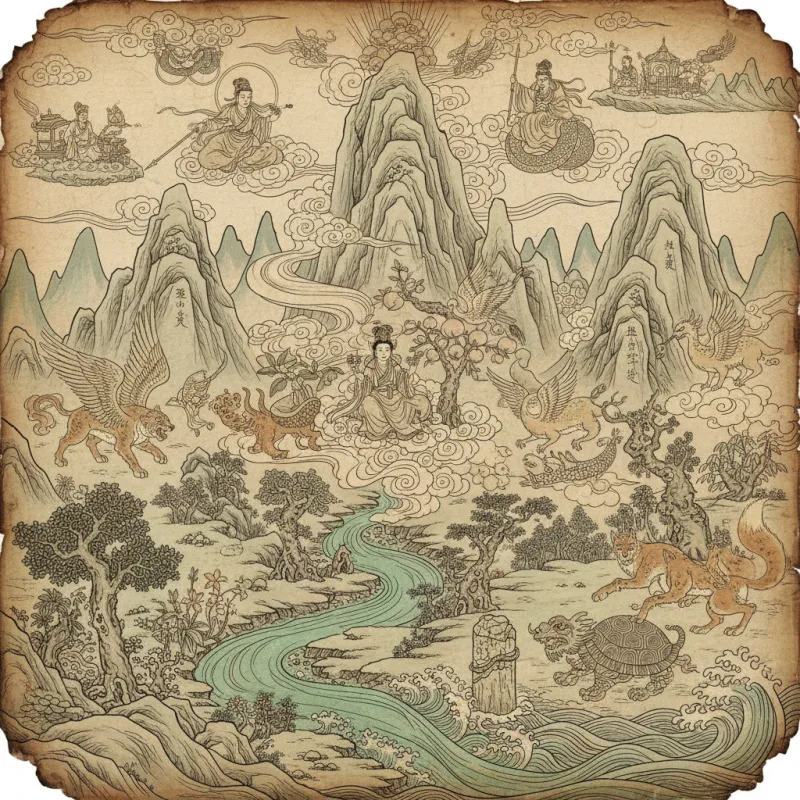
Kunlun Mountain: The Axis Mundi of Chinese Mythology
Introduction: The Cosmic Mountain at the Center of the World
In the vast tapestry of Chinese mythology, few locations hold as much significance as Kunlun Mountain (昆仑山, Kūnlún Shān). Rising from the pages of the Shanhai Jing (山海经, Shānhǎi Jīng, Classic of Mountains and Seas) and countless other ancient texts, Kunlun stands as China's primordial axis mundi—the cosmic pillar connecting heaven, earth, and the underworld. This mythical mountain serves not merely as a geographical feature but as the very foundation of Chinese cosmological thought, a place where gods dwell, immortals gather, and the boundaries between mortal and divine dissolve.
The concept of Kunlun transcends simple mythology. It represents the Chinese understanding of sacred geography, the pursuit of immortality, and the hierarchical structure of the cosmos itself. To understand Kunlun is to grasp a fundamental aspect of how ancient Chinese civilization conceived of its place in the universe.
The Geography of the Divine: Kunlun in the Shanhai Jing
The Shanhai Jing provides our earliest and most detailed descriptions of Kunlun Mountain, though these accounts are fragmented across different sections of the text. In the Xishan Jing (西山经, Western Mountains Classic), Kunlun is described as an enormous mountain complex located in the far west, beyond the known world of ancient China.
According to the text, Kunlun rises 11,000 li (里, a traditional Chinese unit of distance) into the sky, with a circumference of 800 li at its base. The mountain is described as having nine levels or terraces (九重, jiǔ chóng), each representing a different realm of existence. The lowest levels are accessible to exceptional mortals and lesser spirits, while the highest peaks are reserved for the supreme deities and the most accomplished immortals.
The Shanhai Jing describes Kunlun as surrounded by the Weak Water (弱水, Ruò Shuǐ), a mystical river that cannot support even a feather—nothing can float upon its surface, making the mountain virtually inaccessible to ordinary beings. This detail emphasizes Kunlun's role as a liminal space, a threshold between the mundane and the sacred that only the worthy can cross.
At the mountain's summit lies the Hanging Garden (悬圃, Xuánpǔ), a paradise of jade terraces and golden palaces where the Queen Mother of the West holds court. The text describes trees bearing the peaches of immortality (蟠桃, pántáo), jade springs flowing with the elixir of life, and phoenixes singing in groves of precious stones.
The Queen Mother of the West: Sovereign of Kunlun
No discussion of Kunlun Mountain would be complete without examining its most famous resident: Xiwangmu (西王母, Xīwángmǔ), the Queen Mother of the West. In the Shanhai Jing, she is described in terms that blend the divine with the monstrous—a figure with a human face, tiger's teeth, and a leopard's tail, dwelling in a cave on the mountain's western slope.
This early depiction, however, evolved dramatically over the centuries. By the Han Dynasty (206 BCE - 220 CE), Xiwangmu had transformed into an elegant goddess of immortality, presiding over Kunlun's paradise with grace and authority. She became the keeper of the peaches of immortality, which ripened only once every 3,000 years. When these peaches matured, she would host the legendary Peach Banquet (蟠桃会, Pántáo Huì), inviting all the immortals and worthy deities to partake in the fruit that renewed their eternal life.
The Queen Mother's role extends beyond mere hospitality. She serves as the gatekeeper of immortality itself, determining who among mortals might ascend to divine status. Her palace on Kunlun represents the ultimate destination for Daoist practitioners seeking to transcend mortality through cultivation (修炼, xiūliàn) and spiritual refinement.
The famous story of King Mu of Zhou (周穆王, Zhōu Mù Wáng) illustrates this relationship. According to the Mu Tianzi Zhuan (穆天子传, Biography of Emperor Mu), this legendary ruler journeyed to Kunlun and met with Xiwangmu. She entertained him with songs and wine, and they exchanged poems. Though he was granted a glimpse of paradise, he remained mortal—a reminder that even imperial power cannot guarantee access to the divine realm without proper spiritual cultivation.
The Cosmic Architecture: Kunlun's Nine Levels
The nine-tiered structure of Kunlun Mountain reflects the Chinese cosmological principle of hierarchical organization. Each level represents not just physical elevation but spiritual advancement, creating a vertical map of existence itself.
The lowest tiers, known as the Kunlun Qiu (昆仑丘, Kunlun Hills), are where exceptional mortals and minor spirits might venture. Here grow strange plants with medicinal properties and dwell creatures that blur the line between natural and supernatural—the baihu (白虎, white tiger) that guards the western direction, and various shenren (神人, spirit people) who have achieved partial transcendence.
The middle levels house the palaces of various immortals (xian, 仙) who have successfully cultivated the Dao but have not yet achieved the highest enlightenment. These zhongxian (中仙, middle immortals) continue their cultivation in this rarified atmosphere, studying under more advanced practitioners and refining their spiritual essence (jing, 精).
The uppermost levels, particularly the Hanging Garden at the summit, represent the realm of the shangxian (上仙, upper immortals) and the supreme deities. This is where the Queen Mother of the West maintains her court, where the peaches of immortality grow, and where the jade pool (Yaochi, 瑶池) reflects the movements of the stars themselves.
This vertical structure made Kunlun a perfect metaphor for the Daoist path of cultivation. Just as one must ascend the mountain level by level, so too must the practitioner progress through stages of spiritual development, each requiring greater discipline, purity, and understanding.
The Jade Pool and the Peaches of Immortality
Among Kunlun's many wonders, two features stand out in Chinese mythological imagination: the Jade Pool (瑶池, Yáochí) and the peach trees of immortality.
The Jade Pool, located near the summit of Kunlun, is described as a lake of crystalline perfection, its waters possessing transformative properties. In some accounts, the pool serves as a mirror reflecting the heavens, allowing the Queen Mother to observe all that transpires in the celestial realm. In others, bathing in its waters can heal any illness or injury, restore youth, or even grant immortality to those deemed worthy.
The peach trees (pantao, 蟠桃) represent perhaps the most famous feature of Kunlun's paradise. These are no ordinary fruit trees—they bloom once every thousand years and bear fruit only after three thousand years. The peaches themselves are classified into different grades: the lowest tier grants 360 years of life, the middle tier confers immortality and the ability to fly, while the highest tier bestows complete transcendence and unity with the Dao.
The symbolism of the peach in Chinese culture extends far beyond Kunlun mythology. Peaches represent longevity, spring, renewal, and the feminine principle (yin, 阴). The fact that they grow on Kunlun under the care of Xiwangmu connects the pursuit of immortality with feminine divine power, a notable feature in a culture often dominated by masculine religious and philosophical figures.
Kunlun as the Source of Rivers
Beyond its role as a divine dwelling place, Kunlun serves a crucial cosmological function as the source of the world's great rivers. The Shanhai Jing and other texts describe how the Yellow River (黄河, Huáng Hé), among other waterways, originates from springs on Kunlun Mountain.
This geographical mythology served multiple purposes. First, it explained the origins of the rivers that sustained Chinese civilization, connecting the mundane necessity of water to the divine realm. Second, it reinforced Kunlun's position as the center of the world—just as all rivers flow from this cosmic mountain, so too does all life and civilization ultimately derive from this sacred source.
The connection between Kunlun and the Yellow River also appears in the myth of Gun (鲧) and Yu (禹), the father and son who attempted to control the great floods. Gun stole the xirang (息壤, self-renewing soil) from Kunlun to dam the floods, an act of hubris that led to his execution. His son Yu succeeded where Gun failed, but through proper channels and divine approval, ultimately receiving the mandate to found the Xia Dynasty. This myth reinforces the principle that access to Kunlun's resources requires proper spiritual authority and alignment with cosmic order.
The Pillar of Heaven: Kunlun's Cosmological Function
In Chinese cosmology, Kunlun functions as one of the pillars supporting the heavens, a concept that appears across many ancient cultures. The mountain connects the three realms: heaven (tian, 天), earth (di, 地), and the underworld (difu, 地府).
This axis mundi function made Kunlun the natural pathway for communication between realms. Gods could descend the mountain to interact with the mortal world, while exceptional humans could ascend toward divinity. Shamans (wu, 巫) and Daoist practitioners would visualize themselves climbing Kunlun during meditation, using the mountain as a spiritual map for their internal cultivation.
The concept of Kunlun as a cosmic axis also relates to Chinese astronomical observations. The mountain's position in the far west, where the sun sets, connected it to the realm of death and transformation. Yet it was also the place of renewal, where the sun would begin its journey back toward the east. This dual nature—simultaneously the place of endings and beginnings—made Kunlun a perfect symbol for the cyclical nature of existence in Chinese thought.
Historical and Geographical Connections
While Kunlun Mountain exists primarily in the realm of mythology, ancient Chinese scholars and explorers attempted to identify it with real geographical features. The actual Kunlun Mountain range, stretching across modern-day Xinjiang, Tibet, and Qinghai provinces, was often proposed as the earthly manifestation of the mythical mountain.
However, the mythical Kunlun always exceeded any physical location. As Chinese geographical knowledge expanded, the mythical mountain seemed to retreat further west, always beyond the horizon of the known world. This pattern reflects a common feature of sacred geography—the divine realm must remain somewhat inaccessible, always beckoning but never fully attainable through mere physical travel.
During the Han Dynasty, as the Silk Road opened China to Central and Western Asian influences, some scholars speculated that Kunlun might be located in the Pamir Mountains or even further west. These speculations blended Chinese mythology with reports from travelers, creating a rich tapestry of geographical and mythological imagination.
Kunlun in Daoist Practice and Literature
The influence of Kunlun mythology extended far beyond the Shanhai Jing, becoming central to Daoist religious practice and literature. In Daoist internal alchemy (neidan, 内丹), practitioners visualized their own bodies as containing a microcosmic Kunlun, with the head representing the mountain's summit and the dantian (丹田, elixir fields) serving as the jade pool where spiritual essence could be refined.
The Zhuangzi (庄子), one of the foundational texts of Daoist philosophy, references Kunlun as the dwelling place of the perfected person (zhenren, 真人) who has transcended ordinary existence. Later Daoist texts, such as the Baopuzi (抱朴子) by Ge Hong, provide detailed instructions for spiritual practices aimed at achieving the immortality associated with Kunlun's residents.
In Chinese poetry and literature, Kunlun became a standard reference for the unattainable ideal, the distant paradise, or the ultimate goal of spiritual cultivation. The Tang Dynasty poet Li Bai (李白) frequently invoked Kunlun imagery in his verses celebrating Daoist themes and the pursuit of transcendence.
Conclusion: The Enduring Power of the Sacred Mountain
Kunlun Mountain represents far more than a mythological location—it embodies fundamental Chinese concepts about the structure of reality, the possibility of transcendence, and the relationship between the human and divine realms. As the axis mundi of Chinese mythology, it provides a vertical map of existence, from the mundane world through ascending levels of spiritual refinement to the ultimate paradise where immortals dwell in the presence of the Queen Mother of the West.
The mountain's influence extends across Chinese culture, from religious practice to literature, from cosmological speculation to artistic representation. Even today, Kunlun remains a powerful symbol in Chinese culture, representing the eternal human aspiration to transcend limitations and achieve something greater than ordinary existence.
In the pages of the Shanhai Jing and countless other texts, Kunlun stands eternal—its jade terraces gleaming, its peach trees blooming once every three millennia, its weak waters flowing around its base, forever beckoning humanity toward the divine. It reminds us that in Chinese mythology, the sacred is not separate from the world but rises from it, accessible to those with the wisdom, virtue, and determination to make the ascent.