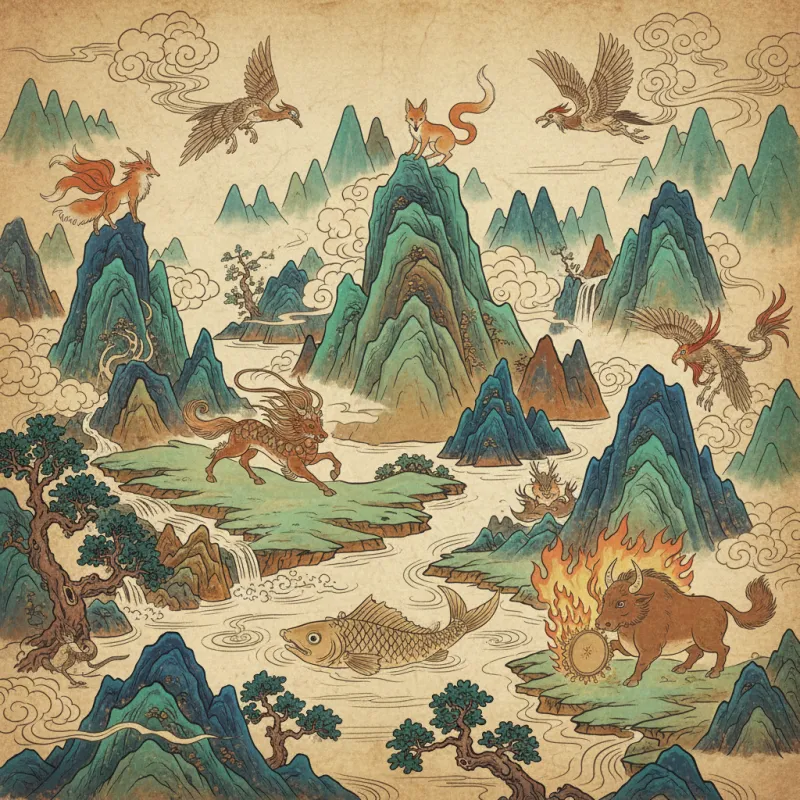
Picture this: a mountain range where nine-tailed foxes prowl beneath trees that glow with jade light, where rivers run backwards uphill, and where a single peak might house both the gateway to heaven and a creature that devours dreams. This isn't fantasy fiction—it's the Shanhaijing (山海经, Shānhǎijīng), the "Classic of Mountains and Seas," a text so strange that scholars still argue whether it's geography, mythology, or something else entirely.
The Mountains That Defy Logic
The Shanhaijing catalogs over 550 mountains across its eighteen sections, but these aren't ordinary peaks. Take Mount Kunlun (昆仑山, Kūnlún Shān), described as the axis mundi of Chinese cosmology—a towering pillar connecting earth to heaven, guarded by a creature called Kaiming (开明兽, Kāimíng Shòu) with nine human heads on a tiger's body. The text claims Kunlun rises 11,000 li high (roughly 3,400 miles), which would pierce through Earth's atmosphere. Absurd? Absolutely. But that's precisely the point.
These mountains function as narrative devices, each one a self-contained ecosystem of the bizarre. Mount Zhong (钟山, Zhōng Shān) in the Beishan Jing (北山经, Northern Mountains Classic) section hosts the god Zhulong (烛龙, Zhúlóng), whose eyes opening and closing literally create day and night. When he breathes out, winter arrives; when he breathes in, summer returns. The mountain itself becomes inseparable from the deity—geography and mythology fused into one.
Creatures That Challenge Classification
The bestiary of the Shanhaijing reads like a fever dream catalog. We're talking about 277 documented creatures, many defying biological possibility. The Bifang (毕方, Bìfāng), a one-legged bird wreathed in flames, appears on Mount Zhang'e (章莪山, Zhāng'é Shān) and supposedly heralds fires wherever it lands. Then there's the Zouyu (驺虞, Zōuyú), a righteous tiger with a white body and black tail that only appears during times of perfect governance—essentially a political barometer in animal form.
What strikes me most is how specific these descriptions get. The text doesn't just say "there's a weird bird"—it tells you the mountain's exact location, the creature's diet, what sounds it makes, and often what calamities or blessings its appearance portends. The Lushu (鹿蜀, Lùshǔ) from Mount Jigu (杻谷山, Chǒugǔ Shān) has a horse's body, white head, tiger stripes, and a red tail. Wearing its hide supposedly grants you many descendants. This precision gives the text an almost scientific veneer, as if the compiler genuinely believed they were documenting real zoology.
The Geography of the Impossible
Modern scholars love debating whether the Shanhaijing describes actual places. Some mountains clearly correspond to real locations—the text's descriptions of mineral deposits and water sources occasionally align with geological reality. But then you hit entries like the "Flowing Sand" (流沙, Liúshā) region where water flows upward, or mountains that float in the sky, and the whole "ancient geography textbook" theory collapses.
I think the text operates on a different logic entirely. It's mapping a cosmological landscape where physical and spiritual geography overlap. The five sacred mountains (五岳, Wǔyuè) mentioned throughout aren't just tall peaks—they're cosmic anchors, each governing a cardinal direction and associated with specific colors, elements, and supernatural hierarchies. Mount Tai (泰山, Tàishān) in the east isn't merely a mountain; it's where souls go for judgment after death, as later Daoist traditions would elaborate.
The Xishan Jing (西山经, Western Mountains Classic) section describes a chain of fifty-seven mountains stretching 12,380 li. The compiler meticulously notes distances between peaks, yet casually mentions that one mountain produces a metal that makes you invisible when forged into weapons. This blend of pseudo-scientific measurement and outright magic is the text's signature move—it keeps you off-balance, never quite sure what's metaphor and what's meant literally.
Creatures as Cultural Mirrors
The monsters of the Shanhaijing reveal ancient Chinese anxieties and values. Many creatures are explicitly labeled as omens—their appearance predicts drought, flood, war, or prosperity. The Qiongqi (穷奇, Qióngqí), a winged tiger that eats people starting from their heads, specifically targets the righteous while rewarding the wicked. It's essentially an anti-moral universe creature, embodying fears about cosmic injustice.
Then you have creatures like the Feiyi (飞鱼, Fēiyú), a fish with six legs that appears during droughts. Eating it prevents nightmares. The practicality here is striking—this isn't just mythology for mythology's sake. These creatures serve functions, offer solutions, or explain natural phenomena. The text becomes a survival manual for navigating a world where the supernatural is simply another category of nature.
The famous nine-tailed fox (九尾狐, Jiǔwěihú) appears on Mount Qingqiu (青丘山, Qīngqiū Shān), and contrary to its later reputation as a seductive demon in novels like Fengshen Yanyi (封神演义, Fēngshén Yǎnyì), the Shanhaijing describes it as an auspicious creature whose appearance signals peace and prosperity. This shows how mythological creatures evolve—the same entity can shift from blessing to curse depending on which dynasty is doing the interpreting.
The Compiler's Mysterious Identity
Nobody knows who actually wrote the Shanhaijing. Traditional attribution points to Yu the Great (大禹, Dà Yǔ) and his minister Boyi (伯益, Bóyì) around 2200 BCE, but that's clearly legendary. Textual analysis suggests multiple authors across several centuries, with the earliest sections possibly dating to the Warring States period (475-221 BCE) and later additions continuing into the Han Dynasty (206 BCE - 220 CE).
What fascinates me is the compiler's voice—or rather, the lack of one. The text presents information with bureaucratic neutrality: "300 li further west is Mount X. It has Y mineral. A creature called Z lives there. It looks like this. Eating it cures that." No editorializing, no skepticism, no wonder. This deadpan delivery makes the absurdities hit harder. When the text casually mentions a mountain where immortals live who can fly and never die, then immediately moves on to discuss copper deposits, the juxtaposition is almost comedic.
Why These Mountains Still Matter
The Shanhaijing has influenced Chinese culture for over two millennia. Its creatures populate everything from Han Dynasty tomb art to modern video games. The text established templates—the divine mountain, the omen beast, the transforming demon—that later literature would endlessly remix. When you read Journey to the West (西游记, Xīyóu Jì) and encounter mountains full of monsters, you're seeing the Shanhaijing's DNA.
But beyond cultural influence, the text preserves something valuable: a worldview where mountains aren't just geological formations but living entities with personalities, histories, and supernatural residents. In our age of satellite mapping and geological surveys, we've gained precision but lost enchantment. The Shanhaijing reminds us that mountains once meant something more—they were homes to gods, gateways to other realms, and characters in their own right.
Modern environmental movements sometimes talk about treating nature as sacred, as having intrinsic value beyond human use. The Shanhaijing did this 2,300 years ago, though in a very different register. Its mountains demand respect not because they're pristine wilderness, but because they're dangerous, powerful, and inhabited by beings who might eat you or grant you immortality depending on their mood.
Reading the Text Today
If you want to explore the Shanhaijing yourself, be warned: it's repetitive, fragmentary, and often boring. Long stretches catalog mountains with minimal variation—"200 li west is Mount X, it has jade and copper, a river flows from it." Then suddenly you'll hit an entry about a mountain where the sun and moon rise, or a creature that's half-human, half-fish and screams like a baby.
The best approach is to dip in randomly rather than reading cover-to-cover. Treat it like an ancient Wikipedia—a reference work you consult for specific entries rather than a narrative you follow. The Nanshan Jing (南山经, Southern Mountains Classic) section has particularly vivid creature descriptions, while the Dahuang Jing (大荒经, Great Wilderness Classic) sections venture into full mythological territory with creation stories and divine genealogies.
For those interested in how these myths connect to broader Chinese cosmology, exploring the divine hierarchies of Chinese mythology provides essential context, while the symbolism of sacred mountains delves deeper into why these peaks held such significance.
The Shanhaijing isn't an easy text, but it's an essential one. It shows us a China where every mountain had a story, every creature carried meaning, and geography itself was a form of mythology. In our flattened, fully-mapped world, there's something thrilling about a text that insists: no, actually, there are still mountains out there full of monsters, and they're waiting for you to find them.
Related Reading
- Human-Animal Hybrids in the Shanhai Jing: Gods with Beast Features
- Enigmatic Beasts and Mystical Lands in the Shanhaijing Classic of Mountains and Seas
- Fenghuang: The Chinese Phoenix and Its True Meaning