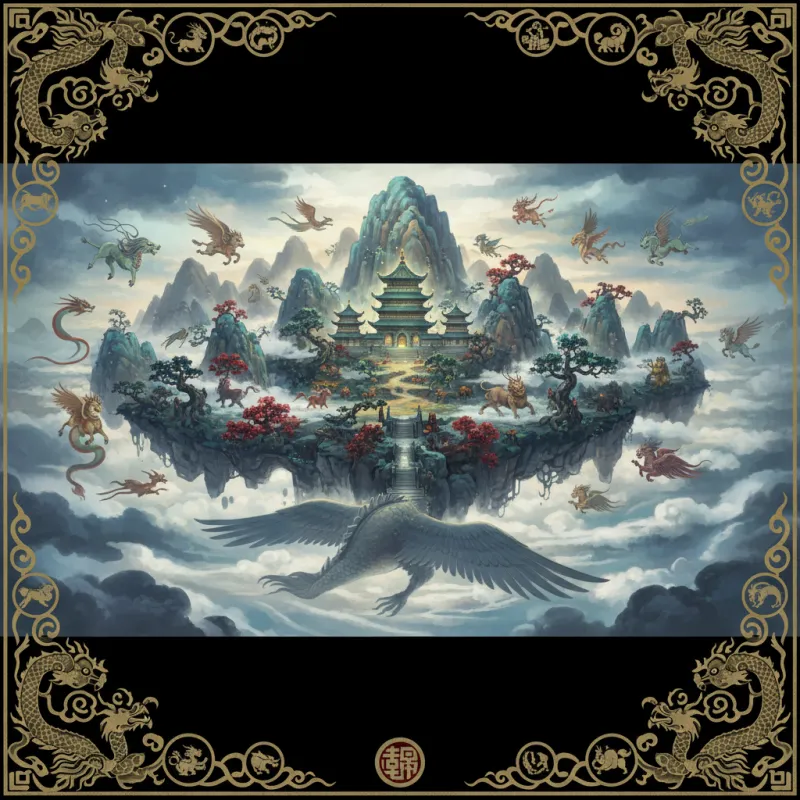
Penglai Island: The Mythical Home of the Immortals
Introduction: The Eternal Quest for Paradise
In the vast tapestry of Chinese mythology, few places capture the imagination quite like Penglai Island (蓬莱, Pénglái). This legendary paradise, shimmering somewhere in the Eastern Sea, has captivated emperors, poets, and dreamers for over two millennia. Unlike the terrestrial mountains catalogued in the Shanhai Jing (山海经, Shānhǎi Jīng, Classic of Mountains and Seas), Penglai exists in a liminal space between reality and myth—a floating sanctuary where immortals dwell and the elixir of eternal life flows freely.
The allure of Penglai is inseparable from humanity's oldest obsession: the conquest of death itself. While the Shanhai Jing describes countless strange lands filled with bizarre creatures and divine beings, Penglai represents something more tantalizing—a place where mortals might actually achieve xian (仙, xiān, immortality) and transcend the limitations of human existence.
The Origins in Ancient Texts
Beyond the Shanhai Jing
While Penglai's fame eventually eclipsed many locations described in the Shanhai Jing, the island's earliest mentions appear in texts from the Warring States period (475-221 BCE). The Liezi (列子, Lièzǐ), a Daoist philosophical text, provides one of the most detailed early descriptions of not just Penglai, but five immortal mountains floating in the Eastern Sea: Daiyu (岱舆, Dàiyú), Yuanqiao (员峤, Yuánqiáo), Fanghu (方壶, Fānghú), Yingzhou (瀛洲, Yíngzhōu), and Penglai itself.
According to the Liezi, these mountains were originally adrift, floating with the tides until the Celestial Emperor commanded fifteen giant sea turtles to hold them steady by taking turns supporting them on their heads. However, a giant from the Longbo Kingdom (龙伯国, Lóngbó Guó) caught six of these turtles while fishing, causing two of the mountains—Daiyu and Yuanqiao—to drift away and sink into the northern ocean. This catastrophic loss left only three immortal islands, with Penglai becoming the most celebrated.
The Qin and Han Dynasty Obsession
The historical record shows that belief in Penglai was far from mere folklore. The Shiji (史记, Shǐjì, Records of the Grand Historian) by Sima Qian documents how Qin Shi Huang (秦始皇, Qín Shǐhuáng), the first emperor of unified China, became obsessed with finding these islands. In 219 BCE, he dispatched the court alchemist Xu Fu (徐福, Xú Fú) with thousands of young men and women, along with craftsmen and supplies, to locate Penglai and retrieve the elixir of immortality.
Xu Fu never returned—some legends claim he reached Japan and became its first emperor, while others suggest he found Penglai but chose to remain there rather than return to the tyrannical Qin Shi Huang. This expedition represents one of history's most ambitious quests for immortality, demonstrating how deeply the Penglai myth influenced even the most powerful rulers.
The Geography of Paradise
A Landscape of Wonders
The descriptions of Penglai in various texts paint a picture of supernatural beauty that surpasses even the fantastic landscapes of the Shanhai Jing. The island is said to be constructed entirely of precious materials—palaces of gold and silver, trees bearing pearls and jade as fruit, and towers made of crystal that catch and refract sunlight into rainbow cascades.
The Shizhou Ji (十洲记, Shízhōu Jì, Records of the Ten Continents), attributed to Dongfang Shuo of the Han Dynasty, describes Penglai as spanning 70,000 li (approximately 35,000 kilometers) in circumference. The island features the Linglong Pavilion (玲珑馆, Línglóng Guǎn), where immortals gather, and the Jade Capital (玉京, Yù Jīng), the administrative center of the celestial bureaucracy.
Unlike earthly mountains, Penglai's peaks are said to be perfectly symmetrical and eternally spring-like. The Bowu Zhi (博物志, Bówù Zhì, Records of Diverse Matters) notes that the island experiences no winter, no storms, and no natural decay. Flowers bloom perpetually, and the air itself is infused with qi (气, qì, vital energy) so pure that merely breathing it extends one's lifespan.
The Barrier of Illusion
What makes Penglai particularly elusive is the supernatural barrier protecting it. According to legend, as ships approach the island, it appears to rise from the sea like a magnificent city of towers and palaces. But as vessels draw closer, the entire vision dissolves into mist, or the island seems to recede into the distance no matter how far one sails. This phenomenon, called haishi shenlou (海市蜃楼, hǎishì shènlóu, mirage), is actually the Chinese term for mirage, derived directly from Penglai legends.
The Shanhai Jing describes many dangerous waters and impassable barriers, but Penglai's defense is unique—it's not physical danger but perceptual impossibility. Only those with sufficient spiritual cultivation or divine favor can pierce the veil and reach the island's shores.
The Inhabitants: Immortals and Divine Beings
The Eight Immortals Connection
While the Shanhai Jing catalogs numerous deities and strange beings, Penglai became particularly associated with the Ba Xian (八仙, Bā Xiān, Eight Immortals), a group of legendary figures who achieved immortality through various means. Though their stories developed primarily during the Tang and Song dynasties—much later than the Shanhai Jing—they became Penglai's most famous residents.
Each of the Eight Immortals represents a different social class and path to enlightenment: Lü Dongbin (吕洞宾, Lǚ Dòngbīn), the scholarly swordsman; He Xiangu (何仙姑, Hé Xiāngū), the only female immortal; Lan Caihe (蓝采和, Lán Cǎihé), the eccentric wanderer; and others. Their legendary crossing to Penglai—where each used their magical implement to traverse the sea—became a popular artistic motif symbolizing the journey to enlightenment.
The Queen Mother of the West
Interestingly, Penglai shares inhabitants with locations described in the Shanhai Jing. The Queen Mother of the West (Xiwangmu, 西王母, Xīwángmǔ), who appears in the Shanhai Jing as a fearsome deity with tiger's teeth and a leopard's tail dwelling in the Kunlun Mountains, is also said to maintain a palace on Penglai. This connection suggests how later Daoist mythology synthesized and expanded upon the earlier cosmology of the Shanhai Jing.
The Queen Mother's famous peach garden, where the pantao (蟠桃, pántáo, immortal peaches) ripen once every 3,000 years, is sometimes located on Penglai rather than Kunlun. These peaches grant immortality to those who consume them, making the Queen Mother's banquets the most coveted invitations in the celestial realm.
The Elixir of Immortality
Alchemical Traditions
Central to Penglai's allure is the changsheng buyao (长生不老药, chángshēng bùlǎo yào, elixir of immortality). Unlike the strange foods described in the Shanhai Jing—such as the flesh of certain creatures that grant specific powers—Penglai's elixir represents the perfected achievement of Daoist alchemy.
The island is said to contain the jiuzhuan jindan (九转金丹, jiǔzhuǎn jīndān, nine-times-refined golden elixir), the ultimate product of waidan (外丹, wàidān, external alchemy). This practice involved combining minerals like cinnabar, lead, and mercury in precise ratios and subjecting them to repeated heating and cooling cycles. The resulting substance, when consumed, would supposedly transform the mortal body into an immortal one.
Historical records show that this pursuit had tragic consequences—multiple Chinese emperors died from elixir poisoning, including Tang Taizong and Tang Xianzong. The irony of dying while seeking immortality eventually led Daoist practitioners to emphasize neidan (内丹, nèidān, internal alchemy), cultivating immortality through meditation and breath control rather than consuming toxic substances.
The Lingzhi Mushroom
Beyond alchemical elixirs, Penglai is particularly famous for its lingzhi (灵芝, língzhī, "spirit mushroom," Ganoderma lucidum). While the Shanhai Jing mentions various magical plants, the lingzhi became specifically associated with Penglai and immortality. These mushrooms, growing from the island's jade soil, are said to be far more potent than their earthly counterparts.
In Chinese art, immortals are frequently depicted holding lingzhi mushrooms or staffs topped with their distinctive fan-shaped caps. The fungus became so symbolic of longevity that it appears in countless paintings, carvings, and decorative motifs, always evoking the paradise of Penglai.
Cultural Impact and Legacy
In Literature and Poetry
Penglai's influence on Chinese literature is immeasurable. Tang Dynasty poets like Li Bai (李白, Lǐ Bái) frequently referenced the island as a metaphor for unattainable ideals or transcendent beauty. In his poem "Dreaming of Wandering in Tianmu Mountain," Li Bai writes of celestial realms that clearly draw inspiration from Penglai imagery.
The island also appears in classical novels. Journey to the West (Xiyou Ji, 西游记, Xīyóu Jì) references Penglai multiple times, and several immortals in the story maintain residences there. The novel's cosmology blends Shanhai Jing geography with later Daoist mythology, creating a rich supernatural landscape where Penglai holds a place of honor.
Architectural and Artistic Representations
The Penglai Pavilion (蓬莱阁, Pénglái Gé) in Shandong Province, built during the Song Dynasty, represents humanity's attempt to create a terrestrial echo of the mythical island. Perched on a cliff overlooking the Yellow Sea, the pavilion complex became one of China's Four Great Towers and a pilgrimage site for those seeking blessings of longevity.
In traditional Chinese painting, Penglai appears in the xianshan (仙山, xiānshān, immortal mountains) genre, depicting floating islands amid swirling clouds and mists. These paintings often show the characteristic architecture of celestial palaces, with upturned eaves and multiple tiers, surrounded by auspicious creatures like cranes and deer—animals associated with immortality.
Modern Interpretations
The Penglai myth continues to resonate in contemporary Chinese culture. The island appears in video games, television dramas, and films as a setting for martial arts adventures and fantasy narratives. The concept of a hidden paradise where the rules of mortality don't apply remains powerfully appealing.
Interestingly, some modern scholars have attempted to identify real-world inspirations for Penglai. Theories range from the Korean Peninsula to the Japanese archipelago, with some suggesting that ancient Chinese sailors' encounters with these lands, distorted by distance and imagination, gave birth to the legend. The mirage phenomenon observed in the Bohai Sea, where atmospheric conditions can create spectacular illusions of floating cities, likely contributed to the myth's persistence.
Philosophical Significance
Daoist Cosmology
Within Daoist thought, Penglai represents more than a physical location—it's a state of being. The island symbolizes the perfected self, the body transformed through cultivation into a vessel for pure qi. The journey to Penglai mirrors the internal journey of spiritual refinement.
This interpretation aligns with the Zhuangzi (庄子, Zhuāngzǐ), which speaks of xiaoyao you (逍遥游, xiāoyáo yóu, free and easy wandering)—a state of spiritual liberation. Penglai becomes the destination of this wandering, the place where one achieves complete freedom from worldly attachments and limitations.
The Unattainable Ideal
There's profound wisdom in Penglai's elusiveness. Unlike the mountains in the Shanhai Jing, which can theoretically be reached through sufficient travel, Penglai remains forever beyond grasp. This reflects a deeper truth about human aspiration—some goals inspire us not because we'll achieve them, but because the pursuit itself ennobles us.
Xu Fu's expedition, whether it succeeded or failed, represents humanity's refusal to accept mortality as final. The quest for Penglai is the quest for transcendence, for something beyond the mundane cycle of birth and death. In this sense, every scientific advance, every artistic masterpiece, every act of love that defies time's erosion is its own voyage toward Penglai.
Conclusion: The Eternal Horizon
Penglai Island endures in Chinese cultural consciousness not despite its impossibility, but because of it. While the Shanhai Jing mapped a world of wonders that ancient people believed truly existed somewhere beyond known borders, Penglai occupies a different space—the realm of aspiration, where the human spirit reaches toward immortality.
The island reminds us that mythology serves purposes beyond explanation or entertainment. It provides symbols for our deepest longings and highest aspirations. In Penglai's mist-shrouded shores, its palaces of jade and gold, its immortals who have transcended death itself, we see reflected humanity's eternal refusal to accept limitation.
Whether Penglai exists as a physical place matters less than what it represents: the possibility of transformation, the hope for transcendence, and the belief that somewhere, beyond the horizon of the known world, paradise awaits those brave enough to seek it. Like the best myths, Penglai is true not because it happened, but because it continues to happen—in every heart that refuses to accept that this world, with all its beauty and sorrow, is all there is.
The quest for Penglai continues, not in ships sailing eastward, but in laboratories seeking to extend life, in meditation halls where practitioners cultivate inner immortality, and in the imagination of artists and writers who keep the dream alive. The island may forever recede before us, dissolving into mist as we approach, but the journey itself—that eternal voyage toward something greater—remains humanity's most noble endeavor.