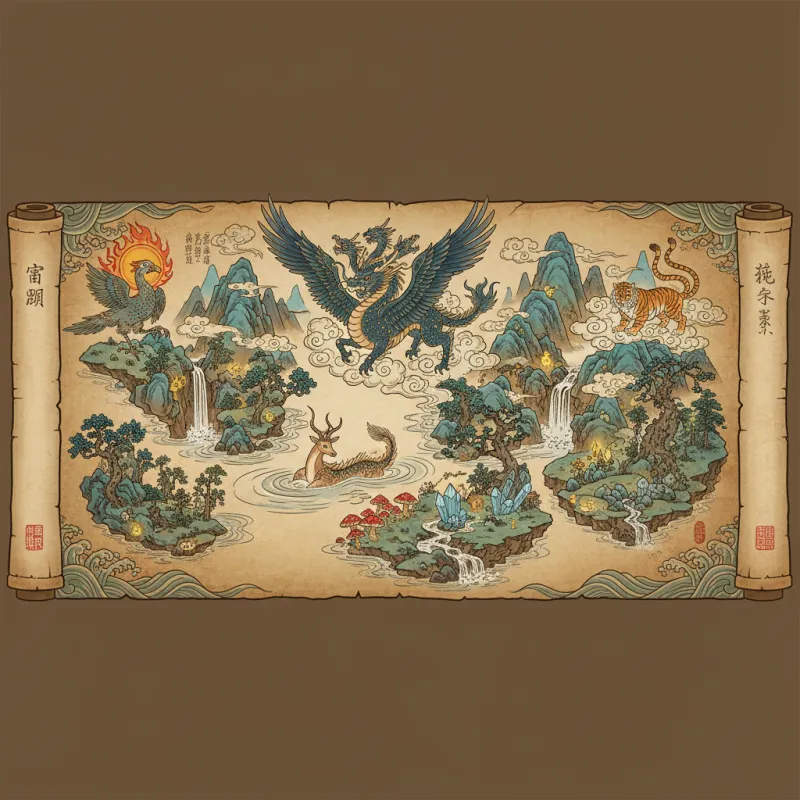
Picture this: a nine-tailed fox prowling through bamboo forests, a bird with three heads singing in harmony, mountains that walk on human legs. These aren't fever dreams or modern fantasy—they're meticulous entries from a 2,000-year-old Chinese text that reads like an ancient field guide to the impossible. The Shanhaijing (山海经, Shānhǎijīng), or Classic of Mountains and Seas, stands as one of humanity's strangest documents: part geography textbook, part bestiary, part fever dream committed to bamboo slips by scribes who wrote with the confidence of eyewitnesses.
The Text That Defies Classification
Compiled between the 4th and 1st centuries BCE during the Warring States period and early Han dynasty, the Shanhaijing frustrates every attempt to pin it down. Scholars have argued for centuries whether it's mythology, proto-geography, shamanic ritual text, or elaborate fiction. The truth? It's probably all of these at once. Spanning 31,000 characters across 18 sections, the text catalogs 550 mountains, 300 waterways, and over 400 creatures with the systematic precision of a naturalist—except the "natural" world it describes includes mountains that float, rivers that flow upward, and animals that would make a modern biologist weep.
What makes the Shanhaijing particularly maddening and fascinating is its matter-of-fact tone. There's no sense of wonder or disbelief in the writing. The text describes a six-legged creature with four wings called the dijiang (帝江, dìjiāng) with the same clinical detachment it uses for ordinary deer. This deadpan delivery has led some scholars to suggest the compilers genuinely believed they were documenting real geography—perhaps of distant lands distorted through layers of retelling, or shamanic visions treated as literal truth.
Creatures That Haunt the Collective Imagination
The menagerie within the Shanhaijing reads like nature's rough drafts—experimental designs that never made it into the final version of reality. Take the jiuwei hu (九尾狐, jiǔwěi hú), the nine-tailed fox that appears on Qingqiu Mountain. The text notes that its cry sounds like a baby and that eating its flesh protects against poison. This creature would go on to become one of Chinese mythology's most enduring figures, shape-shifting through literature from the Tang dynasty's romantic tales to modern anime. The fox spirits of Chinese folklore owe their entire existence to this brief Shanhaijing entry.
Then there's the Zhuque (朱雀, zhūquè), the Vermillion Bird of the South, one of the Four Symbols that would become fundamental to Chinese cosmology and feng shui. The text describes it dwelling in the southern wilderness, a creature of fire and summer. But the Shanhaijing also catalogs dozens of lesser-known avians: the jingwei (精卫, jīngwèi), a bird born from a drowned princess who spends eternity trying to fill the ocean with pebbles—a myth that became China's symbol for persistence against impossible odds.
The bixie (辟邪, bìxié), a winged lion-like creature, appears as a guardian against evil spirits. You'll still see stone bixie flanking temple entrances across China today, their lineage traceable directly to the Shanhaijing's terse description. The text's influence on Chinese protective talismans and guardian creatures cannot be overstated—it essentially wrote the playbook.
Geography of the Impossible
The Shanhaijing organizes its world into five sections corresponding to the cardinal directions and center, each containing mountains, rivers, and their associated creatures. But this isn't geography as we understand it. The "Overseas East Classic" describes the Land of Gentlemen where people never argue and yield to each other constantly—a utopian fantasy that reveals more about Warring States period anxieties than actual places. The "Great Wilderness West Classic" mentions the Kunlun (昆仑, kūnlún) Mountains, home to the Queen Mother of the West and the peaches of immortality, a location that would become central to Daoist mythology.
Some locations seem to reference real places through a distorted lens. The text mentions southern regions with people who have tattooed bodies and cut their hair short—likely garbled accounts of Southeast Asian peoples filtered through multiple retellings. Other passages describe lands where the sun rises and sets, possibly attempting to explain astronomical phenomena through mythological frameworks. The Shanhaijing sits at that fascinating intersection where empirical observation meets mythological interpretation, where travelers' tales get processed through a worldview that doesn't distinguish between natural and supernatural.
Shamanic Roots and Ritual Functions
Here's what most casual readers miss: the Shanhaijing wasn't meant to be read like a novel. Many scholars now believe it served as a ritual manual for shamans or wu (巫, wū) who needed to know which creatures inhabited which mountains for ceremonial purposes. The text often notes which animals can be eaten for specific benefits—protection from poison, prevention of disease, enhancement of fertility. This reads less like mythology and more like a pharmacological guide for ritual specialists.
The systematic organization—always noting the mountain's location, distance from the previous mountain, associated minerals, plants, and creatures—suggests a mnemonic device. Shamans traveling in trance states through spiritual landscapes needed landmarks, and the Shanhaijing provided them. The creatures weren't just stories; they were signposts in an otherworldly geography that shamans navigated as part of their practice. This interpretation explains the text's bizarre combination of precision and impossibility—it's precise about a geography that exists in visionary space, not physical space.
Literary Afterlife and Cultural Mutations
The Shanhaijing's influence on Chinese literature is like a underground river—not always visible but nourishing everything above it. Qu Yuan's Tianwen (天问, tiānwèn, "Heavenly Questions") from the 3rd century BCE draws heavily on Shanhaijing imagery. The Tang dynasty poet Li Bai referenced its mountains and creatures in his wine-soaked verses. The 16th-century novel Journey to the West borrowed liberally from the Shanhaijing's bestiary—Sun Wukong's various adversaries often trace their lineage back to creatures first cataloged in this ancient text.
But the text's influence extends beyond literature into art, medicine, and even political symbolism. Ming and Qing dynasty painters created elaborate illustrated editions, transforming terse descriptions into visual spectacles. Traditional Chinese medicine incorporated some of the text's claims about animal properties—though thankfully most doctors stopped recommending eating mythical creatures. Modern Chinese fantasy literature and gaming industries mine the Shanhaijing constantly, treating it as an inexhaustible source of creature designs and worldbuilding elements.
Modern Interpretations and Ongoing Mysteries
Contemporary scholars continue wrestling with the Shanhaijing's fundamental nature. Some argue it preserves genuine geographical knowledge of ancient China's periphery, with "monsters" representing foreign peoples and unfamiliar animals described by travelers who'd never seen them. Others see it as purely mythological, a window into how ancient Chinese people conceptualized the cosmos. A third camp suggests it's a deliberately constructed cosmology, an attempt to map spiritual rather than physical reality.
The text's descriptions of minerals and metals—it catalogs jade, gold, copper, and various stones with the same systematic approach it uses for creatures—have led some researchers to investigate whether it contains genuine geological information. A few controversial studies have claimed to match Shanhaijing mountain descriptions to actual locations, though mainstream scholarship remains skeptical. The relationship between ancient Chinese mineral knowledge and mythology remains an active area of research.
Why the Shanhaijing Still Matters
In an age of Google Earth and genetic sequencing, why should anyone care about a 2,000-year-old text full of impossible creatures? Because the Shanhaijing reminds us that humans have always been storytelling animals, that we've always tried to make sense of the unknown by cataloging it, naming it, fitting it into systems. The text's compilers faced a world far more mysterious than ours—where the next valley might contain anything, where the edges of the known world dissolved into rumor and wonder.
The Shanhaijing preserved that sense of possibility, that feeling that the world might be stranger and more marvelous than we imagine. Every time a modern fantasy author creates a new creature, every time a game designer populates a world with impossible beings, they're walking in the footsteps of the Shanhaijing's anonymous compilers. The text taught Chinese culture—and through it, the world—that the fantastic could be systematized, that wonder could be cataloged, that imagination deserved the same serious attention as empirical observation.
The nine-tailed fox still prowls through our collective imagination, the jingwei bird still drops its pebbles into the sea, and somewhere in the mist-shrouded mountains of the mind, the creatures of the Shanhaijing wait to be discovered again by each new generation of readers willing to believe, even for a moment, that the impossible might be meticulously, systematically, undeniably real.
Related Reading
- Unraveling the Mysteries of Shanhaijing: Myths, Creatures, and Fantastic Realms
- Kunlun Mountain: Where Heaven Meets Earth in Chinese Mythology
- Shanhaijing Cosmology: How Ancient China Imagined the Universe