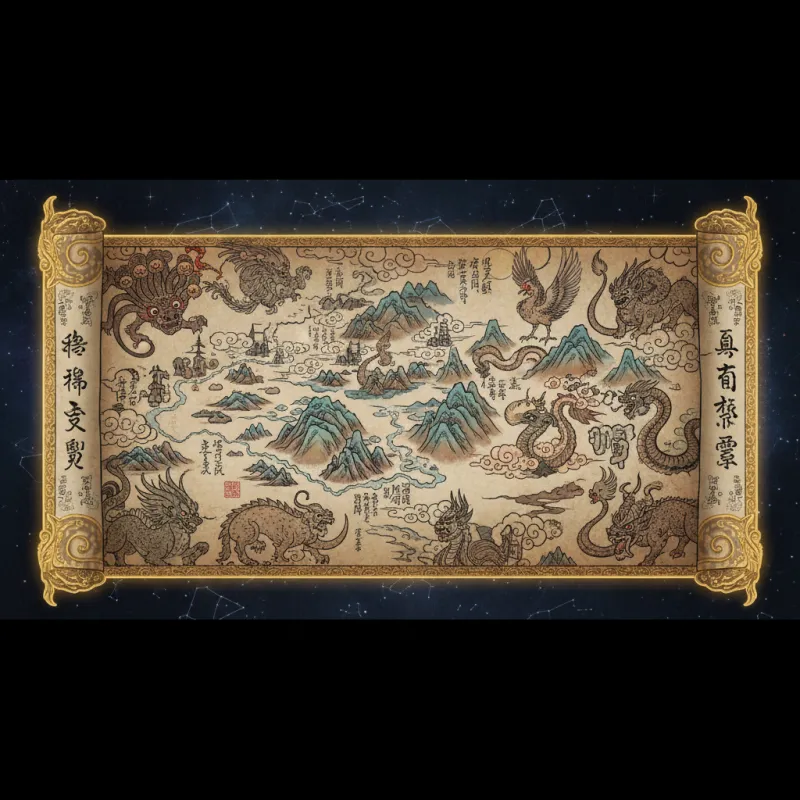
Picture this: somewhere around 200 BCE, a scribe in the Han court carefully copies out a description of the Lushu, a creature with a horse's body and bird's wings. He pauses, dips his brush, and adds: "其状如..." — "its form is like..." Like what? The phrase hangs there, incomplete, because the scribe expects you're looking at the picture right next to the text. Except that picture is gone. Lost. Vanished into the void of history along with every other original illustration from the Shanhaijing (山海经, Shānhǎijīng, "Classic of Mountains and Seas").
This is the beautiful problem at the heart of illustrated Shanhaijing editions: every single image you've ever seen of these creatures — in museums, video games, modern books, or scrolling through your phone — is someone's educated guess. The visual tradition of the Shanhaijing isn't a record of what these creatures looked like. It's a two-thousand-year conversation between artists trying to imagine the unimaginable.
The Clues in the Text
The Shanhaijing is practically begging for illustrations. The text is structured like an ancient field guide, with entries that read: "Three hundred li further east is Mount Qingqiu. There is a beast there. Its form is like a fox with nine tails. Its cry is like a baby. It eats people." That phrase "its form is like" (其状如, qí zhuàng rú) appears hundreds of times, always suggesting visual comparison. A creature is "like a sheep but with four horns," "like an ox but with white tail," "like a human but with wings."
These aren't complete descriptions — they're reference points. The text assumes you can see the base animal (sheep, ox, human) and then modify it mentally. Or better yet, look at the illustration. Scholars have found over 150 instances where the text's phrasing only makes sense if there was originally an accompanying image. The Shanhaijing without pictures is like a museum with all the labels but none of the art.
But here's what we know for certain: if those original Han Dynasty illustrations existed, they're gone. The earliest surviving illustrated editions date from the Song Dynasty (960-1279 CE), already a thousand years after the text was compiled. Everything before that is reconstruction, imagination, and artistic interpretation layered on top of cryptic verbal clues.
The Ming Dynasty Revolution
The Shanhaijing illustrations that most people recognize today — the ones that show up in museum exhibitions, academic books, and as inspiration for contemporary creature designs — come from the Ming Dynasty (1368-1644 CE). Specifically, from a 1597 edition illustrated by Jiang Yinghao (蒋应镐, Jiǎng Yìnghào) and a 1609 edition by Wang Qi (王圻, Wáng Qí) and his son Wang Siyi (王思义, Wáng Sīyì).
These Ming artists made a crucial decision: they would illustrate every single creature mentioned in the text. Not just the famous ones like the nine-tailed fox or the Kunpeng, but the obscure ones too — the weird fish with six legs, the bird that looks like a chicken but has three heads, the snake with a human face. The result was hundreds of woodblock prints that gave visual form to creatures that had existed only as words for over a millennium.
The Ming style is distinctive: creatures are shown in profile, often against minimal backgrounds, with careful attention to the specific details mentioned in the text. If the Shanhaijing says a creature has "patterns like a tiger," the Ming artists dutifully add stripes. If it has "one eye," they show exactly one eye, positioned centrally in the head. The illustrations have a charming literalness — they take the text at its word, even when that word describes something anatomically impossible.
The Qing Dynasty Refinements
The Qing Dynasty (1644-1912 CE) artists inherited the Ming visual tradition but pushed it in new directions. The most famous Qing edition, illustrated by Wu Renchen (吴任臣, Wú Rènchén) in 1667, shows creatures in more dynamic poses, often interacting with their environments. A bird doesn't just stand there — it perches on a branch. A water creature isn't floating in white space — it's emerging from stylized waves.
This shift reflects changing artistic sensibilities. Qing illustrators were influenced by developments in Chinese landscape painting and natural history illustration. They wanted their Shanhaijing creatures to feel like they inhabited a real world, even if that world was mythical. The creatures gain context, personality, even a hint of behavior. You can almost imagine how they move.
But here's the fascinating tension: as the illustrations became more sophisticated artistically, they also became more interpretive. The Ming artists stuck close to the text's literal descriptions. The Qing artists made choices. If the text says a creature is "like a fox," which kind of fox? What's its posture? Its expression? Every artistic decision is an interpretation, and interpretations can diverge wildly from artist to artist.
The Problem of Impossible Bodies
Some Shanhaijing creatures are straightforward to illustrate: a fox with nine tails is just a fox with nine tails. But others present genuine puzzles. Take the Dijiang (帝江, Dìjiāng), described as "shaped like a yellow sack, red like cinnabar fire, with six feet and four wings, faceless and eyeless." How do you draw that? Where do the wings attach to a sack? How do six feet work anatomically?
Different artists have solved this problem in different ways. Some Ming illustrators essentially drew a blob with appendages sticking out at odd angles — literal but bizarre. Later artists tried to impose more anatomical logic, giving the Dijiang a more bird-like or beast-like body structure that could plausibly support wings and feet. Modern illustrators sometimes go full abstract, treating the Dijiang as a challenge in surrealist design.
The same problem appears with creatures that have human faces on animal bodies, or animal heads on human bodies, or multiple heads, or eyes in strange places. The text describes these features matter-of-factly, but translating them into coherent visual form requires artists to make decisions about proportion, placement, and biological plausibility. Should a "human face" on a tiger body be the same size as a human face? Should it have a neck? Should it show emotion?
These aren't trivial questions. They're fundamental to how we understand these creatures. A nine-tailed fox with a serene human face reads very differently from one with a grotesque or frightening face, even though the text doesn't specify. Every illustration is an argument about what these creatures mean.
The Modern Explosion
The 20th and 21st centuries have seen an explosion of Shanhaijing illustration, driven by new media and new audiences. Video games, animated films, comic books, and digital art have all taken their turn reimagining these ancient creatures. Some modern artists work in traditional ink and brush, deliberately evoking Ming and Qing aesthetics. Others use digital tools to create hyper-detailed, almost photorealistic renderings that make these mythical beasts look like they could be discovered by a wildlife photographer.
What's striking is how much variation exists. Put ten modern Shanhaijing illustrations of the same creature side by side, and you might not recognize they're depicting the same thing. This isn't a failure of accuracy — it's the natural result of working from descriptions that were never meant to stand alone. The text gives you a framework, but the details are up to you.
Some contemporary artists lean into this ambiguity, creating deliberately strange or unsettling interpretations that emphasize the alien nature of these creatures. Others try to "naturalize" them, designing creatures that look like they could plausibly evolve and exist in a real ecosystem. Both approaches are valid responses to the same ancient text.
What We're Really Looking At
Here's the thing that makes illustrated Shanhaijing editions so fascinating: they're not really about the creatures. They're about the artists. Every illustrated edition is a window into how a particular person, in a particular time and place, understood the relationship between text and image, between description and reality, between the known and the unknown.
The Ming artists, working in an era of encyclopedic ambition, wanted completeness and clarity. The Qing artists, influenced by naturalism, wanted plausibility and grace. Modern artists, working in an age of digital fantasy and global media, want spectacle and originality. None of them are "wrong," because there's no original to be wrong about.
This is why the illustrated Shanhaijing tradition matters beyond just being pretty pictures of weird creatures. It's a case study in how humans visualize the invisible, how we give form to descriptions, how we negotiate between faithfulness to a source text and creative interpretation. Every artist who tackles the Shanhaijing is participating in a conversation that's been going on for two thousand years: what do these creatures look like? And maybe more importantly: what do we want them to look like?
The original illustrations are lost, yes. But maybe that's not entirely a tragedy. If we had the "definitive" Han Dynasty images, the conversation would be over. Instead, we have something richer: an endless, evolving visual tradition where every generation gets to imagine the unimaginable in their own way. The Shanhaijing creatures aren't frozen in time. They're alive, changing, adapting to new eyes and new hands. That's not a bug in the transmission of ancient knowledge — it's a feature.
Related Reading
- How to Read the Shanhai Jing: A Beginner's Guide
- East vs. West: Comparing Mythical Creatures Across Cultures
- How Shanhai Jing Inspired Modern Fantasy Art and Design
- The Illustrated Shanhaijing: How Artists Have Imagined the Unimaginable
- Discovering the Enigmatic Hybrid Creatures of Shanhaijing
- Shanhaijing in Video Games and Anime
- Exploring the Enigmatic Mountains and Creatures of the Shanhaijing