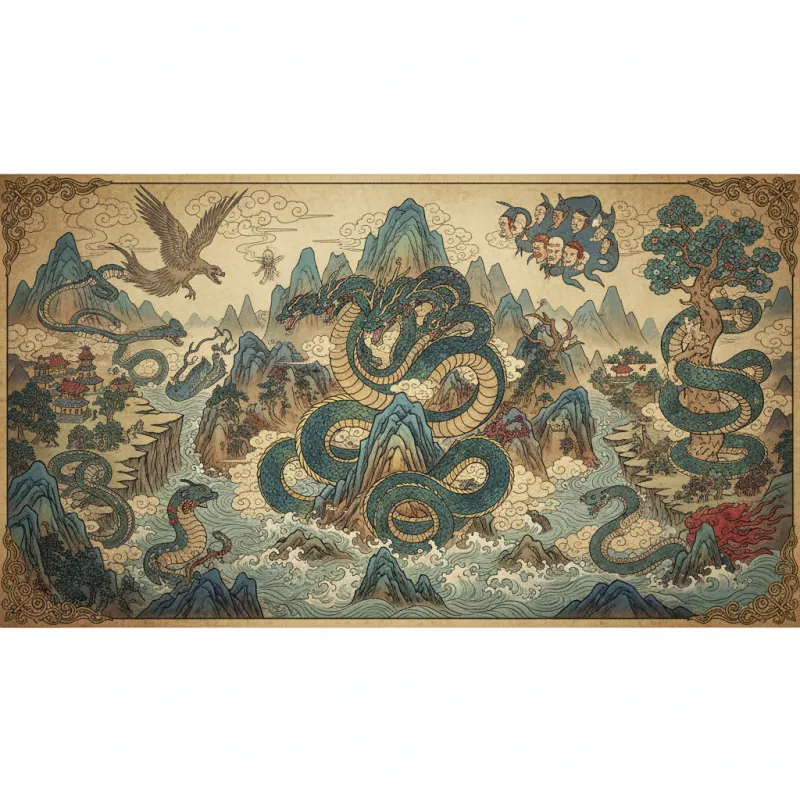
A nine-headed serpent rises from the waters of Mount Kunlun, each mouth breathing a different poison, each head capable of independent thought. This isn't fantasy fiction—it's a creature meticulously documented in the Shanhaijing (山海经, Shānhǎijīng), where serpents aren't mere animals but cosmic forces that shaped the geography and destiny of ancient China.
The Serpent as Cosmic Architect
The Shanhaijing presents serpents as fundamental to creation itself. Consider Nüwa (女娲, Nǚwā), the serpent-bodied goddess who didn't just repair the broken sky with five-colored stones—she literally held up the pillars of heaven with her coiled form. This isn't metaphor. The text describes her lower body as explicitly serpentine, a detail that separates her from later sanitized versions where she appears fully human.
What's fascinating is how this serpentine form grants her creative power. The Shanhaijing suggests that her ability to mold humanity from yellow earth stems directly from her connection to the primordial serpent energy—the same force that allows her to understand both earth and heaven simultaneously. Her brother-consort Fuxi (伏羲, Fúxī) shares this form, and together their intertwined serpent bodies appear in Han dynasty tomb art, representing the fundamental unity of yin and yang.
Geographic Guardians and Territorial Markers
Travel through the Shanhaijing's mountains and you'll notice something peculiar: serpents mark boundaries. The text catalogs serpents not randomly but systematically, positioning them at critical geographic junctures. The Bashe (巴蛇, Bāshé), a serpent so massive it swallows elephants whole and takes three years to digest them, dwells specifically in the southern wilderness—a region the ancient Chinese considered the edge of civilization.
This isn't coincidence. The Bashe's bones, according to the text, cure heart and abdominal ailments, making it both threat and resource. Its placement in the south serves as a warning: beyond this point, nature operates by different rules. The serpent becomes a living border marker, more effective than any stone monument.
The Feilian (飞廉, Fēilián), a serpent with a bird's body, guards the western mountains where the sun sets. Its hybrid form—part serpent, part avian—embodies the transitional space between day and night, known and unknown. These aren't random monster placements; they're a sophisticated geographic coding system where serpent types indicate specific environmental and spiritual conditions.
The Nine-Headed Hydra of Chinese Myth
Long before Greek mythology gave us the Hydra, the Shanhaijing documented the Xiangliu (相柳, Xiāngliǔ), a nine-headed serpent that served Gonggong (共工, Gònggōng), the water god who tried to overthrow the cosmic order. Each of Xiangliu's nine heads could eat from nine different mountains simultaneously, and wherever it passed, the land turned into fetid marshland.
The text gets specific about Xiangliu's defeat. When Yu the Great (大禹, Dà Yǔ) finally killed it, its blood was so toxic that nothing would grow where it spilled. Yu tried three times to dam the poisoned area, but each dam collapsed. Finally, he built a platform for the emperors—transforming the site of corruption into a seat of power. This detail reveals something crucial: the Shanhaijing doesn't present serpents as purely evil. Xiangliu's poison, properly contained, becomes the foundation of imperial authority.
The nine heads aren't arbitrary either. Nine is the ultimate yang number in Chinese cosmology, representing completion and maximum power. Xiangliu's nine heads make it a perverted mirror of cosmic perfection—complete power turned toward chaos rather than order.
Serpents as Transformation Agents
The Shanhaijing repeatedly links serpents to metamorphosis. The text describes the Zhulong (烛龙, Zhúlóng), a thousand-li-long serpent with a human face whose opened eyes create day and closed eyes bring night. Its breath generates the seasons—exhaling produces summer, inhaling creates winter. This isn't a creature that exists within nature; it's a creature that is nature's fundamental processes.
What makes Zhulong particularly intriguing is its location: the northern wilderness beyond Mount Zhongshan, where conventional time doesn't exist. The text notes that in Zhulong's domain, there is no sun, moon, or stars—only the serpent's eyes providing illumination. This suggests the Shanhaijing understood serpents as pre-solar, primordial beings that existed before the current cosmic order.
The Tengshe (腾蛇, Téngshé), a flying serpent that rides on clouds and mist, represents transformation of a different kind. Unlike dragons, which the Shanhaijing treats as separate beings, the Tengshe exists in a liminal state—not quite earthbound, not quite celestial. It appears in divination texts as a symbol of uncertainty and change, appropriate for a creature that literally exists between earth and sky.
The Pharmacological Serpent
Here's where the Shanhaijing gets practical. The text catalogs serpents not just as mythological beings but as medicinal resources. The Mingsheshe (鸣蛇蛇, Míngshéshé), a serpent with four wings and a sound like a stone chime, has flesh that cures jaundice when eaten. The text specifies preparation methods and dosages with the precision of a medical manual.
This dual nature—mythological and medicinal—reveals how the ancient Chinese viewed these creatures. They weren't purely symbolic nor purely physical. A serpent could simultaneously represent cosmic forces and provide tangible medical benefits. The healing properties of mythical creatures weren't metaphorical; they were documented treatments, even if the creatures themselves existed in a space between myth and reality.
The Feiyi (肥遗, Féiyí), a six-legged serpent with four wings, appears on Mount Taihua. The text notes that its appearance presages severe drought—but also that seeing it brings protection from epidemics. This paradox is typical of Shanhaijing serpents: they're simultaneously omen and remedy, curse and cure.
Serpents and the Mandate of Heaven
The Shanhaijing links serpent encounters directly to political legitimacy. When a ruler sees certain serpents, it confirms or challenges their mandate to rule. The appearance of a white serpent, for instance, signals the transfer of power between dynasties—a detail that later historians would exploit to justify regime changes.
This political dimension explains why the Shanhaijing was preserved despite its fantastic content. It wasn't just mythology; it was a political handbook encoded in monster lore. Understanding which serpents appeared where, and what they signified, gave rulers and advisors a framework for interpreting natural phenomena as political messages.
The text describes how the Yellow Emperor (黄帝, Huángdì) encountered a great serpent during his campaigns and interpreted it as a sign to change his military strategy. This isn't superstition—it's a sophisticated system where natural observations inform political decisions, with serpents serving as the interpretive key.
The Serpent's Enduring Mystery
What makes the Shanhaijing's serpents so compelling isn't their monstrosity but their ambiguity. They're never simply good or evil, natural or supernatural, real or imagined. A serpent might guard treasure or poison the land, cure disease or cause drought, confirm a ruler's legitimacy or herald their downfall—sometimes all simultaneously.
This ambiguity reflects a worldview where categories we take for granted—myth versus reality, symbol versus substance—didn't exist as firm boundaries. The Shanhaijing presents a world where a serpent could be a geographic marker, a medical ingredient, a political omen, and a cosmic force all at once. Modern readers struggle with this multiplicity, wanting to categorize these creatures as either "real animals" or "pure mythology." The text refuses this simplification.
Perhaps that's why these serpents continue to fascinate. They resist our attempts to pin them down, remaining as slippery and transformative as the creatures themselves. In an age of rigid categories and definitive answers, the Shanhaijing's serpents remind us that mystery itself has value—that some questions are more interesting than their answers, and some creatures are more powerful when they remain partially hidden in the mists of Mount Kunlun.
Related Reading
- Magical Artifacts of the Shanhaijing
- Strange Nations of the Shanhai Jing: A Catalog of Impossible Peoples
- Nüwa Repairs the Sky: Saving the World