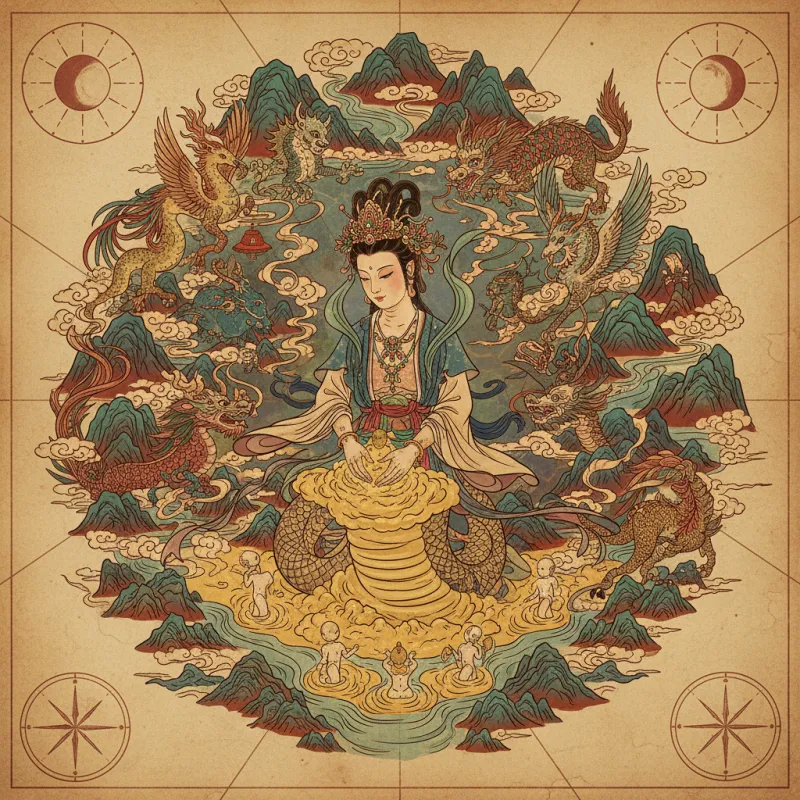
Nuwa Creates Humanity: The Goddess Who Shaped Us from Clay
The Divine Artisan of Chinese Mythology
In the vast pantheon of Chinese mythology, few figures command as much reverence and fascination as Nüwa (女娲), the serpent-bodied goddess who molded humanity from the yellow earth. Her story represents one of the most enduring creation myths in Chinese culture, offering profound insights into ancient Chinese cosmology, the relationship between divine and mortal realms, and humanity's place in the natural order.
Unlike the sudden, word-spoken creation found in some mythological traditions, Nüwa's act of creation is intimate and tactile—a goddess literally getting her hands dirty to bring forth life. This image of divine craftsmanship resonates through millennia of Chinese art, literature, and philosophical thought, establishing Nüwa as not merely a creator deity but as the primordial mother of all humanity.
Nüwa's Origins and Divine Nature
Nüwa appears in various ancient Chinese texts, though her most detailed descriptions emerge from the Shanhai Jing (山海经, Shānhǎi Jīng, "Classic of Mountains and Seas") and later compilations like the Huainanzi (淮南子, Huáinánzǐ) and Fengsu Tongyi (风俗通义, Fēngsú Tōngyì). Her physical form embodies the liminal space between heaven and earth, human and divine—typically depicted with a beautiful human face and upper body, while her lower half takes the form of a powerful serpent or dragon tail.
This hybrid form is no accident. In ancient Chinese cosmology, the serpent represented primal creative energy, transformation, and the mysterious forces of nature. The Shanhai Jing describes numerous divine beings with similar serpentine features, suggesting that this form marked beings of exceptional spiritual power who could navigate between different realms of existence.
Some traditions identify Nüwa as the sister and wife of Fuxi (伏羲, Fúxī), another serpent-bodied deity credited with teaching humanity essential skills like fishing, hunting, and the creation of the bagua (八卦, bāguà)—the eight trigrams fundamental to Chinese philosophy and divination. Together, this divine pair represents the complementary forces of yin (阴, yīn) and yang (阳, yáng), with Nüwa embodying the receptive, nurturing, creative feminine principle.
The World Before Humanity
According to the mythological timeline, Nüwa's creation of humanity occurred after the separation of heaven and earth but before the world was fully populated with human life. The cosmos had already taken shape through the actions of Pangu (盘古, Pángǔ), the primordial giant whose body became the mountains, rivers, and sky. The wanwu (万物, wànwù)—the "ten thousand things" or all phenomena—had begun to flourish.
Yet something was missing. The world teemed with animals, plants, and spirits, but lacked beings capable of consciousness, culture, and the complex social relationships that would eventually define civilization. The earth was beautiful but lonely, filled with natural wonders but devoid of witnesses who could appreciate and give meaning to creation.
Nüwa, wandering through this pristine but empty landscape, felt the weight of this absence. The Fengsu Tongyi, compiled by Ying Shao (应劭, Yìng Shào) during the Eastern Han Dynasty, describes her solitude: "Between heaven and earth, though there were birds and beasts, she felt the world was too quiet and lonely." This emotional dimension—a goddess experiencing loneliness—adds remarkable depth to the creation narrative, suggesting that humanity was born not from divine decree but from a goddess's desire for companionship.
The Act of Creation: Yellow Earth and Divine Breath
The most famous account of Nüwa's creation of humanity describes her kneeling beside the Yellow River, scooping up handfuls of huangtu (黄土, huángtǔ)—the yellow earth or loess that characterizes much of northern China's landscape. This detail roots the myth in geographical reality; the Yellow River valley is indeed where Chinese civilization first flourished, and the distinctive yellow soil became synonymous with the Chinese homeland itself.
With divine skill, Nüwa began to mold the clay, shaping it into figures that resembled her own upper body—human in form, with two arms, two legs, and an upright posture. The texts emphasize her careful craftsmanship, suggesting she worked with the attention of a master sculptor, ensuring each figure had distinct features and characteristics.
But clay alone does not make life. In a moment that parallels creation myths across cultures, Nüwa breathed into these clay figures, infusing them with qi (气, qì)—the vital energy or life force that animates all living things. This breath transformed inert matter into living, breathing humans who could walk, speak, and think. The first humans opened their eyes to see their creator, and Nüwa rejoiced at their animation.
The Two Classes of Humanity
Here the myth takes a fascinating turn that reflects ancient Chinese social structures. According to some versions, Nüwa's initial method—carefully hand-molding each individual—proved too time-consuming. The goddess desired to populate the entire world, not just create a handful of humans.
So Nüwa adapted her technique. She took a length of rope or vine, dipped it into the muddy clay, and swung it in great arcs across the landscape. Where drops of mud fell, they transformed into human beings. This second method allowed for mass production, filling the earth with countless people in a fraction of the time.
However, this dual creation process established a hierarchy. The carefully hand-crafted humans became the guiren (贵人, guìrén)—the noble people, the aristocracy, those of refined character and elevated status. The humans created from scattered mud drops became the xiaoren (小人, xiǎorén) or pingmin (平民, píngmín)—the common people, the masses who would form the foundation of society.
This aspect of the myth clearly served to legitimize social stratification in ancient China, providing a divine origin story for class distinctions. Yet it also reveals something profound about the myth's evolution—it wasn't simply a story about creation but a narrative that helped explain and justify the social order, demonstrating how mythology and social structure intertwine.
Nüwa's Other Great Deeds
Nüwa's role as humanity's creator represents only one chapter in her mythological biography. Perhaps equally famous is her act of cosmic repair, when she saved the world from destruction.
According to the Huainanzi, a catastrophic battle between two powerful deities—Gonggong (共工, Gònggōng), the water god, and Zhuanxu (颛顼, Zhuānxū)—resulted in Gonggong smashing into Buzhou Mountain (不周山, Bùzhōu Shān), one of the pillars supporting the heavens. This collision caused the sky to crack, creating a massive hole through which floods poured down and fires erupted from the earth. The cosmic order itself threatened to collapse.
Nüwa responded with characteristic resourcefulness. She gathered stones of five different colors—representing the five elements (wuxing, 五行, wǔxíng): wood, fire, earth, metal, and water—and melted them down to create a divine paste. With this material, she patched the hole in the sky, restoring cosmic balance. She then killed a giant turtle and used its four legs as new pillars to support the heavens, ensuring stability for future generations.
This myth of butian (补天, bǔtiān, "mending the sky") establishes Nüwa not merely as a creator but as a preserver and protector of both humanity and the cosmic order. She is a goddess who intervenes in times of crisis, using her divine powers to maintain the world her children inhabit.
Symbolism and Cultural Significance
The Nüwa creation myth operates on multiple symbolic levels. At its most basic, it explains human origins through a narrative that ancient Chinese audiences found meaningful and satisfying. But deeper examination reveals layers of philosophical and cultural significance.
The use of earth as the primary material connects humanity fundamentally to the land. Unlike myths where humans descend from the sky or emerge from divine thought alone, Nüwa's humans are literally made from Chinese soil. This grounds human identity in place and emphasizes the intimate relationship between people and their environment—a theme that resonates throughout Chinese philosophy, particularly in Daoist thought about living in harmony with nature.
The act of divine breath infusing life into clay parallels the concept of qi, which became central to Chinese medicine, martial arts, and philosophy. Humans aren't just physical bodies but vessels containing divine energy, a spark of the goddess herself. This suggests inherent human dignity and potential, regardless of social status.
Nüwa's serpentine form also carries rich symbolism. Serpents in Chinese mythology represent transformation, renewal (through shedding skin), and the mysterious creative forces of nature. They're associated with water, fertility, and the earth's hidden powers. By giving the creator goddess this form, the myth links human creation to these primal, generative forces.
Nüwa in Art and Literature
Throughout Chinese history, artists and writers have returned repeatedly to Nüwa's image and story. Han Dynasty tomb reliefs often depict Nüwa and Fuxi with their serpent tails intertwined, holding carpenter's tools—the square and compass—symbolizing their role in ordering the cosmos and establishing civilization's foundations.
Tang Dynasty poet Li Bai (李白, Lǐ Bái) referenced Nüwa's sky-mending feat in his poetry, using it as a metaphor for restoration and renewal. The Ming Dynasty novel Fengshen Yanyi (封神演义, Fēngshén Yǎnyì, "Investiture of the Gods") features Nüwa prominently, though in a more complex role that includes both benevolent and wrathful aspects.
The Qing Dynasty masterpiece Dream of the Red Chamber (Honglou Meng, 红楼梦, Hónglóu Mèng) opens with a reference to Nüwa's sky-mending, describing a leftover stone that becomes central to the novel's plot. This literary device connects the human drama that follows to cosmic mythology, suggesting that even individual human stories participate in the grand narrative established by the gods.
Modern Interpretations and Relevance
In contemporary China, Nüwa remains a powerful cultural symbol. She appears in popular media, from television dramas to video games, often reimagined for modern audiences while retaining her core identity as humanity's creator and protector.
Feminist scholars have found particular interest in Nüwa, noting that Chinese mythology places a female deity at the center of human creation—a contrast to many other cultural traditions where male gods dominate creation narratives. Nüwa's agency, creativity, and problem-solving abilities present a powerful model of feminine divine power.
Environmental thinkers have also drawn on Nüwa's story, particularly her sky-mending feat, as a metaphor for ecological restoration. Just as Nüwa repaired the damaged cosmos, modern humans face the challenge of healing environmental damage and restoring balance to natural systems.
Conclusion: The Enduring Mother
Nüwa's myth of creating humanity from yellow earth endures because it speaks to fundamental questions about human origins, purpose, and identity. Unlike abstract or distant creator deities, Nüwa is intimate and accessible—a goddess who felt lonely, who worked with her hands, who cared enough about her creations to save them from cosmic disaster.
The image of a divine being kneeling by a river, carefully shaping clay into human form, captures something essential about the creative process itself—whether artistic, biological, or cultural. It suggests that creation requires both vision and labor, both divine inspiration and earthly materials, both careful attention and bold improvisation.
For the ancient Chinese, Nüwa's story explained not just where humans came from but what humans are: beings made from earth but animated by divine breath, connected to the land but capable of consciousness and culture, vulnerable to cosmic forces but protected by a goddess who continues to watch over her children.
This myth reminds us that we are, in the most literal sense according to Chinese tradition, children of the earth—shaped from its soil, sustained by its resources, and ultimately returning to its embrace. Yet we also carry within us something of Nüwa's divine qi, that spark of creative energy that allows us to shape our own world, just as the goddess once shaped us from clay beside the Yellow River.