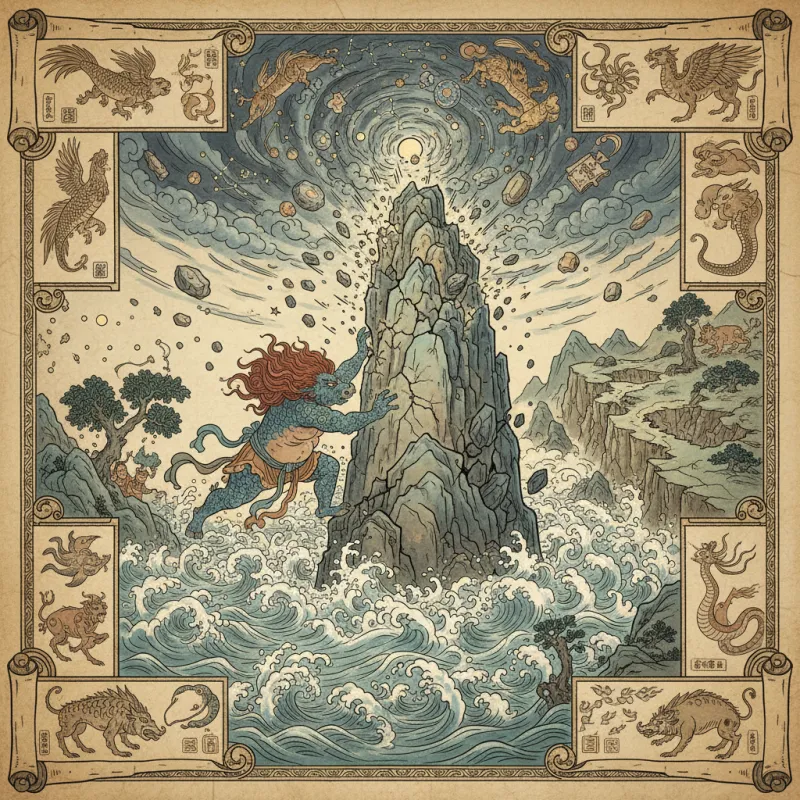
The sky cracked like an eggshell, and it was all because someone couldn't handle losing.
This isn't hyperbole. In Chinese mythology, the literal architecture of the cosmos — the pillars holding heaven above earth — shattered because a defeated god threw the ultimate rage-quit. Gonggong (共工, Gòng Gōng), the water deity with a serpent's body and human face, lost a battle for cosmic supremacy and decided that if he couldn't rule the universe, he'd break it instead. He rammed his head into Mount Buzhou (不周山, Bù Zhōu Shān), the northwestern pillar of heaven, and brought the whole structure down.
The result? The sky tilted northwest. The earth lurched southeast. Rivers began flowing east. Stars drifted toward the northern horizon. Floods consumed the land. One tantrum, and the fundamental geometry of existence changed forever.
What makes this myth extraordinary isn't just its cosmic scale — it's that this ancient story, recorded as early as the Warring States period (475-221 BCE), accurately describes real astronomical and geographical phenomena that ancient Chinese observers could see with their own eyes. The myth doesn't just explain why things are broken. It explains why they're broken in precisely the way they are.
The Battle That Broke the World
The Huainanzi (淮南子, Huái Nán Zǐ), compiled around 139 BCE, gives us the most complete version of the story. Gonggong and Zhuanxu (颛顼, Zhuān Xū) — sometimes replaced by the fire god Zhurong (祝融, Zhù Róng) in later versions — fought for control of the cosmos. The texts don't elaborate much on the battle itself, which is frustrating because I'd love to know what a fight between primordial elemental gods actually looked like. Water versus fire? Water versus earth? The sources are maddeningly vague.
What they're not vague about is the aftermath. Gonggong lost. And in his fury, he didn't retreat or accept defeat. He headbutted Mount Buzhou so hard that the pillar snapped.
The cosmology here is crucial. Ancient Chinese thought conceived of the sky as a dome or canopy supported by pillars at the cardinal directions, with Mount Buzhou as the northwestern support. This wasn't metaphorical architecture — this was how educated people in the Han dynasty and earlier actually imagined the structure of the universe. When Gonggong broke the pillar, he didn't damage a symbol. He destroyed load-bearing infrastructure.
The Liezi (列子, Liè Zǐ) adds a detail that makes the catastrophe even more visceral: when the pillar broke, the "cords of earth" snapped too. Heaven and earth, which had been bound together in a stable configuration, suddenly came unmoored. The sky sagged. The earth buckled. And everything that had been level and balanced went crooked.
The Goddess Who Patched the Sky
Enter Nüwa (女娲, Nǚ Wā), the creator goddess who'd already made humanity from yellow clay. Now she had to save her creation from drowning.
The Huainanzi describes her solution with remarkable specificity. She smelted five-colored stones to patch the broken sky. She killed a giant black turtle and used its four legs as replacement pillars. She gathered reed ash to dam the floodwaters. She slew a dragon in the province of Ji (冀州, Jì Zhōu) to save the people there.
This is emergency cosmic engineering on an unimaginable scale. Nüwa isn't performing magic — she's doing construction work with mythological materials. The five-colored stones suggest the five elements (wuxing, 五行) of Chinese cosmology: wood, fire, earth, metal, and water. She's not just patching a hole; she's restoring elemental balance to a universe knocked out of equilibrium.
But here's what's fascinating: she doesn't fix everything. The Huainanzi explicitly states that even after Nüwa's repairs, "the sky still tilts to the northwest, so the sun, moon, and stars drift in that direction; the earth is still lower in the southeast, so water and silt flow that way."
The repair job was good enough to prevent total collapse, but the damage was permanent. The universe still bears the scars of Gonggong's tantrum. This is a creation myth that acknowledges imperfection, that builds brokenness into the fundamental structure of reality. The world we live in isn't pristine — it's a patched-up emergency repair, and you can still see the cracks.
Why Rivers Flow East (And Why This Matters)
Here's where the myth becomes genuinely remarkable: it's not just a story. It's an explanation for observable phenomena that ancient Chinese scholars could verify.
Stand anywhere in China and look at the major rivers. The Yellow River (黄河, Huáng Hé), the Yangtze (长江, Cháng Jiāng), the Huai (淮河, Huái Hé) — they all flow generally eastward toward the Pacific. The myth explains this as a consequence of the earth tilting southeast after Gonggong's destruction of Mount Buzhou. Water flows downhill, and the "downhill" direction is now permanently skewed toward the southeast.
Similarly, if you track the celestial pole — the point in the sky around which all stars appear to rotate — it's not directly overhead anywhere in China. It's tilted toward the north. The myth explains this as the sky sagging northwest after the pillar broke. The stars "drift" in that direction because the entire celestial dome is now crooked.
This is proto-scientific thinking embedded in mythological narrative. Ancient Chinese astronomers and geographers observed these patterns and needed explanations. The Gonggong myth provides a unified theory: one catastrophic event explains both the hydrological and astronomical anomalies. It's wrong, obviously — we now know about Earth's axial tilt, gravity, and plate tectonics — but it's wrong in an intellectually sophisticated way. It's attempting to account for real data.
The Shanhaijing (山海经, Shān Hǎi Jīng), that bizarre catalog of mythical geography, mentions Mount Buzhou in its descriptions of the western regions, placing it in the far northwest beyond the known world. Later commentators tried to identify it with real mountains — the Kunlun range, the Pamirs, even the Himalayas. They were trying to locate the myth in physical space, to find the actual broken pillar. This impulse to ground mythology in geography is characteristic of Chinese mythological thinking, which rarely separates the supernatural from the natural world entirely.
Gonggong: Villain or Victim?
Let's talk about Gonggong himself, because his characterization is more complex than "angry loser breaks universe."
In some versions, he's a straightforward villain — a chaos god who opposes cosmic order and deserves his defeat. But other texts paint him more sympathetically. The Guoyu (国语, Guó Yǔ), a historical text from the 4th century BCE, describes Gonggong as a descendant of the Flame Emperor (炎帝, Yán Dì) who "desired to regulate the waters" but "obstructed the hundred rivers" and caused floods. He's not evil here — he's incompetent, a well-meaning administrator whose water management projects went catastrophically wrong.
This version makes the pillar-breaking incident less about rage and more about despair. He failed at his cosmic duty, was defeated and humiliated, and in his shame destroyed the very structure he was supposed to maintain. It's almost tragic.
The Shanhaijing describes Gonggong's minister, Xiangliu (相柳, Xiāng Liǔ), as a nine-headed serpent who ate from nine mountains simultaneously and whose vomit created foul-smelling swamps. When Yu the Great (大禹, Dà Yǔ) — the legendary flood-controller who appears in Nüwa Creates Humanity — finally killed Xiangliu, the creature's blood was so toxic that nothing would grow where it spilled. Yu had to dam the area and build a platform for the gods to live on. This detail suggests that Gonggong's administration was fundamentally corrupt, that his water management wasn't just incompetent but actively poisonous.
So which is he? The angry god who breaks the world out of spite? The failed administrator who destroys what he couldn't control? The chaos deity who opposes cosmic order? Chinese mythology doesn't pick one answer. It holds all these versions simultaneously, letting different texts and different eras emphasize different aspects of his character.
The Cosmic Repair and Its Limits
Nüwa's repair work deserves more attention than it usually gets. The image of a goddess smelting stones to patch the sky has become iconic in Chinese culture — it's referenced in everything from classical poetry to modern fantasy novels. But the specific details reveal a lot about ancient Chinese cosmological thinking.
The five-colored stones correspond to the five elements and the five directions (including center). By using all five colors, Nüwa isn't just plugging a hole — she's restoring the elemental balance that Gonggong disrupted. The black turtle whose legs become pillars is significant too. Turtles in Chinese mythology represent stability, longevity, and the connection between heaven and earth. The creature's shell is round like heaven; its belly is flat like earth. Using a turtle's legs as cosmic pillars isn't random — it's symbolically appropriate.
But the repair is explicitly incomplete. The Huainanzi doesn't hide this fact; it emphasizes it. The world after Nüwa's intervention is functional but flawed. The sky still tilts. The earth still slopes. The rivers still flow wrong. The stars still drift.
This is philosophically interesting. Many creation myths describe a perfect world that becomes corrupted — the Garden of Eden, the Golden Age. The Gonggong myth does the opposite. It describes a broken world that gets partially fixed. We don't live in a fallen paradise. We live in a repaired disaster zone, and the repairs are holding but imperfect.
This might explain why Chinese mythology is so comfortable with ongoing cosmic maintenance. The world isn't a finished creation that runs on its own. It's a damaged structure that requires constant attention. When floods come, you need heroes like Yu the Great to control them. When droughts strike, you need rain-makers and dragon-summoners. The universe isn't self-sustaining — it's a fixer-upper that humanity inherited from the gods.
Scientific Echoes in Ancient Myth
Modern scholars have noted the remarkable correspondence between the Gonggong myth and actual geological and astronomical facts. China's major rivers do flow east and southeast. The celestial pole is tilted. The myth gets these details right.
Some researchers have speculated about whether the myth preserves folk memory of actual catastrophic events — massive floods, earthquakes, or meteor impacts that ancient populations experienced and tried to explain. The problem with this theory is timing. The myth appears in texts from the Warring States period and Han dynasty, but it clearly draws on much older oral traditions. How far back does it go? We don't know.
What we can say is that the myth demonstrates sophisticated observational skills. Someone noticed that rivers flow east. Someone tracked the movement of stars and realized the celestial pole is offset. Someone connected these two observations and created a unified explanation. That's not primitive thinking — that's the beginning of scientific reasoning, wrapped in mythological narrative.
The myth also reveals ancient Chinese assumptions about causation. In Western mythology, natural phenomena often result from divine will or punishment — Zeus throws lightning bolts because he's angry. In the Gonggong myth, natural phenomena result from structural damage to the universe. The rivers flow east not because a god commands it, but because the ground is tilted. The stars drift north not because they're following divine orders, but because the sky is crooked. It's a more mechanistic, almost engineering-based view of how the cosmos works.
This mechanistic thinking appears throughout Chinese mythology. When Gun (鲧, Gǔn), Yu's father, tries to control the floods, he steals magical soil that expands infinitely. It's not a prayer or a sacrifice — it's a technology, a tool with specific properties. When Yu succeeds where his father failed, he doesn't pray harder or make better offerings. He digs channels and builds dams. Chinese myths are full of gods and heroes who solve problems through engineering rather than magic.
Living in a Broken Universe
The Gonggong myth has had remarkable staying power in Chinese culture. It appears in classical poetry, philosophical texts, and historical commentaries. The phrase "Gonggong touched Buzhou" (共工触不周, Gòng Gōng chù Bù Zhōu) became a literary shorthand for catastrophic destruction caused by rage or pride.
The Tang dynasty poet Li Bai (李白, Lǐ Bái) referenced the myth in his poem "The Road to Shu is Hard" (蜀道难, Shǔ Dào Nán), describing mountains so tall they seem to prop up the sky like the pillars of heaven. The Song dynasty philosopher Zhu Xi (朱熹, Zhū Xī) discussed the myth in his commentaries, trying to rationalize it within his neo-Confucian cosmology. Even the 16th-century novel Journey to the West (西游记, Xī Yóu Jì) references Nüwa's five-colored stones — the protagonist Sun Wukong (孙悟空, Sūn Wù Kōng) was born from a stone that was supposedly left over from Nüwa's sky-patching project.
In modern times, the myth has been adapted into countless fantasy novels, video games, and films. The image of Nüwa smelting stones to repair the sky has become a symbol of feminine power and creative problem-solving. Gonggong himself appears as a villain in some adaptations, a tragic figure in others, and occasionally as a misunderstood rebel against cosmic tyranny.
What makes the myth endure, I think, is its fundamental honesty about the world's imperfection. We don't live in a pristine creation. We live in a universe that's been broken and patched back together, and you can still see where the cracks were. The sky tilts. The rivers flow wrong. The stars drift. And we make do with what we have, in a cosmos that's functional but flawed, held together by emergency repairs that were never meant to be permanent.
That's not a comforting message, exactly. But it's an honest one. And in its own way, it's more hopeful than myths of perfect creation and inevitable fall. If the world is already broken, then we're not responsible for breaking it. We're just responsible for keeping the repairs intact, for maintaining the patches, for making sure the pillars hold for one more generation.
Gonggong broke the pillar. Nüwa fixed it as best she could. And we're still here, living in the crooked universe they left us, watching the rivers flow east and the stars drift north, in a world that's damaged but not destroyed, broken but not beyond repair.
Related Reading
- The Ten Suns: When the Sky Caught Fire
- Creation Myths of the Shanhaijing: How the World Was Made (Multiple Times)
- Pangu and the Cosmic Egg: Chinese Creation Story
- Discovering the Enigmatic Hybrid Creatures of Shanhaijing
- Sacred Objects of Chinese Mythology: Seals, Mirrors, and Cauldrons — Shanhai Perspective
- Enigmatic Birds of the Shanhaijing: Myths, Legends, and Significance