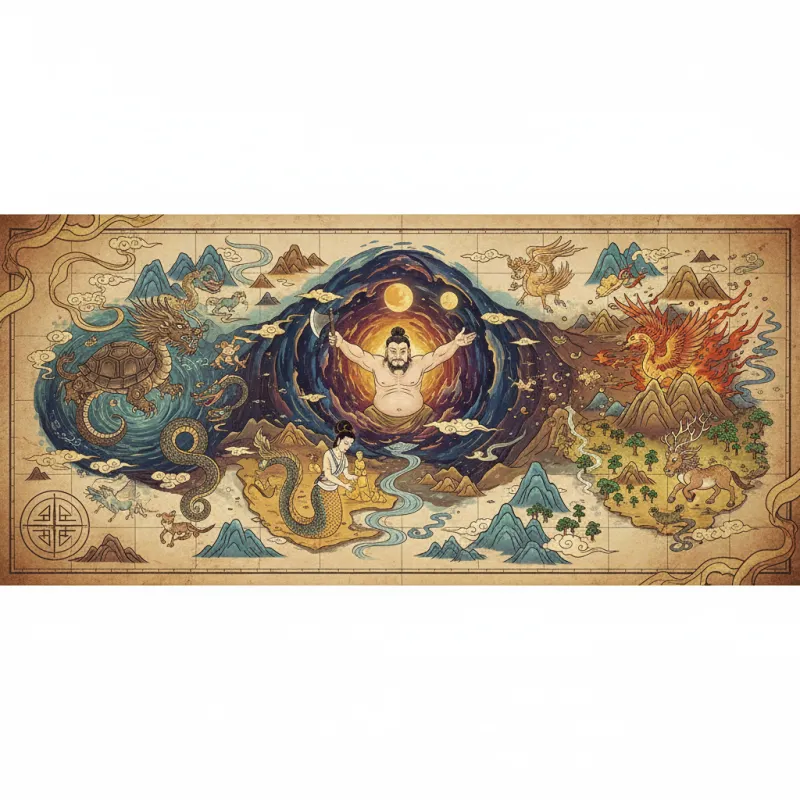
The universe began as an egg. Not a metaphorical egg, not a poetic egg — an actual cosmic egg, floating in primordial chaos. Inside it, a hairy giant named Pangu (盘古, Pángǔ) slept for eighteen thousand years. When he finally woke up, he was understandably cranky. He grabbed an axe and split the egg in half. That's how the world began. Or rather, that's one way the world began.
The Problem with Asking "How Did It All Start?"
Western readers often approach Chinese mythology expecting a Genesis — one authoritative account that explains everything. They won't find it. The Shanhaijing (山海经, Shānhǎijīng, Classic of Mountains and Seas) and related texts present multiple creation stories that contradict each other cheerfully and without apology. Pangu splits the cosmic egg. Nüwa molds humans from yellow clay. Fuxi and Nüwa are both creators and the first married couple. The goddess Xiwangmu rules from her mountain palace while the world takes shape around her.
This isn't confusion. It's sophistication. Different questions demand different answers. How did the physical universe form? Ask Pangu. How did humans appear? Ask Nüwa. How did civilization begin? Ask Fuxi. The Chinese mythological tradition treats creation not as a single event but as a series of transformations, each requiring its own story.
Pangu: The Giant Who Became Everything
The Pangu myth appears relatively late in Chinese literature — the earliest surviving version comes from the third century CE, in Xu Zheng's Sanwu Liji (三五历记, Three and Five Historical Records). This lateness has led some scholars to suggest foreign influence, possibly from Indian cosmic egg myths. But the story took root deeply in Chinese imagination.
After Pangu split the cosmic egg, the light, pure yang (阳, yáng) energy rose to form heaven. The heavy, turbid yin (阴, yīn) energy sank to form earth. Pangu stood between them, growing ten feet taller each day for another eighteen thousand years, pushing heaven and earth apart until they reached their proper distance. When his work was done, he died. His body became the world: his breath became wind and clouds, his voice became thunder, his left eye became the sun, his right eye became the moon. His limbs became the four cardinal directions and the five sacred mountains. His blood became rivers, his muscles became farmland, his hair became stars, his skin and body hair became plants and trees. Even his sweat became rain and dew.
This is creation through sacrifice and transformation. Pangu doesn't command the world into existence — he becomes it. Every mountain, every river, every gust of wind contains his substance. It's a profoundly materialist creation myth, one that makes the sacred and the physical identical.
Nüwa: The Goddess Who Got Her Hands Dirty
While Pangu created the physical universe, Nüwa (女娲, Nǚwā) created humanity — and she did it twice, using two different methods that produced two different classes of people.
First, she carefully molded humans from yellow clay beside the river, shaping each one individually with her hands. These handcrafted humans became the nobles and aristocrats. But the work was slow and tedious. Nüwa grew impatient. She dipped a rope in mud and swung it around, flinging droplets everywhere. Where each droplet landed, a human appeared. These mass-produced humans became the common people.
This origin story does something remarkable: it explains social hierarchy while simultaneously undermining it. Yes, nobles are handcrafted and commoners are mud-splatter. But both are made of the same material by the same goddess using the same river mud. The difference is one of technique, not essence. It's a creation myth that acknowledges class while refusing to make it cosmically absolute.
Nüwa appears throughout the Shanhaijing and related texts, but her most famous deed comes later: repairing the sky after the god Gonggong (共工, Gònggōng) damaged it in a fit of rage. She smelted five-colored stones to patch the hole, cut off the legs of a giant turtle to prop up the corners of heaven, and killed a black dragon to save the people. Creation, in Nüwa's hands, is an ongoing project requiring constant maintenance and repair.
Fuxi and the Invention of Civilization
If Pangu created the physical world and Nüwa created humans, Fuxi (伏羲, Fúxī) created civilization. He taught humans to hunt, fish, and domesticate animals. He invented the eight trigrams (八卦, bāguà) that became the foundation of the Yijing (易经, Book of Changes). He established marriage customs and family structures. Some texts identify him as Nüwa's brother; others call him her husband. In some versions, they're depicted as intertwined serpents with human heads, their tails wrapped together — a powerful image of the complementary forces that generate civilization.
The Shanhaijing mentions Fuxi only briefly, but later texts expand his role considerably. What's significant is that his creation is cultural rather than physical. He doesn't make the world or the people — he makes the systems that allow people to live together in organized society. This is creation as education, as the transmission of knowledge and custom.
The Goddess Who Was Already There
Here's where things get interesting. While Pangu, Nüwa, and Fuxi are creating everything, the Queen Mother of the West, Xiwangmu (西王母, Xīwángmǔ), is already ruling from her palace on Mount Kunlun. The Shanhaijing describes her in detail: she has a human face, a leopard's tail, tiger's teeth, and wild hair held by a sheng ornament. She commands the spirits of plague and punishment. She possesses the peaches of immortality.
Xiwangmu doesn't create anything. She simply is. Her presence in the mythology suggests something older than creation itself — a divine feminine power that exists independent of origin stories. While the other myths explain how things came to be, Xiwangmu represents what always was. She's the exception that proves the rule: not everything needs a creation story.
Multiple Creations, Multiple Truths
The Shanhaijing never attempts to reconcile these different creation accounts. Pangu's cosmic sacrifice, Nüwa's clay-molding, Fuxi's cultural innovations, and Xiwangmu's eternal presence coexist without hierarchy or synthesis. This isn't sloppy mythology — it's a different way of thinking about truth.
Each creation story addresses a different question. Pangu explains physical cosmology. Nüwa explains human origins and social structure. Fuxi explains the emergence of civilization. Xiwangmu reminds us that some things transcend origin entirely. Together, they form not a single narrative but a constellation of narratives, each illuminating a different aspect of existence.
This multiplicity reflects the nature of the Shanhaijing itself — a text compiled over centuries from different sources, preserving contradictions rather than erasing them. The world, these myths suggest, is too complex for a single story. Creation happened multiple times, in multiple ways, and continues happening still. Every time Nüwa patches the sky, every time humans learn a new skill, every time chaos transforms into order, the world is created again.
What This Means for Understanding Chinese Mythology
Western readers trained on monotheistic creation narratives often find Chinese mythology frustratingly inconsistent. Where's the authoritative version? Which story is correct? But these are the wrong questions. The Chinese mythological tradition doesn't privilege consistency over richness. It preserves multiple accounts because reality itself is multiple, contradictory, and irreducible to a single explanation.
This approach appears throughout Chinese philosophy and religion. Daoism, Confucianism, and Buddhism coexist in Chinese culture not because people can't decide which is true, but because each addresses different aspects of human experience. Similarly, the creation myths of the Shanhaijing coexist because each addresses different aspects of existence. The question isn't which story is right — it's which story answers the question you're asking.
When you read about the divine beings who shaped the cosmos, or explore the sacred mountains where creation took place, remember: you're not reading history. You're reading a culture's attempt to hold multiple truths simultaneously, to honor complexity rather than reduce it. The world wasn't made once. It was made many times, in many ways, and the making continues.
Related Reading
- Pangu and the Cosmic Egg: Chinese Creation Story
- The Ten Suns: When the Sky Caught Fire
- Gonggong Breaks the Pillar of Heaven
- Nuwa Creates Humanity from Clay
- Discovering the Enigmatic Hybrid Creatures of Shanhaijing
- Unearthing the Cursed Beings of Shanhaijing: Myths, Creatures, and Lands
- Exploring the Myths of Serpents in the Shanhaijing: Creatures of Power and Mystery