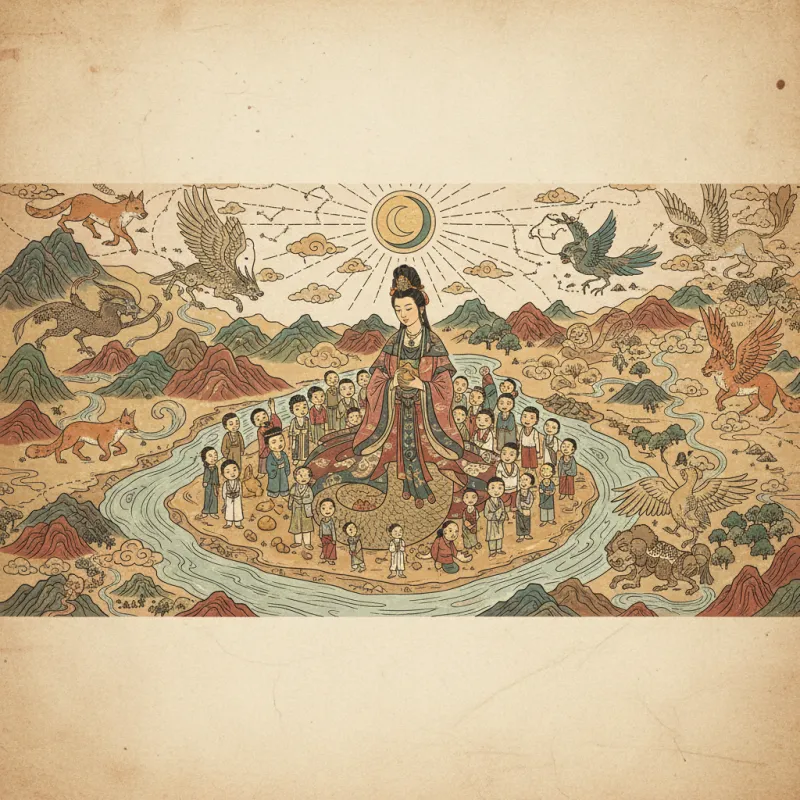
There's a detail in the Nuwa creation myth that most retellings gloss over, and it's the most interesting part of the whole story: the goddess got tired halfway through making humanity, and it shows.
Nuwa (女娲, Nǚ Wā) — the serpent-bodied creator deity who appears in texts from the Han dynasty onward — started her work with care. She knelt by the Yellow River, scooped up handfuls of yellow clay, and sculpted each human figure individually. She shaped their faces, their limbs, the curve of their spines. Each one was a work of art, imbued with her full attention and divine energy. These first humans were beautiful, strong, and intelligent.
Then she got bored.
Or tired. Or impatient. The classical texts aren't entirely clear on her emotional state, but the result is unmistakable: Nuwa dipped a rope into the mud and flicked it. The droplets that flew off became humans too — but rougher, less refined, less carefully made. According to the myth, the hand-sculpted humans became the nobility, while the rope-flung masses became commoners. It's a creation story that accidentally justifies social hierarchy, which is probably why it survived in the historical record while other versions didn't.
The Texts That Tell the Story
The Nuwa creation myth doesn't appear in the Shanhaijing (山海经, Shānhǎi Jīng) itself, which is odd considering how central she is to Chinese cosmology. The Classic of Mountains and Seas mentions her brother-husband Fuxi (伏羲, Fú Xī) but stays silent on Nuwa's creative activities. Instead, we find her story scattered across later texts.
The earliest substantial account comes from Fengsu Tongyi (风俗通义, Fēngsú Tōngyì), a Han dynasty work by Ying Shao written around 195 CE. This is where we get the rope detail — that moment of divine impatience that splits humanity into two classes. The Huainanzi (淮南子, Huáinánzǐ), compiled around 139 BCE, mentions Nuwa's role in repairing the sky after Gonggong damaged the cosmic pillars, but it's less interested in her as a creator of humans and more focused on her as a cosmic repairwoman.
What's fascinating is how the story evolved. Earlier references to Nuwa, like those in the Chu Ci (楚辞, Chǔ Cí) from the Warring States period, present her as a mysterious figure without explaining what she actually did. The creation narrative seems to have been elaborated over centuries, with each dynasty adding details that reflected its own social anxieties.
The Mechanics of Divine Creation
Let's talk about the clay itself. The texts specify yellow clay (黄土, huáng tǔ), which isn't arbitrary — this is the loess soil of the Yellow River valley, the cradle of Chinese civilization. Nuwa wasn't working with just any mud; she was using the same earth that real Chinese farmers worked, the soil that fed dynasties. There's a materiality to this myth that grounds it in geography.
The hand-sculpting process is described with surprising specificity in some versions. Nuwa would form the clay, breathe life into it, and set the figure down to walk. The breath detail connects her to other creation myths worldwide — the Hebrew God breathing life into Adam, the Egyptian god Khnum molding humans on a potter's wheel. But Nuwa's method is more intimate, more hands-on. She's not using tools; she's working with her fingers.
Then comes the rope technique. Some translations call it a vine or a cord, but the principle is the same: Nuwa found a shortcut. She was essentially mass-producing humans through divine automation. The droplets that flew off the rope were smaller, less detailed, less imbued with her direct attention. They still became living humans, but the quality difference was baked into the manufacturing process.
This is where the myth gets uncomfortable for modern readers. It's literally saying that some humans are better made than others, that inequality is cosmically ordained. The nobility didn't earn their status through merit or virtue — they were simply sculpted more carefully. The commoners weren't morally inferior; they were just made in bulk.
Social Hierarchy and Cosmic Order
The class distinction in the Nuwa myth reflects the rigid social stratification of imperial China, but it does something more interesting than just justifying inequality. It makes inequality seem inevitable, natural, part of the fabric of creation itself. This isn't a story about humans creating social classes; it's about social classes being written into the universe before humans even existed.
During the Han dynasty, when this version of the myth was being recorded, China was developing an increasingly complex bureaucratic system. The examination system wouldn't be fully established until the Sui and Tang dynasties, but the idea that some people were naturally suited to rule while others were suited to labor was already deeply embedded in Confucian thought. The Nuwa myth provided a cosmological backstory for this worldview.
But here's what's subversive about the myth: it also suggests that the difference between noble and commoner is arbitrary. Nuwa didn't make nobles because they deserved it or because they were morally superior. She made them first because she started with the hand-sculpting method, and she switched to the rope method because she got tired. The nobles are better made, but only because of timing and the goddess's energy levels. There's no cosmic justice here, just cosmic convenience.
Some later interpretations tried to soften this by suggesting that Nuwa made all humans equal and that social distinctions arose later through human choices. But the original Han dynasty version is blunter: inequality is built into the creation process, and it's nobody's fault. It just is.
Nuwa's Serpent Body and Divine Femininity
Most depictions of Nuwa show her with a human upper body and a serpent's tail, often intertwined with Fuxi's tail in a double helix pattern that eerily resembles DNA. This serpent form connects her to earth, to water, to the primal forces of nature. She's not a distant sky god; she's down in the mud, literally getting her hands dirty.
The fact that a female deity is responsible for creating humanity is significant in a patriarchal culture. Nuwa's creative power is explicitly maternal — she's making children, populating an empty world. But she's not a passive fertility goddess; she's an active creator, an artist, an engineer. She doesn't just give birth to humans; she manufactures them.
Her relationship with Fuxi is complicated in the myths. In some versions, they're siblings who become spouses after a great flood destroys humanity, and they must repopulate the world. In others, they're the original divine couple, the yin and yang of creation. The Shanhaijing tradition tends to emphasize Fuxi more than Nuwa, possibly because male scholars were more comfortable with a male creator figure. But Nuwa's story persisted because it answered a question that Fuxi's story didn't: where did all these different kinds of people come from?
The Rope as Technology
Let's focus on that rope for a moment, because it's doing a lot of work in this myth. The rope represents technology, efficiency, scale. Nuwa starts with artisanal production — each human is a unique, handcrafted item. Then she innovates. She finds a way to produce humans faster, to meet demand, to fill the earth with people.
This is essentially a story about industrialization, written thousands of years before the Industrial Revolution. It's about the trade-offs that come with mass production: you can make more, but each individual item is less refined. You gain quantity at the expense of quality. The rope is Nuwa's assembly line.
What's remarkable is that the myth doesn't condemn this innovation. Nuwa isn't punished for using the rope method. The rope-made humans aren't defective or cursed; they're just different. The myth accepts that both methods are valid, that both kinds of humans have a place in the world. It's a surprisingly pragmatic view of inequality — not celebrating it, but acknowledging it as a consequence of scale.
In some folk versions of the story, Nuwa eventually stops creating humans altogether and instead gives them the ability to reproduce themselves. This is the ultimate automation: she outsources the manufacturing process to the products themselves. Humans become self-replicating, and Nuwa can move on to other projects, like repairing the sky when Gonggong smashes the cosmic pillars in his rage.
Comparing Creation Methods Across Cultures
The Nuwa myth invites comparison with other creation stories, and the differences are revealing. In the Abrahamic tradition, God creates Adam from dust and Eve from Adam's rib — a single, deliberate act of creation. There's no mass production, no shortcuts. Every human descends from this original pair, which means all humans are theoretically equal in their origin, even if they're not equal in practice.
Greek mythology has Prometheus shaping humans from clay, similar to Nuwa, but the Greek version emphasizes Prometheus's suffering for helping humanity rather than the manufacturing process itself. The focus is on the relationship between creator and created, not on the variations in quality.
The Nuwa myth is unusual in explicitly encoding inequality into the creation process. Most creation myths either present humans as uniformly created or explain inequality as a result of later events — the Fall, the Flood, the actions of trickster gods. Nuwa's story says: no, inequality was there from the beginning, built into the method of production.
This might reflect something distinctive about Chinese philosophical thought. Confucianism accepts hierarchy as natural and necessary for social order. Daoism sees inequality as part of the natural flow of things, the interplay of yin and yang. The Nuwa myth fits comfortably into both frameworks. It's not trying to explain inequality away or justify it morally; it's simply describing it as a feature of existence.
The Myth's Evolution and Modern Interpretations
The Nuwa creation story has been retold countless times over the centuries, and each retelling reflects the concerns of its era. During the Tang dynasty, when Buddhism was influential, some versions emphasized Nuwa's compassion and her desire to fill the world with life. During the Ming and Qing dynasties, when neo-Confucianism dominated, the story was often used to reinforce traditional social hierarchies.
In modern China, the myth has been reinterpreted in more egalitarian terms. Some contemporary retellings downplay or eliminate the class distinction entirely, presenting all humans as equally made. Others keep the rope detail but reframe it as a story about diversity rather than hierarchy — the hand-sculpted and rope-made humans are different but not unequal.
The myth has also been analyzed through feminist lenses, with scholars noting that Nuwa is one of the few female creator deities in world mythology who acts independently, without a male counterpart directing her work. She decides to create humans, she chooses her methods, she determines when to stop. Her creative power is absolute.
What's lost in many modern retellings is the myth's original ambiguity about inequality. The Han dynasty version doesn't celebrate the class system, but it doesn't condemn it either. It presents inequality as a fact of existence, something that emerged from the practical constraints of creation. There's a strange honesty in this that more moralistic versions lack.
Why the Story Still Matters
The Nuwa creation myth endures because it grapples with a fundamental human question: why are we different from each other? Why do some people seem to have advantages from birth while others struggle? The myth's answer — that these differences were literally built into us at creation — is both disturbing and oddly comforting. Disturbing because it suggests inequality is inescapable, comforting because it removes moral judgment from the equation.
In a world obsessed with meritocracy and self-made success, the Nuwa myth offers a different perspective. It says: maybe your starting point wasn't your choice. Maybe you were hand-sculpted, maybe you were rope-flung, and either way, it's not about what you deserved. It's about when the goddess got tired.
This doesn't mean we should accept inequality as inevitable in modern society. But it does mean we should recognize that the impulse to explain and justify inequality is ancient, that humans have been wrestling with these questions for millennia. The Nuwa myth is one answer among many, and it's more honest than most about the arbitrary nature of advantage.
The image of Nuwa with her rope, flicking mud into the air, creating humans in batches — it's both absurd and profound. It's a goddess doing mass production, a divine being cutting corners, a creator who gets tired. It's a myth that acknowledges the gap between ideal and reality, between what we wish creation was like and what it might actually have been. And in that gap, there's a kind of truth that more polished myths can't quite capture.
Related Reading
- Gonggong Breaks the Pillar of Heaven
- Pangu and the Cosmic Egg: Chinese Creation Story
- Creation Myths of the Shanhaijing: How the World Was Made (Multiple Times)
- The Ten Suns: When the Sky Caught Fire
- Discovering the Enigmatic Hybrid Creatures of Shanhaijing
- Strange Nations of the Shanhai Jing: A Catalog of Impossible Peoples
- The Ruomu Tree: Where the Suns Set