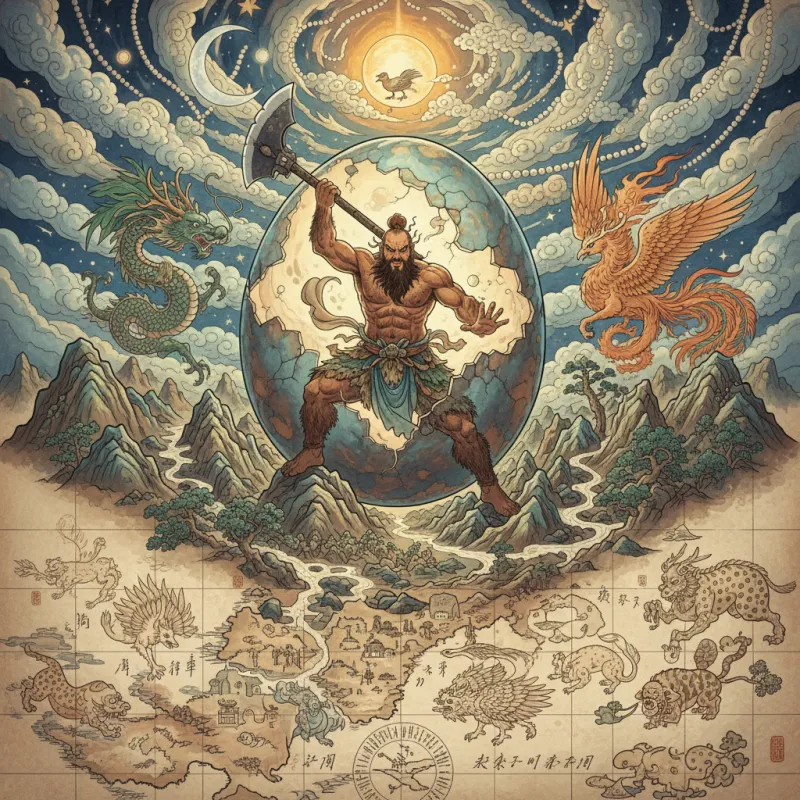
Pangu and the Creation of the World
The Primordial Giant Who Shaped the Cosmos
In the vast tapestry of Chinese mythology, few figures loom as large—quite literally—as Pangu (盤古, Pángǔ), the cosmic giant whose sacrifice transformed chaos into the ordered universe we inhabit today. While the Shanhai Jing (山海經, Shānhǎi Jīng, Classic of Mountains and Seas) primarily catalogs the geography and creatures of the ancient world, the Pangu creation myth represents one of Chinese civilization's most fundamental cosmological narratives, explaining not just how the world came to be, but why it possesses the structure and characteristics we observe.
The Cosmic Egg and the Birth of Pangu
Before there was heaven and earth, before mountains rose and rivers flowed, there existed only hundun (混沌, hùndùn)—primordial chaos. This wasn't mere emptiness or void, but rather an undifferentiated state where all elements existed together in a swirling, formless mass. Ancient texts describe this chaos as resembling a giant egg, containing within it all the potential of creation, all the qi (氣, qì, vital energy) that would eventually animate the cosmos.
Within this cosmic egg, Pangu slumbered for eighteen thousand years. During this immense gestation period, the forces of yin (陰, yīn) and yang (陽, yáng)—the fundamental complementary principles of darkness and light, passivity and activity, earth and heaven—began their slow separation. When Pangu finally awakened, he found himself trapped within the confines of the egg, surrounded by the oppressive darkness of undifferentiated chaos.
The giant's response was immediate and violent. Seizing a cosmic axe—some versions say he used his bare hands—Pangu struck at the shell of chaos with tremendous force. The egg shattered with a sound that echoed through the nascent universe, and for the first time, separation occurred. The lighter, purer elements—the yang forces—rose upward to form tian (天, tiān, heaven or sky). The heavier, turbid elements—the yin forces—sank downward to become di (地, dì, earth).
The Eighteen Thousand Year Vigil
But Pangu's work had only just begun. The newly separated heaven and earth, still unstable and drawn to their original unified state, threatened to collapse back together. Understanding that the cosmos required a pillar to maintain this crucial separation, Pangu positioned himself between heaven and earth, becoming the axis mundi—the cosmic pillar that would hold the universe in its proper configuration.
Each day, heaven rose ten feet higher. Each day, earth grew ten feet thicker. And each day, Pangu himself grew ten feet taller, maintaining the separation through the sheer force of his expanding body. This process continued for another eighteen thousand years, a period that mirrors the eighteen thousand years of his gestation, creating a symmetry that ancient Chinese philosophers found deeply meaningful. By the time this growth ceased, heaven and earth were separated by ninety thousand li (里, lǐ, a traditional Chinese unit of distance), and Pangu had become a giant of unimaginable proportions.
During this period, Pangu didn't merely grow—he actively shaped the cosmos. His breath became the wind and clouds. When he spoke, his voice created thunder. His left eye became the sun, bringing light and warmth to the world, while his right eye transformed into the moon, providing gentle illumination during the night. This detail carries profound symbolic weight: in Chinese cosmology, the left side is associated with yang and the sun, while the right side connects to yin and the moon, demonstrating how even Pangu's body reflected the fundamental dualities of existence.
The Ultimate Sacrifice: Pangu's Transformation
After eighteen thousand years of holding heaven and earth apart, Pangu's strength finally waned. The cosmic giant, having fulfilled his purpose, collapsed and died. But in death, Pangu achieved his greatest act of creation. Rather than simply ceasing to exist, his body underwent a magnificent transformation, with each part becoming a fundamental feature of the natural world.
His breath, which had created wind and clouds during his life, dispersed to become the atmosphere itself—the very air that all living creatures would breathe. His voice, which had thundered across the cosmos, became the rumbling of storms that would water the earth and demonstrate heaven's power. His flesh transformed into the soil, the rich earth that would nourish countless generations of plants and sustain all terrestrial life.
Pangu's bones, the framework that had supported his cosmic body, hardened into rocks and minerals, forming the geological foundation of the world. His blood flowed outward to become the rivers and seas, creating the waterways that would shape civilizations and enable trade. The Huanghe (黃河, Huánghé, Yellow River) and the Changjiang (長江, Chángjiāng, Yangtze River)—China's two great rivers—were said to flow with Pangu's vital essence.
His sinews and veins stretched across the landscape to become roads and paths, the natural routes that humans and animals would follow in their travels. His muscles formed the fertile fields and agricultural lands that would feed humanity. His skin and body hair transformed into grasses, flowers, and vegetation, covering the earth with a living carpet of green.
Perhaps most dramatically, his limbs became the wuyue (五嶽, wǔyuè, Five Great Mountains) that anchor Chinese sacred geography. His head formed Taishan (泰山, Tàishān) in the east, the most revered of all Chinese mountains. His feet became Huashan (華山, Huàshān) in the west, known for its precipitous peaks. His left arm transformed into Hengshan (衡山, Héngshān) in the south, while his right arm became the northern Hengshan (恆山, Héngshān, written with a different character). His belly formed Songshan (嵩山, Sōngshān) in the center, completing the sacred pentad that would become pilgrimage sites for countless generations.
The Parasites Become Humanity
One of the most intriguing—and humbling—aspects of the Pangu myth concerns the origin of humanity itself. According to some versions of the tale, the fleas and lice that had lived on Pangu's body were transformed by the wind and rain into the first human beings. This detail, far from being demeaning, actually carries profound philosophical implications about humanity's place in the cosmos.
We are not separate from nature but intimately connected to it, born from the very body of the cosmic creator. We are small in comparison to the vastness of creation, yet we are part of the sacred transformation that brought order to chaos. This origin story instills both humility—we are as parasites compared to the cosmic giant—and dignity—we are born from the divine substance of creation itself.
Other versions attribute human creation to Nüwa (女媧, Nǚwā), the goddess who molded people from yellow clay, but the Pangu version emphasizes the organic, natural emergence of humanity from the transformed body of the cosmos itself.
Philosophical and Cultural Significance
The Pangu myth operates on multiple levels of meaning within Chinese thought. On the cosmological level, it explains the fundamental structure of the universe—the separation of heaven and earth, the existence of natural features, and the origin of the elements. But it also encodes deeper philosophical principles that would influence Chinese thinking for millennia.
The concept of sacrifice (犧牲, xīshēng) stands at the heart of the myth. Pangu doesn't create the world through divine command or magical incantation, but through sustained effort and ultimate self-sacrifice. He literally gives his body to create the world, demonstrating that creation requires the transformation of the creator. This principle would resonate through Chinese culture, from the Confucian emphasis on self-cultivation and service to others, to the Daoist understanding of transformation and the cyclical nature of existence.
The myth also illustrates the principle of transformation (變化, biànhuà) that is central to Chinese cosmology. Nothing is static; everything is in a constant state of change and becoming. Pangu transforms from sleeper to awakener, from separator to pillar, from living giant to the substance of the world itself. This reflects the Daoist concept of wuwei (無為, wúwéi)—effortless action that flows with the natural order—as Pangu's transformation is not forced but natural, the inevitable culmination of his cosmic purpose.
Historical Development of the Myth
Interestingly, the Pangu myth doesn't appear in the earliest Chinese texts. The Shanhai Jing, compiled during the Warring States period and Han Dynasty (roughly 4th century BCE to 2nd century CE), doesn't mention Pangu at all. The earliest known reference appears in the Sanwu Liji (三五歷紀, Sānwǔ Lìjì, Historical Records of the Three Sovereigns and Five Emperors) by Xu Zheng (徐整, Xú Zhěng) during the Three Kingdoms period (220-280 CE).
This relatively late appearance has led scholars to debate the myth's origins. Some suggest it may have originated among the Miao (苗, Miáo) or Yao (瑤, Yáo) peoples of southern China before being incorporated into Han Chinese mythology. Others see influences from Buddhist cosmology, which entered China along the Silk Road. The cosmic egg motif, for instance, appears in Indian creation myths, suggesting possible cross-cultural exchange.
Regardless of its origins, the Pangu myth became firmly embedded in Chinese cultural consciousness, appearing in countless literary works, artistic representations, and philosophical discussions. It provided a creation narrative that complemented rather than contradicted other Chinese cosmological concepts, such as the Taiji (太極, Tàijí, Supreme Ultimate) and the Bagua (八卦, Bāguà, Eight Trigrams) of the Yijing (易經, Yìjīng, Book of Changes).
Pangu in the Context of World Mythology
When we place Pangu alongside creation myths from other cultures, fascinating parallels and contrasts emerge. Like the Norse giant Ymir, whose body also formed the world, Pangu represents the primordial being whose sacrifice enables creation. However, unlike many Western creation myths where a god creates the world through command or craft, Pangu's creation is organic and transformative—he becomes the world rather than making it.
This distinction reflects fundamental differences in Chinese philosophical thought. Where Western traditions often emphasize transcendence—God above and separate from creation—Chinese cosmology emphasizes immanence—the divine within and inseparable from the natural world. Pangu doesn't stand outside creation as its architect; he is creation, his very substance transformed into the mountains, rivers, and sky.
Legacy and Contemporary Relevance
The Pangu myth continues to resonate in contemporary Chinese culture. It appears in literature, film, video games, and popular culture, constantly reinterpreted for new generations. The image of the cosmic giant holding heaven and earth apart has become a powerful metaphor for perseverance, sacrifice, and the maintenance of order against chaos.
In environmental discourse, the myth takes on new meaning. Pangu's body becoming the natural world reminds us that we are not separate from nature but part of it, born from it, sustained by it. The destruction of mountains, pollution of rivers, and degradation of soil is, in this mythic framework, the desecration of Pangu's sacred body—a powerful metaphor for environmental stewardship.
The myth also speaks to questions of purpose and meaning. Pangu's eighteen thousand years of holding heaven and earth apart—a task that must have seemed endless and thankless—demonstrates that meaningful work often requires sustained effort without immediate reward. His ultimate transformation shows that our greatest contributions may come not from what we accomplish during our lives, but from what we leave behind.
Conclusion: The Eternal Giant
The Pangu creation myth stands as one of Chinese mythology's most powerful narratives, encoding within its dramatic imagery profound truths about the nature of existence, the relationship between humanity and the cosmos, and the transformative power of sacrifice. From the shattering of the cosmic egg to the final transformation of the giant's body into the features of the natural world, the myth traces a journey from chaos to order, from unity to diversity, from potential to actualization.
In Pangu, we see reflected the Chinese understanding of creation not as a single moment of divine command, but as an ongoing process of transformation and sacrifice. We see the principle that order requires effort to maintain, that separation and distinction are necessary for existence, and that the greatest acts of creation require the transformation of the creator.
As we walk upon the earth, gaze at the mountains, follow the rivers, and breathe the air, the Pangu myth invites us to remember that we move within the transformed body of the cosmic giant, that the world itself is sacred, and that we are intimately connected to the primordial act of creation that brought order from chaos and made existence possible.