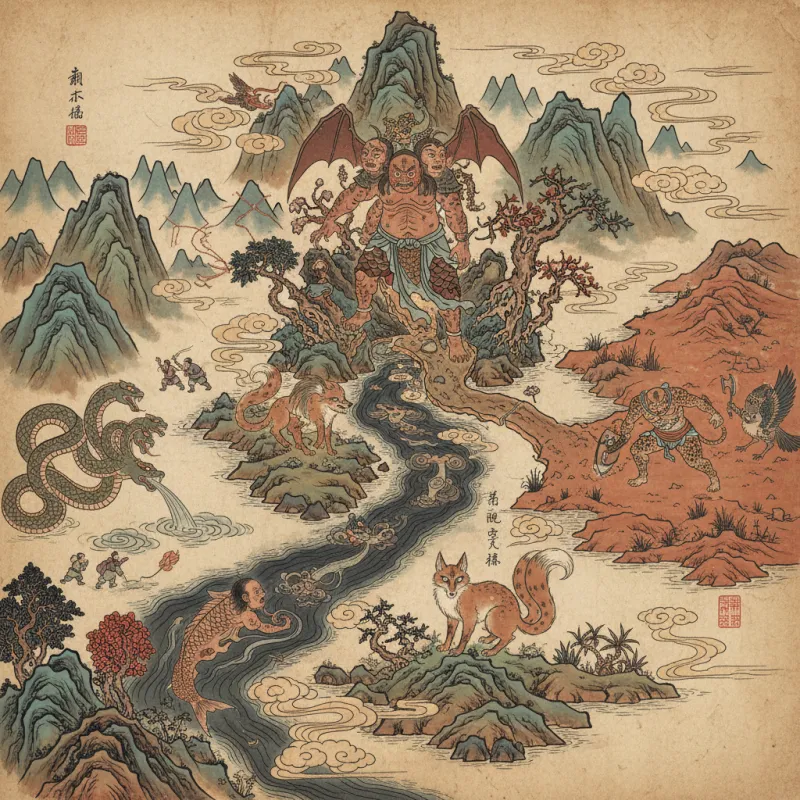
The nine-headed serpent Xiangliu (相柳, Xiāngliǔ) vomited poison across the land, and wherever its saliva touched, no crops would grow for generations. This wasn't just a monster story told to frighten children—it was recorded as geographical fact in the Shanhaijing (山海经, Shānhǎijīng), the "Classic of Mountains and Seas," where cursed beings weren't metaphors but actual inhabitants of the world's edges. These creatures didn't just threaten travelers; they corrupted the land itself, turning fertile valleys into wastelands and pure waters into toxic swamps.
When Geography Becomes Nightmare
The Shanhaijing, compiled between the 4th century BCE and early Han Dynasty, reads like a surveyor's handbook written during a fever dream. Its authors—likely multiple scribes working across centuries—catalogued mountains, rivers, and mineral deposits with bureaucratic precision, then casually mentioned that a particular peak was home to a creature with a human face and tiger's body that ate its own children. This wasn't considered unusual. The text treats cursed beings as natural features of the landscape, as matter-of-fact as noting which direction a river flows.
What makes these beings "cursed" isn't always their appearance or behavior—it's their fundamental wrongness, their violation of natural order. The Zhuyin (烛阴, Zhúyīn), a thousand-li-long serpent with a human face, doesn't hunt or kill. It simply exists, and its existence is the curse: when it opens its eyes, day comes; when it closes them, night falls. It doesn't eat, doesn't sleep, doesn't breathe—just watches. Ancient readers understood this creature represented something more disturbing than any predator: a being that shouldn't exist but does.
The Taxonomy of Corruption
The Shanhaijing categorizes its cursed beings with surprising specificity. There are creatures cursed by their nature (天生, tiānshēng), born wrong from the start. The Hundun (混沌, Hùndùn), described in the text as a faceless, six-legged yellow sack, represents primordial chaos that refuses to evolve. It has no eyes, no mouth, no nose—just undifferentiated flesh. When the well-meaning emperors Shu and Hu tried to "help" Hundun by drilling holes for sensory organs, it died. The message was clear: some beings are meant to remain incomplete, and trying to "fix" them only destroys them.
Then there are beings cursed by circumstance or punishment. The Xingtian (刑天, Xíngtiān), who fought the Yellow Emperor and lost his head, continued fighting with his nipples as eyes and his navel as a mouth. This wasn't resilience—it was a curse of eternal, futile rage. The Shanhaijing describes him dancing with his axe and shield on Changyang Mountain, forever reenacting a battle he already lost. Unlike heroic figures who transcended death, Xingtian became a monument to the impossibility of accepting defeat.
Lands That Remember
The cursed beings of Shanhaijing don't just inhabit the land—they transform it. The text describes the Qiongqi (穷奇, Qióngqí), a winged tiger that specifically hunts and devours virtuous people while protecting the wicked. But here's what makes it truly cursed: the regions where Qiongqi dwells become morally inverted. Good deeds bring misfortune, evil acts bring prosperity. The land itself becomes corrupted, creating zones where human ethics cease to function.
This geographical corruption appears throughout the text. After Xiangliu was finally killed by the hero Yu, its blood poisoned the earth so thoroughly that nothing would grow. Yu tried to dam the toxic land, but the dams kept collapsing. Finally, he built a platform for the emperors to use for sacrifices—turning cursed ground into sacred space through sheer bureaucratic determination. The Shanhaijing records this as historical fact, complete with the platform's location and dimensions.
The text describes the Country of the Feathered People (羽民国, Yǔmínguó), where inhabitants have bird-like features and can fly. This sounds whimsical until you read further: these people are described as having "long heads" and being unable to die properly. They exist in a state between life and death, neither fully alive nor able to rest. The land itself seems to trap them in this liminal state, suggesting that some territories in the Shanhaijing are cursed not by their inhabitants but by their fundamental nature.
The Bureaucracy of Monsters
What's striking about the Shanhaijing's approach to cursed beings is its administrative tone. Each entry typically follows a formula: location, physical description, behavior, and sometimes a note about what eating the creature might cure. The Taowu (梼杌, Táowù), a tiger-like creature with human face and boar's teeth, is described as "stubborn and ignorant, unable to be taught." It represents not just physical danger but intellectual corruption—the curse of willful stupidity.
This bureaucratic cataloguing suggests the text's compilers saw these beings as problems requiring documentation and management, not unlike flood control or bandit suppression. The Shanhaijing occasionally notes which cursed beings can be avoided, which must be fought, and which should simply be left alone. The Taotie (饕餮, Tāotiè), the infamous glutton with a body but no head below its mouth, appears on ancient bronze vessels as a warning. The text describes it as having "a human face and sheep's body, eyes under its armpits, tiger's teeth and human hands." Its curse is insatiable hunger—it eats everything, including eventually itself.
Echoes in Later Tradition
The cursed beings of Shanhaijing didn't stay confined to the ancient text. They evolved, migrated into other stories, and sometimes became protective spirits rather than threats. The Nian (年兽, Niánshòu), the New Year beast, likely derives from Shanhaijing creatures—a being whose curse is periodic, returning annually to devour and destroy until humans learned to frighten it away with noise and red color.
Later dynasties reinterpreted these beings through Confucian, Daoist, and Buddhist lenses. The Tang Dynasty scholar Guo Pu (276-324 CE) wrote extensive commentaries on the Shanhaijing, trying to rationalize its creatures as distorted accounts of real animals or as moral allegories. But this misses the point. The text's power lies in its refusal to explain. It presents cursed beings as facts requiring documentation, not interpretation.
The Ming Dynasty novel Journey to the West borrowed heavily from Shanhaijing's bestiary, but sanitized it. The demons Sun Wukong fights are obstacles to be overcome, not fundamental violations of natural order. They can be defeated, converted, or recruited. The truly cursed beings of Shanhaijing can't be redeemed because they aren't evil—they're wrong, existing in ways that reality shouldn't permit.
The Curse of Knowledge
Perhaps the deepest curse in the Shanhaijing isn't carried by any creature but by the text itself. It claims to describe the real world—not a fantasy realm or spiritual dimension, but actual mountains, rivers, and the beings that inhabit them. Early readers would have understood these descriptions as genuine geography, making the cursed beings not myths but neighbors, separated only by distance.
This creates a peculiar anxiety. If you travel far enough west, will you reach the land where the sun sets into the mouth of a cosmic serpent? If you dig deep enough, will you find the underground rivers where eyeless fish with human hands swim? The Shanhaijing suggests that cursed beings aren't safely contained in stories—they're out there, in unmapped territories, waiting.
Modern readers might dismiss this as primitive superstition, but the text's compilers were sophisticated enough to distinguish between observation and hearsay, often noting "it is said" or "according to reports" for secondhand information. They believed they were documenting reality, which means they believed the world contained fundamental wrongness—beings and places that violated natural law simply by existing.
The Shanhaijing never explains why these cursed beings exist or what purpose they serve. They simply are, catalogued with the same neutral tone used for describing mineral deposits or medicinal plants. This refusal to moralize or rationalize makes the text more unsettling than any horror story. It suggests that the universe contains curses as natural features, as permanent and unmovable as mountains, as inevitable as rivers flowing to the sea.
Related Reading
- Hundun: The Faceless Creature of Chaos
- Flood Myths: Noah vs Gun-Yu
- Unraveling the Mysteries of Shanhaijing: Mythical Creatures and Enigmatic Lands