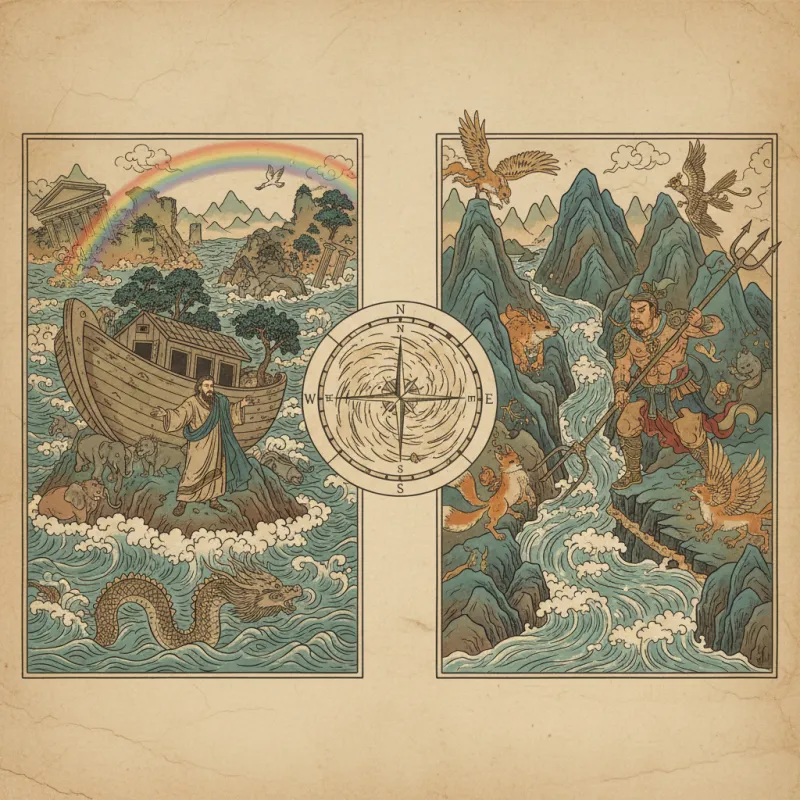
Every major civilization has a flood story, but only two have shaped the moral imagination of billions: the biblical account of Noah and the Chinese saga of Gun (鯀) and Yu (禹). One man builds a boat and waits for divine mercy. The other two wage a multi-generational war against the waters themselves, armed with stolen divine soil and an iron will to reshape the earth. The difference isn't just narrative flavor—it's a fundamental split in how humans conceive their relationship to catastrophe, authority, and the natural world.
Divine Wrath vs. Cosmic Imbalance
The Genesis flood arrives as punishment. God surveys humanity and finds it irredeemably corrupt—"every inclination of the thoughts of the human heart was only evil all the time" (Genesis 6:5). The solution is annihilation: forty days and nights of rain to scrub the earth clean, preserving only Noah's family and a breeding pair of each animal species. The flood is personal, deliberate, and moral. It's about sin and judgment.
The Chinese flood in the Shanhaijing (山海經, Classic of Mountains and Seas) and later texts like the Shujing (書經, Book of Documents) has no such moral dimension. The waters rise because the cosmic order has fractured. Some versions blame Gonggong (共工), the water deity who smashed Mount Buzhou in a fit of rage, tilting the earth and causing rivers to flow backward. Other accounts simply describe the flood as a natural disaster that lasted for generations, drowning fields and forcing people into the mountains. There's no divine anger here—just chaos that needs managing.
This distinction matters. In the biblical worldview, the flood is a reset button pressed by an omnipotent God. In the Chinese version, it's a problem to be solved through human ingenuity and persistence, even if that means defying heaven itself.
Obedience vs. Rebellion: Two Approaches to Salvation
Noah's role is fundamentally passive. God provides the blueprint for the ark—300 cubits long, 50 cubits wide, 30 cubits high, built from gopher wood and sealed with pitch. Noah follows instructions. He gathers animals. He waits. When the dove returns with an olive branch, he knows the ordeal is over. His virtue lies in his obedience, his willingness to trust divine wisdom even when it seems insane to build a massive boat on dry land.
Gun takes the opposite approach. Appointed by Emperor Yao (堯) to control the floods, Gun doesn't pray or build an ark. He steals xirang (息壤), a magical self-expanding soil from heaven, and uses it to build dams and barriers against the rising waters. This is cosmic theft—Gun literally robs the divine realm to save humanity. The Shanhaijing describes xirang as soil that "grows of itself" and "never diminishes," a kind of perpetual matter that could theoretically hold back infinite water.
It doesn't work. After nine years of failure, the floods continue. The Heavenly Emperor, furious at Gun's theft and incompetence, orders his execution. Depending on which text you read, Gun is either killed on Feather Mountain (羽山) or transforms into a yellow bear or a three-legged turtle. But here's the crucial part: from Gun's corpse emerges his son Yu, who will succeed where his father failed.
Yu the Great (大禹, Da Yu) inherits his father's mission but changes tactics. Instead of blocking the water, he channels it. For thirteen years, Yu travels across China, dredging rivers, cutting through mountains, creating irrigation systems. The Shujing claims he passed his own house three times during this period and never stopped to visit his family. He works so hard that the hair wears off his legs and he develops a permanent limp—the famous "Yu step" (禹步) that later becomes a ritual dance in Daoist ceremonies.
Yu succeeds not through divine favor but through relentless engineering and personal sacrifice. His reward? He becomes the founder of the Xia Dynasty (夏朝), China's first hereditary dynasty. The flood-tamer becomes emperor.
The Ark vs. The Nine Provinces: Preservation vs. Transformation
Noah's ark is a vessel of preservation. Its purpose is to keep a remnant of the old world alive until the waters recede and everything can return to normal—or rather, to a purified version of normal. The ark doesn't fight the flood; it rides it out. When Noah finally disembarks on Mount Ararat, God makes a covenant never to flood the earth again, sealing the promise with a rainbow. The message is clear: humans should not expect to control nature. They should trust God to manage it.
Yu's solution is radically different. He doesn't preserve the old world—he creates a new one. The Yugong (禹貢, Tribute of Yu) chapter in the Shujing describes how Yu divides the empire into nine provinces (九州, jiuzhou), each with its own geography, resources, and tribute obligations. He doesn't just drain the floodwaters; he reorganizes the entire landscape into a rational, administrable system. Mountains are categorized. Rivers are mapped. Soil types are classified. This is nation-building through hydraulic engineering.
The contrast extends to their relationships with animals. Noah brings animals onto the ark as passengers—he's their temporary custodian. Yu, according to the Shanhaijing, encounters countless strange creatures during his travels: the nine-tailed fox, the flying snake, the bird with one eye and one wing. These aren't passengers to be saved but obstacles to be overcome or resources to be cataloged. The Shanhaijing itself may have originated as a kind of field guide compiled during Yu's flood-control expeditions, documenting the weird fauna and geography of a newly accessible world.
Covenant vs. Merit: Different Models of Authority
After the flood, God establishes a covenant with Noah: "Never again will I curse the ground because of humans... Never again will I destroy all living creatures" (Genesis 8:21). This is a vertical relationship—God above, humanity below, bound by divine promise. Noah's authority comes from being chosen, from finding favor in God's eyes. He doesn't earn salvation through competence; he receives it through grace.
Yu's authority is earned through demonstrated ability. The Mencius (孟子) explicitly frames Yu's ascension as meritocratic: Emperor Shun (舜) chose Yu as his successor not because of divine revelation but because Yu had proven himself the most capable administrator in the realm. This becomes the ideological foundation for the "Mandate of Heaven" (天命, tianming)—the idea that rulers govern not by divine right but by demonstrated virtue and competence. If you can control the floods, you can control the empire.
This difference echoes through millennia of political philosophy. The biblical tradition emphasizes covenant, grace, and obedience to divine law. The Chinese tradition emphasizes merit, practical achievement, and the ruler's responsibility to maintain cosmic and social order. When Chinese dynasties fall, it's because they've lost the Mandate of Heaven through incompetence or corruption—not because they've violated a divine covenant.
The Aftermath: Memory and Meaning
The Noah story ends with a promise and a warning. The rainbow is a reminder that God will never again destroy the world by flood, but the implicit threat remains: divine judgment is always possible, just in different forms. The flood becomes a moral lesson about sin, repentance, and divine mercy. It's invoked in sermons, paintings, and theological debates about human nature and salvation.
The Gun-Yu story becomes something else entirely: a founding myth of Chinese civilization and a template for good governance. Every subsequent dynasty invokes Yu as the model ruler—the one who put the people's welfare above his own comfort, who transformed chaos into order through personal sacrifice and technical skill. The Shujing claims that Yu "made the land habitable" and "defined the nine provinces," essentially creating China as a political and geographical entity.
Yu's flood control also establishes a pattern that repeats throughout Chinese history: the state's legitimacy depends on its ability to manage water. The Grand Canal, built over centuries to connect northern and southern China, is Yu's legacy. So are the massive irrigation projects of the Qin and Han dynasties. Even Mao Zedong's disastrous Great Leap Forward included ambitious (and often catastrophic) hydraulic engineering schemes, justified by invoking Yu's example. The Communist Party's Three Gorges Dam is the latest iteration of this ancient impulse—the belief that human engineering can and should reshape nature on a massive scale.
Two Floods, Two Civilizations
The Noah and Gun-Yu stories aren't just different flood myths—they're different philosophies of human existence. One teaches that salvation comes from obedience to divine will and that humans should accept their place in a cosmic hierarchy. The other teaches that salvation comes from human effort, that nature is a problem to be solved rather than a judgment to be endured, and that authority must be earned through demonstrated competence.
Neither approach is inherently superior. Noah's obedience preserves a remnant of humanity when all seems lost. Yu's engineering creates a civilization that will endure for millennia. But the stories reveal fundamentally different assumptions about power, nature, and human agency.
When you read about Gun stealing the xirang from heaven, you're reading about a culture that believes humans can and should challenge cosmic authority when necessary. When you read about Noah building his ark exactly to divine specifications, you're reading about a culture that believes wisdom lies in submission to a higher power. Both men face the same catastrophe. Both save their people. But the methods they choose—and the values those methods embody—point toward radically different futures.
The next time you see flood waters rising, ask yourself: would you rather build an ark or dig a canal? Your answer might reveal more about your worldview than you think. For more on how Chinese and Western myths diverge in their treatment of cosmic order, see Creation Myths: Pangu vs. Genesis. And if you're curious about other Chinese heroes who defied heaven for humanity's sake, explore Prometheus vs. Nüwa: Fire Theft and Human Creation.
Related Reading
- Chinese Dragons vs European Dragons
- The Great Flood: Why Every Civilization Has a Flood Myth
- Chinese vs. Egyptian Mythology: Afterlives and Animal Gods
- Chinese vs. Norse Mythology: Dragons, Giants, and World Trees
- Hundun: The Faceless Creature of Chaos
- Discovering the Guardians of Shanhaijing: Mythical Creatures and Legendary Lands
- Mystical Beasts of the Shanhaijing: A Journey Through Myth and Geography