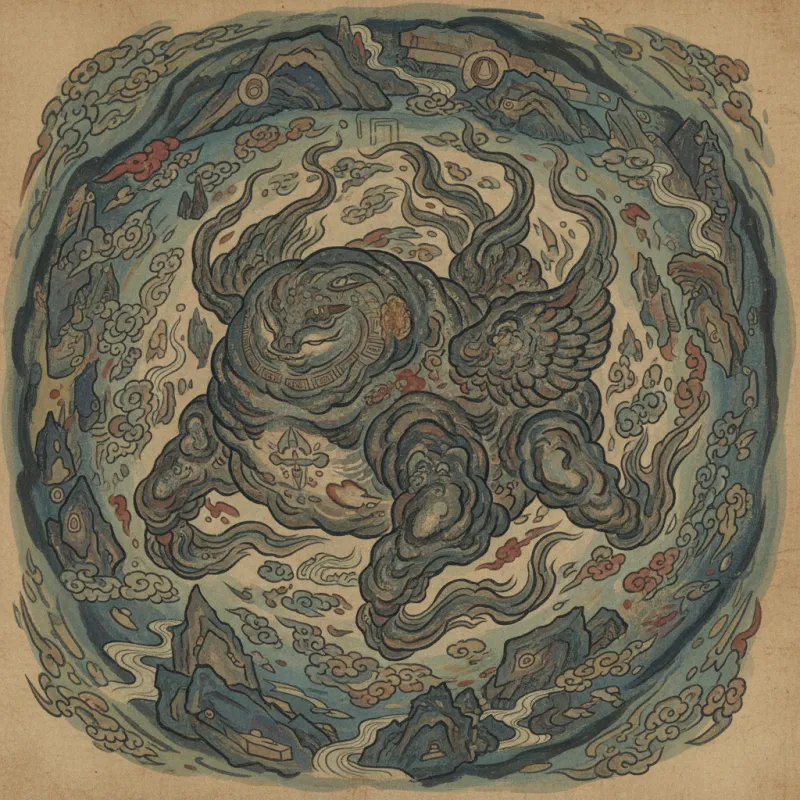
Picture a creature so primordial that it existed before the very concept of distinction itself—no eyes to see, no ears to hear, no mouth to speak. This is Hundun (混沌, hùndùn), the faceless embodiment of chaos that haunted the pages of ancient Chinese texts and the philosophical debates of sages for millennia. Unlike the fearsome dragons or cunning fox spirits that populate Chinese mythology, Hundun represents something far more unsettling: the undifferentiated void that preceded all creation, and perhaps, the state to which all things must eventually return.
The Creature Without Features
The earliest and most vivid description of Hundun appears in the Shan Hai Jing (山海经, Shānhǎi Jīng), specifically in the Xishan Jing (Western Mountains Classic) section. The text describes Hundun as resembling a yellow sack or a dog, with six legs and four wings, yet possessing no face whatsoever—no eyes, no nose, no mouth, no ears. This creature dwells on Mount Tianshan, and despite its lack of sensory organs, it somehow perceives and understands the world around it. The paradox is intentional: Hundun exists in a state that defies the normal categories of being.
What makes this description particularly striking is its deliberate inversion of natural order. Most mythical creatures in the Shan Hai Jing are composites—a bird with a human face, a fish with snake's body—but they still possess recognizable features. Hundun alone is defined by absence. The yellow color traditionally associated with earth and the center in Chinese cosmology suggests that Hundun occupies a liminal space, neither fully formed nor completely formless. Some scholars argue that the six legs and four wings represent the six directions (north, south, east, west, up, down) and the four seasons, making Hundun a living embodiment of spatiotemporal totality before differentiation.
The Parable of Misguided Kindness
The most famous story involving Hundun comes not from the Shan Hai Jing but from the Zhuangzi (庄子, Zhuāngzǐ), the foundational Daoist text compiled around the 4th century BCE. In the "Inner Chapters," Zhuangzi tells a deceptively simple parable that has haunted Chinese philosophy ever since. The emperors of the South Sea and North Sea, named Shu (倏, Shū, "Swift") and Hu (忽, Hū, "Sudden"), would frequently meet in the territory of Hundun, the emperor of the Center. Hundun always treated them with exceptional hospitality.
Wanting to repay this kindness, Shu and Hu noticed that while all humans have seven openings—two eyes, two ears, two nostrils, and one mouth—to see, hear, smell, and eat, Hundun had none. They decided to bore these openings into Hundun as a gift. Each day, they drilled one hole. On the seventh day, Hundun died.
This parable operates on multiple levels. On the surface, it's a cautionary tale about imposing one's own standards onto others, no matter how well-intentioned. But Zhuangzi's deeper meaning cuts to the heart of Daoist philosophy: differentiation is death. The moment the undifferentiated chaos gains features, gains the ability to distinguish between this and that, self and other, it loses its essential nature and perishes. The seven openings represent the seven emotions or the seven apertures through which we engage with the phenomenal world—and through which we lose our connection to the Dao (道, Dào), the undifferentiated source of all things.
Chaos as Cosmological Principle
The name Hundun itself is linguistically rich. The character 混 (hùn) means "to mix" or "turbid," while 沌 (dùn) suggests "confused" or "chaotic." Together, they evoke the primordial state before heaven and earth separated, before yin and yang distinguished themselves, before the ten thousand things came into being. This concept appears throughout Chinese cosmogony, from the Huainanzi (淮南子, Huáinánzǐ) compiled in the 2nd century BCE to the Liezi (列子, Lièzǐ) and beyond.
In the Huainanzi, the cosmological process begins with hundun—a state of undifferentiated qi (气, qì, vital energy) before the light and clear yang rose to become heaven and the heavy and turbid yin sank to become earth. This wasn't merely a one-time event in the distant past but an ongoing principle. The universe constantly oscillates between order and chaos, differentiation and unity. Hundun represents not just the beginning but the ever-present possibility of return to the source.
Compare this to the Greek concept of Chaos, which also represents a primordial void, but with a crucial difference. Greek Chaos is typically conceived as an empty abyss, a gap or chasm. Chinese hundun is full—pregnant with all possibilities, containing everything in potential but nothing in actuality. It's closer to the quantum foam of modern physics than to an empty void. The creature Hundun, then, is a living metaphor for this cosmological principle, a being that exists in the state that preceded existence itself.
Hundun in Later Traditions
As Chinese thought evolved through the centuries, Hundun took on new meanings while retaining its core symbolism. In Tang Dynasty (618-907 CE) Daoist texts, Hundun became associated with the concept of wuji (无极, wújí), the "limitless" or "without polarity" that precedes taiji (太极, tàijí), the "supreme ultimate" from which yin and yang emerge. The faceless creature became a visual representation of this abstract philosophical principle.
Buddhist texts that entered China also grappled with Hundun, sometimes equating it with śūnyatā (emptiness) or the unborn, uncreated state before karmic formations arise. The Chan (Zen) tradition particularly appreciated the Zhuangzi parable, seeing in it a warning against the discriminating mind that creates dualities and suffering. Several Tang and Song Dynasty Chan masters referenced Hundun in their teachings, using it as a koan-like device to point students toward non-dual awareness.
In popular religion and folk belief, Hundun took on a more ambiguous character. Some traditions portrayed it as a malevolent force of disorder that must be kept at bay through ritual and proper conduct. The Shenyi Jing (神异经, Shényì Jīng), a collection of strange tales from the Han Dynasty, describes Hundun as one of the "Four Perils" (四凶, sì xiōng)—primordial beings of chaos that the sage-king Shun banished to the four corners of the earth to establish cosmic order. This version of Hundun is explicitly negative, representing the forces of disorder that threaten civilization.
Yet even in these more negative portrayals, there's an acknowledgment that chaos cannot be entirely eliminated—only contained or balanced. The Four Perils weren't destroyed but exiled, suggesting that chaos remains a necessary part of the cosmic order, relegated to the margins but never truly absent. This tension between chaos as creative potential and chaos as destructive force runs throughout Chinese thought, with Hundun serving as the primary symbol of this ambiguity.
The Faceless Mirror
What makes Hundun enduringly fascinating is how it functions as a mirror for human anxieties about identity, consciousness, and meaning. A creature without a face cannot be read, cannot be known in the way we know other beings. It offers no expression to interpret, no eyes to meet, no mouth to speak truth or lies. In a culture that placed enormous emphasis on reading faces—from physiognomy to the subtle art of understanding social hierarchies through facial expressions—Hundun represents the ultimate opacity.
This facelessness also raises profound questions about consciousness and perception. How does Hundun experience the world without sensory organs? The Shan Hai Jing suggests it somehow does, that it possesses knowledge despite lacking the apparatus for acquiring it. This anticipates later Buddhist and Daoist discussions about pure awareness that exists prior to and independent of sensory experience. Hundun knows without knowing, perceives without perceiving—a state that mystics across traditions have struggled to describe and that philosophers have debated for millennia.
Modern readers might see in Hundun a precursor to contemporary discussions about artificial intelligence and consciousness. Can awareness exist without a body, without sensory organs, without the specific biological substrate that produces human consciousness? Hundun suggests the ancient Chinese already intuited that consciousness might not require the specific features we associate with sentient beings. It's a remarkably prescient insight wrapped in mythological form.
Living with Chaos
The Hundun myth ultimately asks us to reconsider our relationship with chaos itself. We spend our lives creating order—organizing our homes, structuring our days, categorizing our experiences, defining ourselves through increasingly specific identities. We bore holes into the undifferentiated chaos of raw experience, creating the seven openings through which we engage with the world. And like the emperors Shu and Hu, we believe we're doing something beneficial, something that improves upon the original state.
But Zhuangzi's parable suggests otherwise. Every distinction we make, every category we create, every boundary we draw is a kind of death—a loss of the original wholeness that preceded differentiation. This doesn't mean we should abandon all distinctions and descend into literal chaos. We're not Hundun; we're human beings who require structure and meaning to function. But the myth reminds us that our categories are provisional, that the order we create is always temporary, and that beneath the surface of our carefully organized lives, the undifferentiated chaos of Hundun still churns.
In this sense, Hundun is less a creature to be feared or defeated than a reminder of what we've lost and what we might, in moments of profound insight or meditation, briefly touch again. The faceless creature of chaos isn't our enemy but our origin, not a monster but a mirror reflecting the state before we became ourselves. And perhaps, if we're honest, we can admit that sometimes the burden of having a face—of being a distinct, separate self with all its attendant anxieties and limitations—feels heavy indeed. In those moments, the faceless freedom of Hundun doesn't seem like chaos at all, but like a kind of peace we've forgotten how to access.
The creature still dwells on Mount Tianshan, the texts tell us, yellow and formless, six-legged and four-winged, perceiving everything while possessing no organs of perception. It hasn't changed in three thousand years. We're the ones who keep boring new holes, keep creating new distinctions, keep killing Hundun over and over again in our quest for clarity and order. And yet, somehow, impossibly, Hundun endures—because chaos, unlike order, cannot truly die. It simply waits, faceless and patient, for the moment when all our carefully drilled openings close again and everything returns to the undifferentiated source from which it came.
Related Reading
- The Nine-Headed Bird: Terror of the Skies
- Bifang: The Fire Bird That Brings Disaster
- Exploring Shanhaijing: Mythical Creatures and Ancient Lands of Chinese Cosmology
- Exploring the Enigmatic Seas of the Shanhaijing: Mythical Creatures and Realms
- The Enigmatic Fish of Shanhaijing: Mythical Creatures of Chinese Lore