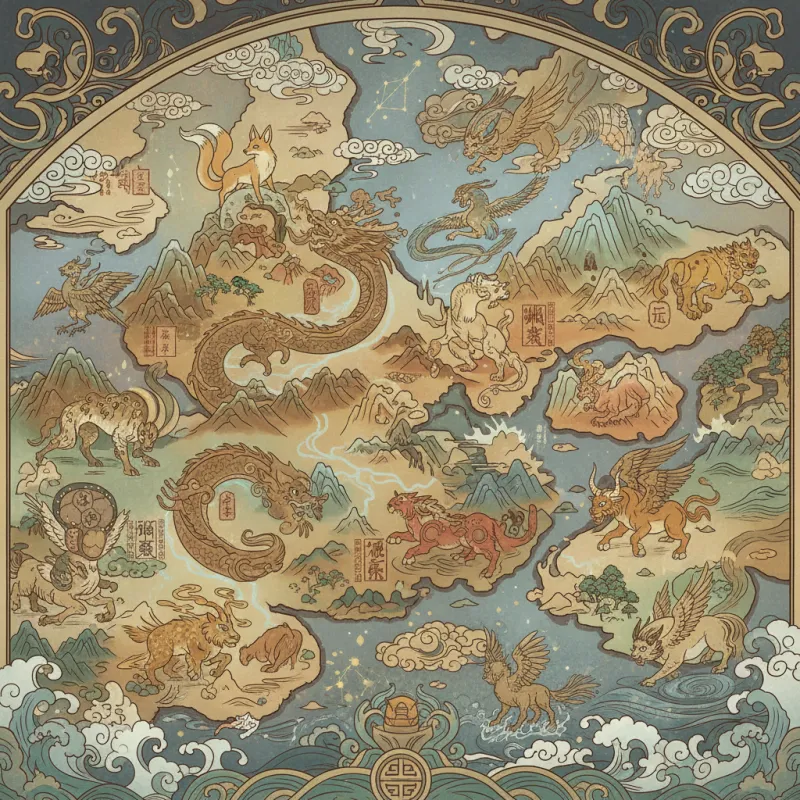
Picture this: a nine-tailed fox prowling through bamboo forests, a bird with three legs circling the sun, a fish that transforms into a bird and soars across continents. These aren't fever dreams or modern fantasy—they're meticulous entries from a 2,000-year-old geographical survey that reads like the field notes of an ancient cryptozoologist. The Shanhaijing (山海经, Shānhǎi Jīng), or Classic of Mountains and Seas, catalogs over 400 creatures with the same matter-of-fact precision you'd expect from a modern wildlife guide, except these animals breathe fire, predict disasters, and occasionally eat humans.
The Text That Defies Classification
Compiled between the 4th century BCE and the early Han Dynasty (around 2nd century CE), the Shanhaijing frustrates every attempt to pin it down. Is it geography? Mythology? Natural history? The answer is yes to all three, which is precisely what makes it extraordinary. Eighteen sections describe mountains, rivers, and regions stretching from the known world of ancient China to fantastical lands beyond the horizon. Each entry follows a formula: location, distance from the previous landmark, resources (jade, copper, medicinal herbs), and creatures—always the creatures.
What sets this text apart from other mythological compilations like the Soushen Ji (搜神记, Sōushén Jì) is its bureaucratic tone. There's no moralizing, no narrative arc. Just: "Three hundred li to the east is Mount Qingqiu, where the nine-tailed fox dwells. Its cry sounds like an infant. It eats humans." The clinical detachment makes it somehow more unsettling—and more believable to its original audience, who likely viewed it as a legitimate geographical reference.
Creatures of Omen and Transformation
The beasts of the Shanhaijing aren't random monsters. They're a sophisticated symbolic language. Take the Qilin (麒麟, Qílín), that chimeric creature with a dragon's head, deer's body, and scales covering its flesh. It appears only during the reign of benevolent rulers—its presence is a cosmic stamp of approval. When Confucius allegedly saw a wounded Qilin in 481 BCE, he interpreted it as an omen of his own impending death and the end of an era. The creature's suffering mirrored the moral decay of the state.
Then there's the Bifang (毕方, Bìfāng), a one-legged bird wreathed in flames. Wherever it appears, fire follows. But here's the twist: ancient Chinese didn't see it as causing fires—it was a warning system, a smoke detector with wings. The Shanhaijing describes it as having a human face and appearing before major conflagrations, giving people time to prepare. This distinction between causation and correlation shows a surprisingly sophisticated understanding of natural phenomena.
The Kunpeng (鲲鹏, Kūnpéng) embodies transformation itself. Starting as a fish thousands of li long (the Kun), it metamorphoses into the Peng, a bird so massive its wings blot out the sky. Daoist philosopher Zhuangzi seized on this creature in the 4th century BCE to illustrate the relativity of perspective—what seems impossibly large to a cicada is merely the natural state of being for the Peng. This beast became a metaphor for transcendence, for breaking free of limited viewpoints. You'll find echoes of it in everything from Tang Dynasty poetry to modern Chinese fantasy novels.
Geography as Mythology, Mythology as Geography
Here's what makes the Shanhaijing genuinely weird: it treats mythical and real locations with identical authority. The text describes Mount Tai (泰山, Tài Shān)—a real, climbable mountain in Shandong Province—in the same breath as the Kunlun Mountains (昆仑山, Kūnlún Shān), the mythical axis mundi where the Queen Mother of the West holds court. Both get coordinates, both get creature catalogs, both get resource inventories.
This wasn't confusion or primitive thinking. It was a different epistemology. The ancient Chinese worldview didn't sharply divide the empirical from the numinous. Mountains were simultaneously physical landmarks and spiritual entities. The Shanhaijing maps a cosmos where geography and mythology occupy the same plane of reality. When it places the Kaiming Beast (开明兽, Kāimíng Shòu)—a nine-headed guardian with a human face—at the gates of Kunlun, it's not being metaphorical. It's telling you what you'll encounter if you travel far enough west.
This geographical-mythological fusion influenced Chinese cartography for centuries. Even Tang Dynasty maps included mythical regions alongside known territories, because the unknown wasn't empty space—it was populated with specific, cataloged beings. The Shanhaijing gave structure to the void beyond the borders.
Beasts as Cultural Memory
Many scholars now believe the Shanhaijing preserves fragmented memories of real animals encountered during ancient migrations and trade. The Zouyu (騶虞, Zōuyú), described as a white tiger with black markings that eats only bamboo, sounds suspiciously like a garbled description of a giant panda—an animal that would have been exotic and rare even in ancient times. The Feilian (飞廉, Fēilián), a deer-bodied creature with a bird's head, might preserve memories of ostriches encountered along early Silk Road routes.
But here's where it gets interesting: even if some creatures started as distorted reports of real animals, they evolved into something more. The Taotie (饕餮, Tāotiè), that gluttonous monster face you see on Shang Dynasty bronzes, appears in the Shanhaijing as a sheep-bodied creature with human face and eyes under its armpits. By the Han Dynasty, it had become a moral symbol—the embodiment of greed and excess. The creature became a cautionary tale, its image carved onto ritual vessels as a reminder against overindulgence.
This is the Shanhaijing's real power: it created a shared vocabulary of symbols that Chinese culture has been remixing for two millennia. When a modern Chinese fantasy novel mentions a Taotie, readers instantly understand the connotations—not because they've read the original text, but because the creature has permeated the culture so thoroughly it's become archetypal.
The Text's Strange Afterlife
The Shanhaijing had a rocky reception in imperial China. Confucian scholars dismissed it as superstitious nonsense, unworthy of serious study. It was too weird, too unrefined, too full of monsters eating people. But it never disappeared. It survived in the margins—copied by Daoist priests, illustrated by eccentric artists, referenced by poets who wanted to signal their unconventional thinking.
The Qing Dynasty scholar Bi Yuan (毕沅, Bì Yuán) spent decades in the 18th century trying to match Shanhaijing locations to real geography, producing annotated editions that are still consulted today. He failed, mostly, but his failure was productive—it demonstrated that the text operates on its own logic, resistant to rationalization.
Modern China has embraced the Shanhaijing with enthusiasm that would shock those Confucian critics. The creatures appear in video games, animated films, and fantasy novels. The text has become a source of cultural pride—proof of China's rich imaginative tradition. When Chinese game developers create monsters, they mine the Shanhaijing first. It's become a kind of open-source mythology, free for endless adaptation.
Reading the Beasts Today
What should a modern reader make of a text that seriously claims there's a country where people have holes through their chests and carry poles through them? The temptation is to read it as pure fantasy, ancient entertainment. But that misses the point. The Shanhaijing is a window into how an ancient culture organized knowledge, how it processed the strange and unfamiliar, how it encoded values and warnings into bestiary form.
These creatures weren't meant to be believed in the way we believe in documented species. They were meant to be useful—as moral exemplars, as omens, as explanations for natural phenomena, as entertainment, as cultural memory. The text works on multiple registers simultaneously, which is why it's survived when more "serious" geographical works have been forgotten.
If you want to understand how Chinese deities and mythological systems developed, you have to grapple with the Shanhaijing. It's the substrate, the primordial soup from which later, more refined mythologies emerged. Every nine-tailed fox in Chinese literature traces its lineage back to those terse entries in the Classic of Mountains and Seas.
The text reminds us that mythology isn't a primitive stage we've outgrown—it's a different way of encoding truth, one that sometimes captures realities that purely empirical description misses. When the Shanhaijing places monsters at the edges of the known world, it's not being naive. It's acknowledging that the unknown is genuinely monstrous, genuinely dangerous, and genuinely fascinating. That's as true now as it was 2,000 years ago. We've just moved the edges farther out.
Related Reading
- Exploring the Enigmatic Seas of the Shanhaijing: Mythical Creatures and Realms
- Exploring the Enigmatic Mountains and Creatures of the Shanhaijing
- Unearthing the Cursed Beings of Shanhaijing: Myths, Creatures, and Lands