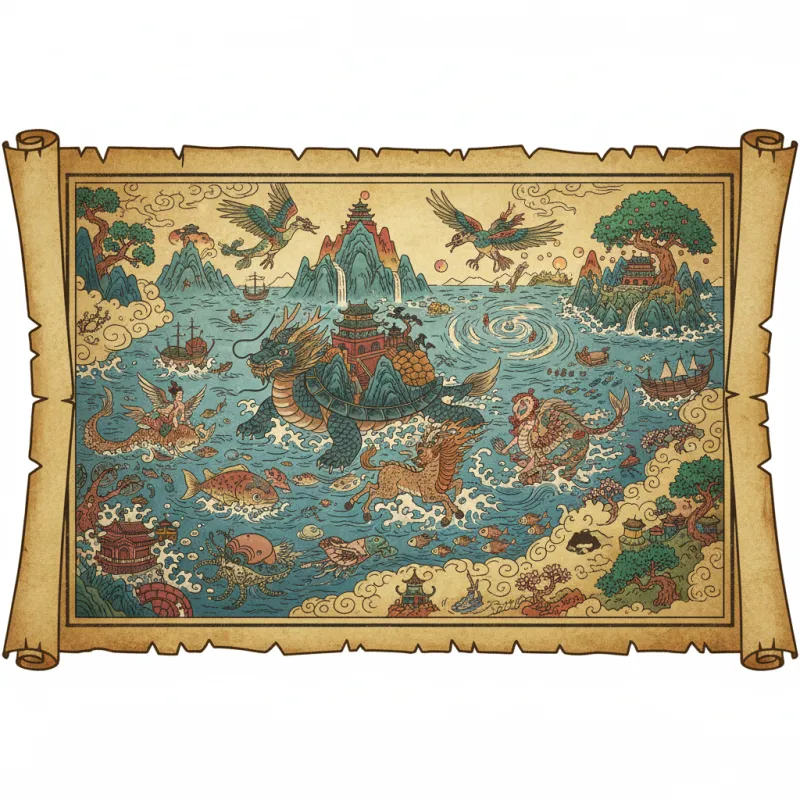
The ancient cartographers who compiled the Shanhaijing (山海经, Shānhǎijīng) weren't just mapping coastlines—they were charting the boundaries between the known world and the realm of gods. When you read descriptions of seas where fish have human faces and islands float on the backs of giant turtles, you're not encountering primitive superstition. You're witnessing a sophisticated cosmological system where geography and mythology merge into something far more profound than either could be alone.
The Four Seas: Cosmic Boundaries of the Ancient World
The Shanhaijing organizes its maritime geography around the concept of the Four Seas (四海, Sìhǎi)—the Eastern, Southern, Western, and Northern Seas that encircle the known world like a cosmic moat. But these aren't the oceans we'd recognize on modern maps. The Eastern Sea (东海, Dōnghǎi), for instance, stretches beyond what we now call the East China Sea into a liminal space where the sun rises from the waters each morning, carried by a divine bird or emerging from the branches of the Fusang tree (扶桑, Fúsāng).
What strikes me most about these descriptions is their internal consistency. The text positions islands, creatures, and divine beings with the same matter-of-fact precision you'd find in a Han Dynasty administrative document. The Southern Sea contains the nation of Yumin (羽民, Yǔmín)—the Feathered People—who live exactly 7,000 li from a specific mountain range. This isn't vague mythmaking; it's systematic world-building that predates Tolkien by two millennia.
The Western Sea holds particular significance as the domain of the Queen Mother of the West (西王母, Xī Wángmǔ), whose palace sits on the shores where immortals gather. This connection between maritime geography and immortality appears throughout the text, suggesting the ancient Chinese viewed the seas not as barriers but as pathways to transcendence.
Creatures of the Deep: When Fish Become Omens
The marine creatures catalogued in the Shanhaijing read like a fever dream, but they follow distinct patterns. Take the Lingyu (鲮鱼, Língyú)—a fish with a human face, hands, and feet that makes sounds like a crying infant. The text specifies that eating its flesh prevents scabies, transforming a bizarre creature into practical pharmacology. This utilitarian approach appears repeatedly: the Feiyu (飞鱼, Fēiyú) with bird wings cures hernias, while the Dijiang (帝江, Dìjiāng)—a faceless, six-legged creature—brings good fortune to any land where it appears.
I find the human-faced fish particularly fascinating because they represent a recurring motif in Chinese cosmology: the blurred boundary between human and animal, civilization and wilderness. These aren't monsters to be slain like in Western mythology; they're liminal beings that exist in the spaces between categories, much like the mythical creatures of the mountains that guard sacred peaks.
The text describes the Kun (鲲, Kūn), a fish so massive that its body stretches thousands of li, which transforms into the Peng (鹏, Péng), a bird whose wings darken the sky. This transformation, later immortalized in Zhuangzi's philosophical writings, suggests the seas of the Shanhaijing aren't just physical spaces but zones of metamorphosis where the fundamental nature of beings can shift.
Islands of Immortals: Maritime Paradises and Cosmic Mountains
Scattered throughout the Shanhaijing's seas are islands that function as terrestrial paradises—most famously the Five Sacred Mountains of the Eastern Sea (东海五山, Dōnghǎi Wǔshān). According to the text, these mountains originally floated freely until the deity Yuqiang (禺强, Yúqiáng) commanded fifteen giant turtles to hold them steady in shifts of 60,000 years each. When a giant from the Longbo nation (龙伯国, Lóngbó Guó) caught six of these turtles, two mountains drifted away and sank, leaving only three: Penglai (蓬莱, Pénglái), Fangzhang (方丈, Fāngzhàng), and Yingzhou (瀛洲, Yíngzhōu).
This story isn't just colorful mythology—it became the foundation for centuries of maritime expeditions. Emperor Qin Shi Huang famously sent the explorer Xu Fu (徐福, Xú Fú) with thousands of young men and women to find these islands and retrieve the elixir of immortality in 219 BCE. The expedition never returned, spawning legends that they founded Japan instead. Whether you believe that or not, it demonstrates how the Shanhaijing's geography shaped real-world exploration and political ambition.
The islands are described as having palaces of gold and silver, trees bearing pearls, and animals that are pure white. Inhabitants never age or die. These descriptions influenced everything from Tang Dynasty poetry to the design of imperial gardens, where artificial islands and mountains attempted to recreate these mythical paradises in miniature.
The Cosmological Function: Seas as Boundaries Between Worlds
What separates the Shanhaijing from mere fantasy is its cosmological sophistication. The seas function as boundaries between the mortal realm and various divine or monstrous domains. The text describes the Guixu (归墟, Guīxū)—a massive whirlpool in the Eastern Sea where all waters ultimately drain, located in a bottomless valley that never fills. This isn't just a geographical feature; it's a cosmological necessity, explaining where the waters of the world's rivers go without causing the seas to overflow.
The Ruoshui (弱水, Ruòshuǐ), or Weak Water, appears in the Western Sea—a body of water so lacking in buoyancy that even feathers sink. Only the Queen Mother of the West's divine birds can cross it, making it an effective barrier between the mortal and immortal realms. This concept of impassable waters protecting sacred spaces appears throughout Chinese literature, from Journey to the West to modern wuxia novels.
These maritime boundaries serve a similar function to the sacred mountains that form the axis mundi in the terrestrial sections of the text—they're not just physical barriers but metaphysical ones, marking transitions between different states of being.
Navigating the Mythical: Ancient Chinese Maritime Consciousness
The Shanhaijing reveals a sophisticated maritime consciousness that contradicts the stereotype of China as a purely land-based civilization. The text describes navigation techniques, seasonal winds, and the positions of islands with enough detail to suggest real seafaring knowledge underlies the mythological overlay. The Eastern Sea sections mention specific distances, directions, and landmarks that may preserve genuine geographical information about ancient coastal trade routes.
Consider the description of the Yanzhou (炎洲, Yánzhōu), or Flame Island, in the Southern Sea, where the ground burns perpetually and inhabitants must wear wooden shoes five inches thick. This could be a mythologized account of volcanic islands in the South China Sea, filtered through the lens of wonder and exaggeration that characterizes the entire text.
The maritime sections also reveal ancient China's awareness of distant lands and peoples. References to nations beyond the seas, some with bizarre customs and appearances, suggest contact with Southeast Asian and Pacific cultures, even if those encounters were transformed into mythology by the time they reached the compilers of the Shanhaijing.
Legacy and Influence: From Ancient Text to Modern Imagination
The seas of the Shanhaijing have rippled through Chinese culture for over two millennia. Tang Dynasty poets like Li Bai referenced Penglai Island in their verses about immortality and transcendence. Ming Dynasty novels like Journey to the West and Investiture of the Gods borrowed heavily from the text's maritime mythology, populating their seas with dragon kings and underwater palaces that echo the Shanhaijing's original visions.
Even today, Chinese fantasy literature and film draw from this well. The 2016 film "The Mermaid" by Stephen Chow, while modern in setting, taps into the same tradition of human-fish hybrids that appears in the ancient text. Video games like "Black Myth: Wukong" incorporate creatures and locations directly from the Shanhaijing, introducing new generations to these ancient maritime myths.
What makes the Shanhaijing's seas endure isn't just their strangeness but their systematic nature. They present a complete world with its own logic, geography, and inhabitants—a world that feels discoverable rather than invented. When you read about the fish with ten bodies sharing one head, or the island where everyone has three faces, you're not just encountering random weirdness. You're exploring a coherent alternative reality that ancient Chinese thinkers constructed with the same care that modern fantasy authors build their worlds.
Reading the Waves: What the Seas Tell Us About Ancient Chinese Thought
The maritime sections of the Shanhaijing ultimately reveal how ancient Chinese thinkers conceptualized the relationship between humanity and the natural world. Unlike Western traditions that often position humans as separate from or dominant over nature, the Shanhaijing's seas present a world where boundaries blur constantly. Humans become fish, fish become birds, islands float and sink, and the very waters themselves possess agency and purpose.
This fluidity reflects core concepts in Chinese philosophy—the Daoist emphasis on transformation, the Buddhist notion of impermanence, and the Confucian understanding of humanity's place within a larger cosmic order. The seas aren't just settings for adventures; they're spaces where these philosophical principles manifest in concrete, imaginable forms.
When you read the Shanhaijing today, you're not just encountering ancient mythology. You're accessing a way of thinking about the world that sees wonder and meaning in every wave, every creature, every distant island on the horizon. The text reminds us that maps are never just maps—they're stories we tell about who we are and what lies beyond the edges of our known world.
Related Reading
- Exploring the Enigmatic Mountains and Creatures of the Shanhaijing
- The Jade Palace of Kunlun: Home of the Queen Mother of the West — Shanhai Perspective
- Kunlun Mountain: Home of the Immortals