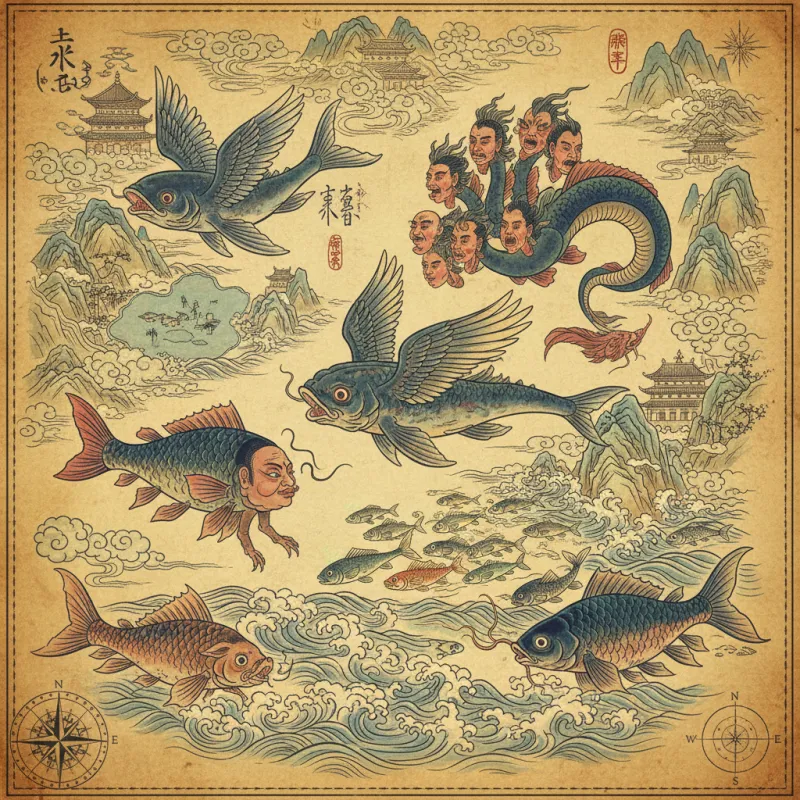
A fish with the face of a human swims through the pages of China's oldest geographical text, its eyes watching you from across three millennia. This isn't fantasy fiction—it's the Shanhaijing (山海经, Shānhǎijīng), the Classic of Mountains and Seas, where fish don't just swim, they prophesy, they transform, and they bridge the gap between the mortal world and the divine.
When Fish Were More Than Food
The compilers of the Shanhaijing—likely multiple authors working between the 4th century BCE and the early Han Dynasty—weren't writing a cookbook or a fishing manual. They were documenting a cosmology where every creature carried meaning, where the natural world pulsed with supernatural significance. The fish in these texts serve as omens, guardians, and sometimes warnings of catastrophe. Unlike the dragons that dominate Chinese mythology or the phoenixes that capture our imagination, these fish operate in a liminal space—neither fully of water nor entirely bound by it.
Take the Renyu (人鱼, Rényú), the "human fish" described in the text. This isn't the romanticized mermaid of Western tradition. The Shanhaijing describes it with clinical precision: it has four legs, makes a sound like an infant crying, and eating its flesh prevents scabies. The practicality is striking—ancient Chinese scholars weren't content with pure mythology; they wanted their fantastic creatures to have tangible, if bizarre, applications. This utilitarian approach to the supernatural tells us something profound about how the ancients viewed the boundary between myth and medicine, between story and survival.
The Ling Yu and the Language of Disaster
The Ling Yu (鯪鱼, Língyú) appears in the text as a fish with the body of a carp but the wings of a bird. When it appears in rivers, the text warns, drought will follow. Here we see the Shanhaijing functioning as an early warning system, encoding environmental observations in mythological language. Was there a real fish species whose migration patterns coincided with drought conditions? Did ancient observers notice correlations between unusual aquatic behavior and weather patterns?
Modern scholars debate whether these creatures represent misidentified real animals, symbolic representations of natural phenomena, or pure invention. I'd argue it's all three simultaneously. The genius of the Shanhaijing lies in its refusal to separate these categories. A fish that brings drought is simultaneously a real observation (perhaps of fish die-offs during dry seasons), a symbolic warning (the inversion of water bringing water's absence), and a narrative device that makes the text memorable across generations.
The Ling Yu connects thematically to other ominous creatures in the text, much like the fearsome beasts that guarded sacred mountains or the birds whose appearance foretold dynastic change. The Shanhaijing constructs an entire ecosystem of meaning where every creature participates in a larger cosmic conversation.
The Chi You Fish and Political Mythology
Perhaps no fish in the Shanhaijing carries more political weight than the Chi You Yu (蚩尤鱼, Chīyóu Yú), named after the legendary rebel leader Chi You who fought against the Yellow Emperor. This fish, described as having a human face and ten bodies, represents the fragmentation and multiplication of rebellion itself. The symbolism is hardly subtle—Chi You, defeated and dismembered by the Yellow Emperor, lives on in aquatic form, his essence scattered but never fully destroyed.
This mythological transformation reveals how the Shanhaijing served as a tool for political legitimation. By the Han Dynasty, when much of the text reached its final form, the Yellow Emperor had been firmly established as the ancestor of Chinese civilization. Chi You, once possibly a rival deity or tribal leader, had been relegated to the role of chaos-bringer, his very name becoming synonymous with rebellion and disorder. That his namesake fish has ten bodies suggests the persistent, hydra-like nature of challenges to imperial authority—cut off one head, and more appear.
The text's treatment of the Chi You fish demonstrates how mythology and statecraft intertwined in ancient China. These weren't just stories; they were arguments about legitimacy, order, and the proper structure of the cosmos.
Fish as Transformative Agents
Several fish in the Shanhaijing possess the ability to transform or to facilitate transformation in others. The Tiao Yu (鯈鱼, Tiáoyú), for instance, is said to have the ability to cure madness when consumed. The He Luo Yu (何罗鱼, Héluóyú) can supposedly cure tumors. This pharmaceutical dimension of mythical fish reflects the deep connection between Chinese mythology and traditional medicine—a connection that persists today in practices like consuming specific animal parts for health benefits.
But transformation goes deeper than physical healing. In Daoist thought, which heavily influenced later interpretations of the Shanhaijing, fish represent the soul's journey through different states of being. The famous parable from Zhuangzi about the fish in the well who cannot comprehend the ocean echoes this transformative potential—fish exist in a medium that humans cannot fully inhabit, making them perfect symbols for altered states of consciousness and spiritual transcendence.
The Shanhaijing's fish often blur the line between species: fish with bird wings, fish with human faces, fish with multiple bodies. This categorical instability isn't a bug; it's a feature. It reflects a worldview where transformation is constant, where boundaries are permeable, and where the cosmos itself is in perpetual flux.
Reading the Waters: Geography and Mythology
The Shanhaijing organizes its content geographically, moving through mountains and seas in a systematic (if sometimes bewildering) fashion. The fish appear in specific waterways, tied to particular locations. The Qing Qiu (青丘, Qīngqiū) region, for example, hosts several unusual fish species, while the Ruo Shui (弱水, Ruòshuǐ)—the "Weak Water" that cannot support boats—contains fish that exist in an element hostile to human navigation.
This geographical specificity matters. The Shanhaijing wasn't meant to be read as pure fantasy but as a guide to the world's wonders and dangers. Whether these locations were real, mythical, or some combination remains debated, but the text's insistence on placing creatures in specific contexts suggests an attempt to map not just physical space but cosmological space—to create a geography of meaning where every region has its characteristic wonders and terrors.
The fish of distant waters serve another function: they mark the boundaries of the known world. The stranger the fish, the farther from civilization you've traveled. This creates a gradient of weirdness radiating outward from the cultural center, with the most bizarre creatures inhabiting the most remote regions. It's a pattern repeated in medieval European maps with their "here be dragons" margins, but the Shanhaijing does it with more specificity and less obvious fear.
The Enduring Mystery of Aquatic Mythology
Why fish? Why did the compilers of the Shanhaijing devote so much attention to aquatic creatures? Part of the answer lies in water's fundamental importance to Chinese civilization. The Yellow River and Yangtze River weren't just water sources; they were the arteries of culture, commerce, and political power. To understand the waters was to understand China itself.
But there's something else at work. Fish inhabit a realm humans can observe but never fully enter. We can see them, catch them, eat them, but we cannot breathe their medium or know their world from the inside. This makes them perfect vehicles for projection, for encoding mysteries that resist easy explanation. The fish of the Shanhaijing swim in the gap between the known and unknown, the natural and supernatural, the mundane and the marvelous.
Today, reading these descriptions of human-faced fish and drought-bringing carp, we might smile at ancient credulity. But the Shanhaijing wasn't written for literal belief—at least not entirely. It was written to preserve a way of seeing the world where every creature participates in a web of meaning, where observation and imagination aren't opposites but partners in understanding. The fish of the Shanhaijing still swim through Chinese culture, surfacing in art, literature, and popular imagination, reminding us that the boundary between myth and reality has always been more permeable than we like to admit.
Related Reading
- Mystical Fish of Shanhaijing: Exploring Legendary Creatures and Enchanted Waters
- Exploring the Enigmatic Creatures and Lands of the Shanhaijing
- Unraveling the Mysteries of Shanhaijing: Mythical Creatures and Enigmatic Lands
- Merfolk in Chinese Mythology: The Shark People and Sea Maidens