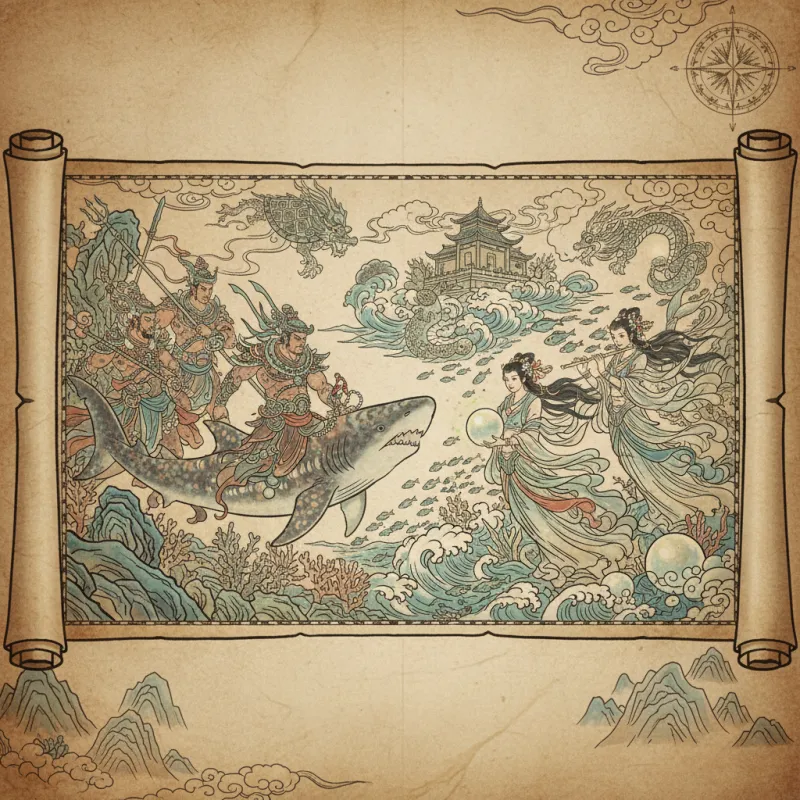
The first time a Jiaoren wept, the tears that fell were not salt water but solid pearls. This wasn't metaphor or poetry—according to the Bowu Zhi (博物志 Bówù Zhì), a 3rd-century compendium of strange phenomena, the Shark People of the South Sea literally cried gemstones. But here's what makes this detail so fascinating: nobody in the text seems particularly surprised by it. The pearl-tears are mentioned almost casually, as if the author is simply recording what everyone already knows about the ocean's most skilled weavers.
This is the essential difference between Chinese merfolk and their Western counterparts. The Jiaoren aren't seductresses luring sailors to their deaths. They're not cursed princesses longing for human legs. They're craftspeople, traders, and neighbors who happen to live underwater. The relationship between humans and these sea-dwellers in Chinese mythology is fundamentally economic and social rather than romantic or adversarial.
The Shark People: Artisans of the Deep
The Shanhaijing (山海经 Shānhǎi Jīng), that sprawling catalog of mythical geography compiled between the 4th and 1st centuries BCE, places the Jiaoren in the South Sea. But it's the later texts—particularly the Bowu Zhi by Zhang Hua and the Soushen Ji (搜神记 Sōushén Jì) by Gan Bao—that flesh out the details of their lives.
The Jiaoren were master weavers. They produced a fabric called jiaoxiao (鲛绡 jiāoxiāo), or "shark silk," that never got wet. Imagine that: a textile so finely woven that water simply refused to penetrate it. Chinese texts describe merchants traveling to the coast specifically to trade with the Jiaoren for this miraculous cloth. The transactions were apparently straightforward—no Faustian bargains, no tricks, just commerce between two intelligent species.
Their tears, as mentioned, crystallized into pearls upon contact with air. But the most valuable commodity the Jiaoren possessed was their body oil. Once rendered and lit, it would burn indefinitely. The Shu Yi Ji (述异记 Shù Yì Jì) from the 6th century describes lamps fueled by Jiaoren oil burning in the tombs of emperors, providing eternal light for the dead. This wasn't presented as grave-robbing or exploitation—the texts suggest the Jiaoren traded their oil willingly, though one wonders what they received in return that could match such a gift.
The Taxonomy of Chinese Sea-Dwellers
The Jiaoren weren't the only humanoid creatures inhabiting China's mythical waters. The Shanhaijing is populated with various sea-people, each with distinct characteristics that suggest different species or regional variations rather than a single "mermaid" archetype.
The Chiru (赤鱬 chìrú), or Red Fish-People, appear in the Classic of Mountains and Seas with fish bodies and human faces. Unlike the Jiaoren, they're described as having scales and fins rather than human-like lower bodies. They're associated with the Eastern Sea and are said to bring drought when they appear on land—a detail that inverts the usual water-creature symbolism.
Then there are the Lingyu (陵鱼 língyú), described as having human heads, hands, and feet but fish bodies. The Shanhaijing places them in various rivers and lakes throughout the mythical landscape. What's intriguing is that these creatures are often listed alongside other fish species, suggesting they were considered part of the natural ecosystem rather than supernatural beings. The Dragon Kings who ruled these waters apparently governed all these species as subjects of their underwater kingdoms.
The Economics of the Impossible
Here's where Chinese merfolk mythology diverges most sharply from Western traditions: the emphasis on trade and material culture. Western mermaids are defined by what they lack (legs, souls, voices) and what they desire (human love, immortality). Chinese sea-people are defined by what they produce and what they're willing to exchange.
The Taiping Guangji (太平广记 Tàipíng Guǎngjì), a 10th-century collection of tales, includes multiple stories of coastal merchants who maintained regular trading relationships with Jiaoren communities. One account describes a merchant family in Guangdong who, for three generations, traded silk and rice wine for shark-silk fabric. The Jiaoren would surface at specific times of the lunar month, conduct their business, and return to the depths. No drama, no tragedy—just commerce.
This practical relationship reflects a broader pattern in Chinese mythology: the supernatural is often integrated into daily life rather than separated from it. The same texts that describe dragons controlling rainfall also explain how to propitiate them for good harvests. The same bestiaries that catalog impossible creatures also note which ones are edible and how they taste.
Tears, Pearls, and the Poetry of Grief
The image of the Jiaoren weeping pearls became one of the most enduring motifs in Chinese literature, but its meaning evolved over centuries. By the Tang Dynasty (618-907 CE), poets had transformed the pearl-tears from a simple biological fact into a metaphor for precious sorrow.
Li Shangyin, the 9th-century master of allusive poetry, wrote: "In the vast sea the bright moon births a pearl / From the blue fields the warm sun produces jade / This feeling could have become a memory / But at the time it already seemed lost." The reference to the "bright moon birthing a pearl" in the sea directly invokes the Jiaoren, but now their tears represent the crystallization of emotion itself—grief made tangible and valuable.
This literary transformation is telling. The Jiaoren began as practical creatures in geographical texts, became trading partners in historical accounts, and finally evolved into symbols of beautiful sadness in poetry. Each layer of meaning accumulated without erasing the previous ones. A Tang Dynasty reader encountering a Jiaoren reference would simultaneously understand it as a real creature from the South Sea, a source of valuable trade goods, and a metaphor for tears that are both painful and precious.
The Eternal Flame: Death, Memory, and Illumination
The most haunting detail about the Jiaoren is that lamp oil. Imagine descending into an imperial tomb and finding it lit by flames that have burned for centuries, fueled by the rendered fat of sea-people. The Shu Yi Ji describes exactly this scenario in the tomb of the First Emperor of Qin.
This isn't presented as horror—at least not explicitly. But there's something deeply unsettling about the image once you sit with it. The Jiaoren oil that burns forever becomes a metaphor for memory that cannot be extinguished, for the past that refuses to stay buried. The dead emperor lies in darkness that isn't dark, illuminated by a light that cannot die because it comes from creatures who themselves exist in a liminal space between human and animal, between land and sea.
Later dynasties apparently found this practice troubling. By the Song Dynasty (960-1279 CE), texts begin to question the ethics of using Jiaoren oil. The Yijian Zhi (夷坚志 Yíjiān Zhì), a 12th-century collection of supernatural tales, includes a story about a tomb robber who steals a Jiaoren-oil lamp and is subsequently haunted by visions of weeping figures rising from the sea. The moral framework is shifting—what was once simple trade is now potentially exploitation.
Comparing Seas: East Meets West
When Jesuit missionaries arrived in China in the 16th century, they immediately noticed the merfolk in Chinese texts and tried to map them onto European categories. Matteo Ricci's writings mention the Jiaoren and attempt to equate them with sirens, but the comparison falls apart under scrutiny.
European mermaids are fundamentally about desire and danger. From the sirens of Homer to Hans Christian Andersen's Little Mermaid, they represent the ocean as a space of temptation and transformation. They sing, they seduce, they drag sailors down or long to join them on land. The boundary between sea and shore is a moral boundary, and crossing it requires sacrifice.
The Jiaoren and their kin represent something different: the ocean as a parallel civilization. They don't want to become human or destroy humans. They have their own culture, their own crafts, their own economy. The boundary between sea and shore is permeable and regularly crossed for practical purposes. The various sea monsters and strange fish that populate Chinese waters are similarly integrated into a coherent ecosystem rather than existing as isolated symbols.
This difference reflects broader cultural attitudes toward nature and the supernatural. Chinese cosmology tends toward integration and hierarchy—everything has its place in an ordered system, from the Jade Emperor in heaven to the Dragon Kings in the sea to humans on land. Western cosmology, particularly in its Christian formulation, tends toward separation and opposition—heaven versus earth, soul versus body, civilization versus wilderness.
The Jiaoren in Modern Memory
The Shark People haven't disappeared from Chinese culture. They surface regularly in contemporary fantasy novels, films, and television series, though often transformed by contact with Western mermaid mythology. The 2016 film The Mermaid by Stephen Chow features a Jiaoren-inspired protagonist, but she's been given the Western mermaid's romantic longing and environmental message.
What's often lost in these modern adaptations is the original strangeness of the Jiaoren—their fundamental otherness combined with their mundane integration into human economic life. They were never meant to be understood or romanticized. They were meant to be traded with, carefully and respectfully, as one trades with any foreign people whose customs are different but whose goods are valuable.
The pearl-tears remain, though. That image has proven too powerful to abandon. In Chinese, the phrase "Jiaoren weeping pearls" (鲛人泣珠 jiāorén qì zhū) still means tears that are both sorrowful and precious, grief that produces something beautiful. It's a more complex emotional landscape than simple sadness—it acknowledges that pain can have value, that loss can create something worth keeping.
Perhaps that's the real legacy of the Shark People: not a specific creature or story, but a way of thinking about the relationship between suffering and beauty, between the human world and the vast, strange ocean that surrounds it. They remind us that the sea contains not just monsters and metaphors, but neighbors—strange neighbors, certainly, weaving their impossible fabrics in the dark water, crying their pearl-tears, burning their eternal flames. And sometimes, if you go to the right beach at the right time with the right goods to trade, they might surface to do business.
Related Reading
- The Four Dragon Kings: Rulers of China's Mythological Oceans
- Leviathans of the Eastern Sea: Giant Sea Creatures in Chinese Myth
- Sea Monsters of the Shanhai Jing: Terrors of the Deep
- Sea Creatures of the Shanhaijing: Monsters from the Deep
- Hundun: The Faceless Creature of Chaos
- Exploring the Myths of Serpents in the Shanhaijing: Creatures of Power and Mystery
- Kunlun Mountain: Where Heaven Meets Earth in Chinese Mythology