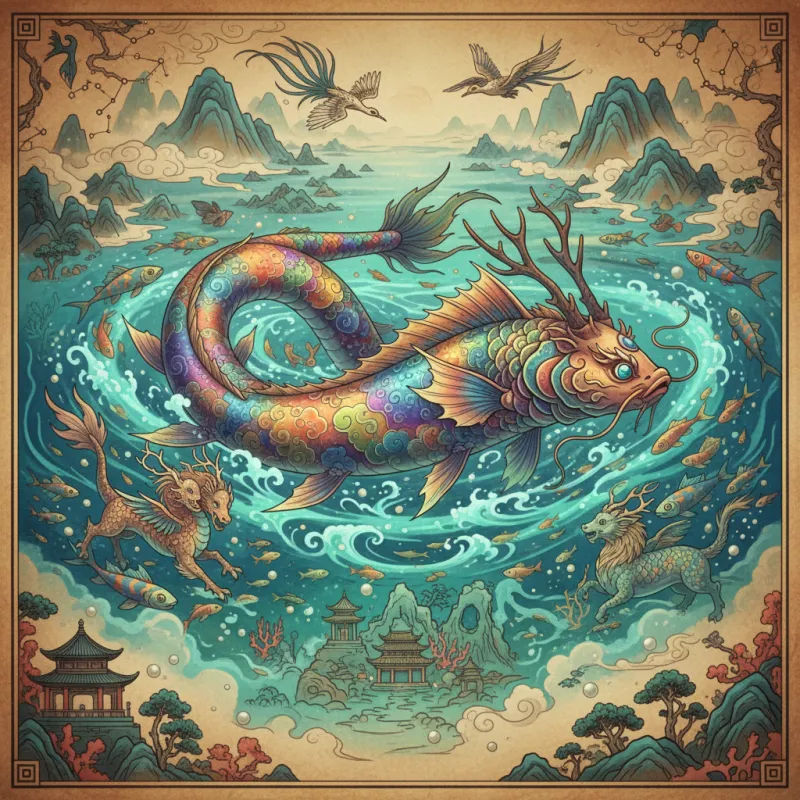
Deep in the waters described by ancient Chinese cartographers, fish didn't just swim—they flew, sang prophecies, and transformed into dragons. The Shanhaijing 山海经 (Shānhǎi Jīng, Classic of Mountains and Seas) catalogs over fifty species of mystical fish, each more bizarre than the last. These aren't mere flights of fancy; they're windows into how pre-Qin dynasty scholars understood the natural world, where the boundary between fish and deity dissolved in the depths of enchanted rivers.
The Fish That Defied Nature's Laws
The Shanhaijing presents aquatic creatures that challenge every biological principle. Take the Wen 鳁 (wēn), a fish with the body of a carp but the wings of a bird, said to inhabit the waters of Mount Tai. According to the text's geographical sections, consuming this creature prevented boils and carbuncles—a detail that reveals how mythical zoology intersected with traditional medicine. The compilers weren't writing fantasy; they were documenting what they believed to be genuine natural history, however distorted by distance and oral transmission.
Even stranger is the Lingyu 鲮鱼 (língyú), described in the Xishan Jing 西山经 (Classic of Western Mountains) section as having four legs and a fish's body. Modern scholars debate whether this represents an early encounter with salamanders or mudskippers, misremembered through generations of retelling. But the text's matter-of-fact tone suggests its authors saw no contradiction in a fish that walked on land—after all, they lived in an era when the divine beasts of Chinese mythology regularly crossed between terrestrial and aquatic realms.
Prophetic Fish and Omens of Disaster
Several Shanhaijing fish species served as harbingers, their appearance signaling cosmic shifts. The Chiru 鴟鵂 (chīxiū) fish, found in the Ying River according to the Zhongshan Jing 中山经 (Classic of Central Mountains), had ten bodies but shared a single head. Its emergence from the depths foretold great droughts—a connection that makes sense when you consider ancient China's agricultural dependence on predictable water cycles.
The Renyu 人鱼 (rényú, human-fish) appears multiple times throughout the text, described with varying features but consistently associated with unusual weather patterns. One passage from the Beishan Jing 北山经 (Classic of Northern Mountains) describes it as having a human face, four legs, and emitting sounds like a crying infant. When caught, its flesh supposedly tasted sweet and prevented madness. This detail is particularly fascinating—it suggests the compilers believed consuming prophetic creatures could transfer their supernatural awareness to humans.
The Geography of Enchanted Waters
The Shanhaijing doesn't just catalog creatures; it maps an entire aquatic cosmology. The text describes 447 mountains and 258 waterways, many inhabited by specific fish species found nowhere else. The Ruoshui 弱水 (Ruòshuǐ, Weak Water) couldn't support even a feather's weight, yet teemed with fish that somehow defied this property. This paradox reveals how the text's authors understood certain waters as operating under different physical laws—spaces where normal rules didn't apply.
The Chishui 赤水 (Chìshuǐ, Red Water) flowed from Kunlun Mountain and contained fish with human faces and snake bodies. The color coding here isn't arbitrary; red waters in Chinese cosmology often marked boundaries between the mortal world and divine realms. Fish inhabiting such waters weren't ordinary creatures but liminal beings existing between categories. This geographical specificity gives the Shanhaijing its peculiar authority—it reads like a genuine travel guide to impossible places.
Transformation and the Fluid Nature of Being
Many Shanhaijing fish possess the ability to transform, reflecting Daoist concepts of constant change and the interconnectedness of all things. The Jiaolong 蛟龙 (jiāolóng, flood dragon) begins as a fish but can ascend to dragonhood after centuries in deep waters. This wasn't metaphor—the text presents transformation as biological fact, a natural stage in certain species' life cycles.
The Kun 鲲 (kūn), later immortalized in Zhuangzi's philosophy, appears in the Shanhaijing as a fish of incomprehensible size in the Northern Ocean. Its transformation into the Peng 鹏 (péng) bird represents the ultimate metamorphosis—from the deepest depths to the highest heavens. This creature influenced Chinese thought for millennia, becoming a symbol for transcendence and the limitless potential of transformation. The legendary birds and phoenixes of Chinese mythology often share this quality of radical transformation.
Medical and Culinary Applications
The Shanhaijing frequently notes the medicinal or culinary properties of its fish, grounding fantastical descriptions in practical concerns. The Dijiang 帝江 (dìjiāng) fish, when eaten, supposedly cured deafness and improved eyesight. The Feiyu 飞鱼 (fēiyú, flying fish) prevented nightmares—a detail that suggests ancient Chinese physicians prescribed specific mythical creatures for psychological ailments.
These medicinal claims weren't random. They followed the logic of lei 类 (lèi), the principle of categorical resonance that governed traditional Chinese medicine. A fish with exceptional vision would naturally improve human eyesight; a creature that flew would lift the spirit. The Shanhaijing operates within this systematic framework, where every creature's properties could be decoded and applied.
The Text's Influence on Later Literature
The aquatic creatures of the Shanhaijing rippled through Chinese literature for two millennia. Tang dynasty poets referenced its fish when describing impossible beauty or otherworldly experiences. The Ming dynasty novel Journey to the West features several fish demons clearly inspired by Shanhaijing descriptions, particularly the Goldfish Spirit who escapes from Guanyin's lotus pond.
Even modern Chinese fantasy literature draws heavily from these ancient aquatic beings. The Shanhaijing's fish appear in contemporary novels, video games, and films, often reimagined but retaining their core strangeness. This enduring influence stems from the text's unique approach—it presents the impossible with such specificity and confidence that it feels real, creating a mythological foundation that later writers could build upon.
Interpreting the Impossible
Modern scholars debate what the Shanhaijing's compilers actually saw. Were these distorted accounts of real animals, encountered through trade routes and garbled in translation? The fish with wings might be flying fish, exaggerated through retelling. The human-faced fish could be seals or dugongs, glimpsed briefly and misremembered.
But this rationalist approach misses something essential. The Shanhaijing wasn't trying to document reality as we understand it—it was mapping a world where the supernatural and natural coexisted without contradiction. Its fish are strange because the world itself was strange, full of spaces where different rules applied. To read the text purely as mistaken natural history is to miss its actual project: creating a comprehensive geography of wonder, where every mountain and river held the possibility of encountering the impossible.
The mystical fish of the Shanhaijing swim through Chinese cultural consciousness still, reminding us of an era when the world remained unmapped and anything might lurk in unexplored waters. They represent not ignorance but a different kind of knowledge—one that valued wonder and possibility over empirical certainty, and found in the depths of rivers and seas a mirror for humanity's own capacity for transformation.
Related Reading
- The Enigmatic Fish of Shanhaijing: Mythical Creatures of Chinese Lore
- Discovering the Enigmatic Hybrid Creatures of Shanhaijing
- Exploring the Enigmatic Seas of the Shanhaijing: Mythical Creatures and Realms
- The Nine-Tailed Fox: From Divine Messenger to Demonic Seductress