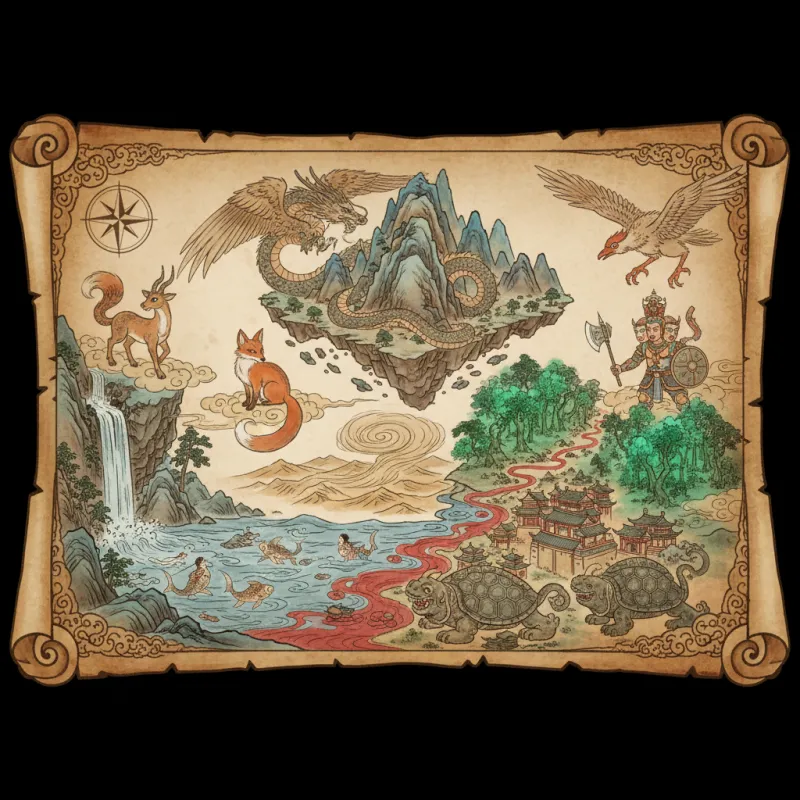
Picture this: a nine-tailed fox prowling through bamboo forests, its fur shimmering with an otherworldly glow. A bird with three legs circling the sun. A fish that transforms into a bird and soars across continents. These aren't fever dreams or modern fantasy—they're the guardians documented in the Shanhaijing 山海经 (Shānhǎijīng, Classic of Mountains and Seas), a text so strange and vivid that scholars still debate whether its authors were recording actual expeditions, preserving oral traditions, or channeling something altogether more mysterious.
Beyond Simple Monsters: Understanding Guardian Hierarchies
The creatures in the Shanhaijing aren't random beasts thrown together for entertainment. They operate within a sophisticated cosmological framework where every guardian serves a specific function. The Zhuque 朱雀 (Zhūquè, Vermillion Bird) doesn't just guard the south—it embodies the element of fire, the season of summer, and the concept of transformation itself. When you understand that the text was compiled during the Warring States period (475-221 BCE), a time of massive political upheaval, these guardians start looking less like folklore and more like a desperate attempt to map order onto chaos.
The hierarchy matters. At the top sit the Siling 四灵 (Sìlíng, Four Spirits)—the Azure Dragon, Vermillion Bird, White Tiger, and Black Tortoise—each commanding a cardinal direction. Below them, hundreds of lesser guardians patrol specific mountains, rivers, and regions. The Kaiming 开明 (Kāimíng) beast guards the Kunlun Mountains with its nine heads and human face, while the Lushu 鹿蜀 (Lùshǔ), a horse-bodied creature with a white head and tiger stripes, protects Mount Zhushan. This isn't random assignment—each guardian's physical characteristics directly correlate to the spiritual properties of their domain.
The Nine-Tailed Fox: Misunderstood Guardian or Genuine Threat?
Let's talk about the Jiuwei Hu 九尾狐 (Jiǔwěi Hú, Nine-Tailed Fox), because popular culture has done this creature dirty. Modern adaptations paint it as a seductress or villain, but the original Shanhaijing entry describes it as an auspicious guardian appearing during times of peace and prosperity. The text specifically states it dwells on Qingqiu Mountain and its appearance signals the rise of benevolent rulers.
So what happened? The fox's reputation shifted dramatically during the Tang Dynasty (618-907 CE) when Buddhist influences merged with existing folklore, transforming protective spirits into cautionary tales about desire and deception. By the time Journey to the West was written in the 16th century, fox spirits had become full-blown antagonists. But if you read the Shanhaijing without later cultural baggage, the nine-tailed fox is clearly a guardian of cosmic balance, not a threat to it. Its nine tails represent the nine provinces of ancient China—it's literally embodying territorial protection.
Geographic Guardians: Mapping the Unmappable
Here's where the Shanhaijing gets genuinely weird. The text describes 447 mountains, 258 rivers, and countless regions, each with its designated guardian. Mount Zhongshan has the Zhuyin 烛阴 (Zhúyīn), a creature so massive that when it opens its eyes, day breaks across the world, and when it closes them, night falls. The Ruoshui River is patrolled by creatures that prevent the unworthy from crossing—a mythological border control system.
Modern scholars like Rémi Mathieu have argued that these geographic descriptions might preserve genuine Bronze Age exploration routes, with "guardians" serving as mnemonic devices for remembering dangerous terrain or territorial boundaries. The Feiyu 飞鱼 (Fēiyú, Flying Fish) that guards certain coastal regions might actually reference real flying fish species, mythologized through repeated storytelling. But then you encounter something like the Xingtian 刑天 (Xíngtiān), a headless giant who uses his nipples as eyes and his navel as a mouth, and the "ancient exploration log" theory starts feeling inadequate.
Transformation and Duality: The Peng and Kun
The most philosophically rich guardian story in the Shanhaijing involves the Kun 鲲 (Kūn) and Peng 鹏 (Péng)—a fish that transforms into a bird. The Kun is so massive that "its back extends for thousands of miles," and when it transforms into the Peng, its wings "hang down like clouds from the sky." This isn't just a cool monster—it's a meditation on transformation, potential, and the artificial boundaries we place on existence.
The Kun-Peng guards the concept of possibility itself. It appears in the northern darkness, a liminal space between known and unknown, and its transformation represents the moment when potential becomes kinetic. Zhuangzi later appropriated this creature for his philosophical writings, but the Shanhaijing version is rawer, less metaphorical. It's a guardian that protects not a place but a state of being—the space where change happens. Compare this to the Western concepts of threshold guardians, and you'll see how uniquely Chinese this formulation is.
The Practical Magic of Guardian Invocation
The Shanhaijing wasn't meant to be read passively. Archaeological evidence from Han Dynasty (206 BCE - 220 CE) tombs shows that people used the text as a practical manual for invoking guardian protection. Specific creatures were called upon for specific needs: the Bai Ze 白泽 (Bái Zé), a creature that could speak human language and knew the names of all supernatural beings, was invoked for protection against evil spirits. The Qilin 麒麟 (Qílín), despite its later association with gentleness, was originally a fierce guardian that appeared only when sage rulers governed justly.
The text provides detailed information about each guardian's appearance, habitat, and the sounds they make—practical identification guides for spiritual practitioners. When the Shanhaijing says the Zouyu 騶虞 (Zōuyú) "looks like a tiger with five-colored markings and a tail longer than its body," it's not being poetic. It's giving you the information you need to recognize this guardian of righteousness when you encounter it, either in vision or reality.
Modern Resonance: Why These Guardians Still Matter
Walk through any Chinese city today and you'll see these guardians everywhere—on temple roofs, in video games, as corporate logos. But most people engaging with them have no idea they're interacting with a 2,400-year-old protection system. The Shanhaijing guardians have been so thoroughly absorbed into Chinese visual culture that they've become invisible through ubiquity.
What makes these guardians endure isn't their power or fearsome appearance—it's their specificity. Unlike vague protective deities, each Shanhaijing guardian has a job description, a territory, and a particular form of protection they offer. The Lushu prevents epidemics. The Qinyuan 钦原 (Qīnyuán) bird wards off fire. The Danghu 当扈 (Dānghù) protects against floods. This isn't abstract spirituality—it's a comprehensive emergency response system encoded in mythology.
The genius of the Shanhaijing is that it never explains itself. It presents these guardians as simple facts: "On this mountain lives this creature with these characteristics." No moralizing, no elaborate origin stories, just documentation. This restraint is what keeps the text alive. Every generation can project new meanings onto these guardians while the core descriptions remain unchanged, a stable foundation for endless interpretation.
The Unfinished Map
The Shanhaijing ends abruptly, mid-description, as if the compilers simply ran out of space or time. Scholars debate whether sections were lost or if the text was always meant to feel incomplete—a map that acknowledges its own limitations. Perhaps that's the final lesson of these guardians: protection isn't about controlling everything, but about knowing what you're protecting and why.
These creatures guard not just mountains and rivers but the boundaries between known and unknown, possible and impossible, human and divine. They're still on duty, waiting in the text, ready to be called upon by anyone willing to learn their names and understand their territories. The question isn't whether these guardians are real—it's whether we're still capable of seeing what they protect.
Related Reading
- Shanhai Jing in Modern Art: Contemporary Illustrations of Ancient Beasts — Shanhai Perspective
- Exploring the Myths of Serpents in the Shanhaijing: Creatures of Power and Mystery
- Magical Plants of the Shanhai Jing: Trees That Grant Immortality — Shanhai Perspective