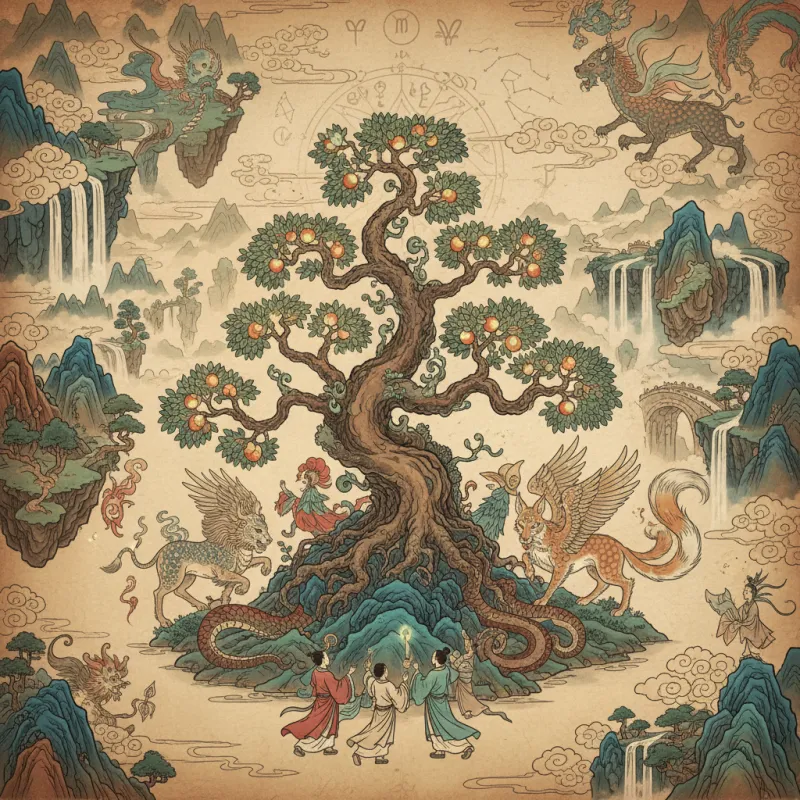
The ancient Chinese believed that death was negotiable. Not through prayer or sacrifice, but through botany. Somewhere in the mountains cataloged in the Shanhaijing (山海经 Shānhǎi Jīng, "Classic of Mountains and Seas"), there grew a tree whose fruit could make you immortal, a grass that could resurrect corpses, and flowers that rendered you invisible to ghosts and gods alike. This wasn't fantasy—it was geography. The text presents these plants with the same matter-of-fact tone it uses to describe regular mulberry trees and hemp fields, as if immortality were simply a matter of knowing which mountain to climb.
The Architecture of Eternity: World Trees
Before we get to the herbs that merely grant eternal life, we need to talk about the trees that hold up the universe itself.
The Fusang Tree (扶桑 Fúsāng) grows in the eastern ocean where the sun rises, its trunk so massive that it takes ten people holding hands to encircle it. According to the Shanhaijing, this is where the ten suns live—yes, ten, not one. Each morning, one sun would climb through the Fusang's branches and begin its journey across the sky while the other nine waited their turn. The tree's roots sit in a pool of boiling water called the Tang Valley (汤谷 Tāng Gǔ), which sounds less like a botanical habitat and more like a cosmic hot tub. When the archer Yi shot down nine of the ten suns during the legendary drought, he fundamentally changed the Fusang's purpose—it went from being a solar parking garage to a monument of divine punishment.
In the west stands the Ruomu Tree (若木 Ruòmù), the Fusang's sunset counterpart. This is where the sun rests after its daily journey, and the tree glows with residual solar energy throughout the night. The Shanhaijing describes it as having purple stems and black flowers, which makes sense if you think about it—it's absorbing the dying light of sunset every single day.
But the most important World Tree is Jianmu (建木 Jiànmù, "Establishing Wood"), which grows at the exact center of the world. This tree has no branches and no shade—it rises straight up like a cosmic elevator shaft connecting earth to heaven. Gods and shamans used it to travel between realms until the Yellow Emperor, worried about unauthorized traffic between the mortal and divine worlds, ordered it cut down. The stump supposedly still exists somewhere, leaking divine energy into the surrounding landscape. Some scholars argue that the later concept of the Kunlun Mountains as the axis mundi replaced the Jianmu myth, but I think they coexisted—one vertical, one horizontal, both serving as bridges to immortality.
The Immortality Pharmacy
Now we get to the practical stuff—the plants you could actually harvest and consume, assuming you could find them and survive the journey.
The Bùsǐ Tree (不死树 Bùsǐ Shù, literally "Not-Die Tree") grows on Mount Kunlun and produces fruit that grants immortality. The text is frustratingly vague about what this fruit looks like, but it's clear that eating it makes you immune to death by aging. Not immune to being stabbed or eaten by a nine-tailed fox, mind you—just aging. This is an important distinction that many immortality-seekers throughout Chinese history failed to appreciate.
The Xúnmù Grass (薰木草 Xúnmù Cǎo) grows on Mount Guye and has the power to resurrect the dead. The Shanhaijing specifies that you need to place it on a corpse, not feed it to them, which suggests it works through contact rather than ingestion. There's no mention of how fresh the corpse needs to be, which raises uncomfortable questions about the limits of its power. Could it resurrect someone dead for years? Decades? Would they come back as they were, or as a desiccated horror? The text doesn't say, which is probably for the best.
Zhūyú (朱萸 Zhūyú, "Vermillion Elm") grows on Mount Tiao and makes you immune to epidemics. During the Han Dynasty, people would wear sprigs of a plant they called zhūyú during the Double Ninth Festival, believing it would ward off disease. Whether this was the same plant described in the Shanhaijing is debatable—the real-world zhūyú is probably Cornus officinalis, a medicinal plant with antibacterial properties, but nothing that would make you plague-proof. Still, the tradition persisted for centuries, which tells you something about how seriously people took the Shanhaijing's botanical claims.
The Jade Orchards
Several mountains in the Shanhaijing grow trees that produce jade instead of fruit. Mount Zhongshan has Yùshù (玉树 Yùshù, "Jade Trees") whose branches are made of actual jade. Mount Kunwu has trees that grow jade flowers. Mount Zhaoyu has forests where jade grows like apples.
This isn't metaphor. The text describes these as actual geological phenomena—trees that somehow mineralize jade through their biological processes. Modern readers tend to interpret this as poetic exaggeration, but I think the ancient compilers of the Shanhaijing were trying to document something they'd actually heard about: perhaps jade deposits that formed in tree-like crystalline structures, or jade objects that had been carved to look like trees and were later misidentified as natural formations.
The Mílǐ Tree (迷黎树 Mílí Shù) on Mount Kunlun produces jade-like fruit that, when eaten, makes you immune to confusion and delusion. This is one of the more psychologically sophisticated immortality plants—it doesn't just extend your life, it clarifies your mind. In Daoist practice, mental clarity was considered a prerequisite for immortality, so a plant that granted both would have been the ultimate prize.
The Invisibility Garden
Several plants in the Shanhaijing grant invisibility, but they work in different ways.
The Shìwēi Grass (视威草 Shìwēi Cǎo) makes you invisible to humans but not to spirits. The Guǐjiàn Grass (鬼见草 Guǐjiàn Cǎo, "Ghost-Seeing Grass") does the opposite—it makes you invisible to ghosts but visible to humans. There's a certain bureaucratic logic to this: the spirit world and human world operate on different frequencies, and you need different plants to jam each signal.
The most powerful invisibility plant is the Línglíng Grass (灵灵草 Línglíng Cǎo), which grows on Mount Lingshan and makes you completely invisible to everything—humans, spirits, and gods. The text warns that people who use this grass sometimes forget they're invisible and starve to death because they can't see their own hands to feed themselves. This is the kind of specific, practical warning that makes me think someone actually tried this and reported back before dying of confusion-induced starvation.
The Poison Gardens
Not all magical plants in the Shanhaijing are beneficial. Some are spectacularly dangerous.
The Dúrén Tree (毒人树 Dúrén Shù, "Poison-Person Tree") grows on Mount Gouwu, and its shade alone can kill you. Not its fruit, not its sap—its shadow. Stand under it too long and you'll die. The text doesn't explain the mechanism, but it's described with the same clinical precision as the beneficial plants, suggesting this was considered a real hazard.
The Gūhún Flower (孤魂花 Gūhún Huā, "Lonely Soul Flower") grows in the underworld regions and attracts ghosts. If you pick one, ghosts will follow you home. This isn't necessarily fatal, but it's definitely inconvenient. The flower apparently smells like death to humans but like home to spirits, which raises questions about olfactory perception across the life-death boundary.
The Practical Problem of Magical Botany
Here's what the Shanhaijing never addresses: if these plants are real and their locations are documented, why isn't everyone immortal?
The text provides detailed geographic coordinates for most of these plants—Mount Kunlun is 800 li west of the Central Kingdom, Mount Lingshan is 500 li south of Mount Kunlun, and so on. These aren't vague "somewhere in the west" directions. They're specific. So why didn't every emperor send expeditions to harvest immortality fruit?
Some did. Qin Shi Huang, China's first emperor, sent the explorer Xu Fu with 3,000 people to find the islands of the immortals and bring back the elixir of life. He never returned—some say he founded Japan instead, which is either the greatest career pivot in history or a convenient excuse for failure. The Han Dynasty emperor Wu sent multiple expeditions to Mount Kunlun. None succeeded.
The most likely explanation is that the Shanhaijing's geography is deliberately scrambled. The distances are real, but the directions are encoded. It's a treasure map where X marks the spot, but the map itself is in cipher. You need the key to decode it, and that key was probably transmitted orally, master to student, and has been lost for two thousand years.
Or maybe the plants were real but have gone extinct. Climate change, deforestation, over-harvesting by immortality-seekers—any of these could have wiped out a species. We've lost thousands of plant species in the past two millennia. Maybe the Bùsǐ Tree was one of them, and immortality died with it.
The Legacy in Literature and Medicine
The Shanhaijing's magical plants influenced Chinese literature and medicine for centuries. The Bencao Gangmu (本草纲目 Běncǎo Gāngmù), the great Ming Dynasty pharmacological encyclopedia, references several Shanhaijing plants while carefully noting that their properties "cannot be verified." This is 16th-century scientific skepticism, but the fact that Li Shizhen felt compelled to include them at all shows their cultural staying power.
In fiction, these plants appear everywhere. Journey to the West features the Ginseng Fruit that grants 47,000 years of life. Strange Tales from a Chinese Studio includes dozens of stories about magical herbs with impossible properties. Even modern Chinese fantasy novels like Lord of the Mysteries and Reverend Insanity feature elaborate systems of magical plants clearly inspired by the Shanhaijing's botanical catalog.
The real genius of the Shanhaijing's plant sections is that they treat immortality as a technical problem with a botanical solution. Not a spiritual achievement, not a divine gift—just a matter of finding the right plant and eating it. This materialist approach to transcendence is very Chinese, very practical, and very appealing. It suggests that death is just another disease, and somewhere in the mountains, there's an herb that cures it.
We just have to find it first.
Related Reading
- Mythical Plants of the Shanhaijing: Trees That Grant Immortality and Flowers That Kill — Shanhai Perspective
- Unearthing the Mythical Flora in Shanhaijing: A Journey Through Legendary Plants
- Lingzhi: The Mushroom of Immortality from Myth to Medicine — Shanhai Perspective
- The Peaches of Immortality: The Most Famous Fruit in Chinese Mythology — Shanhai Perspective
- The Bizarre Plants of the Shanhaijing: Trees That Cure Death and Fruits That Grant Flight — Shanhai Perspective
- Unearthing the Cursed Beings of Shanhaijing: Myths, Creatures, and Lands
- Mystical Fish of Shanhaijing: Exploring Legendary Creatures and Enchanted Waters
- Exploring the Myths of Serpents in the Shanhaijing: Creatures of Power and Mystery