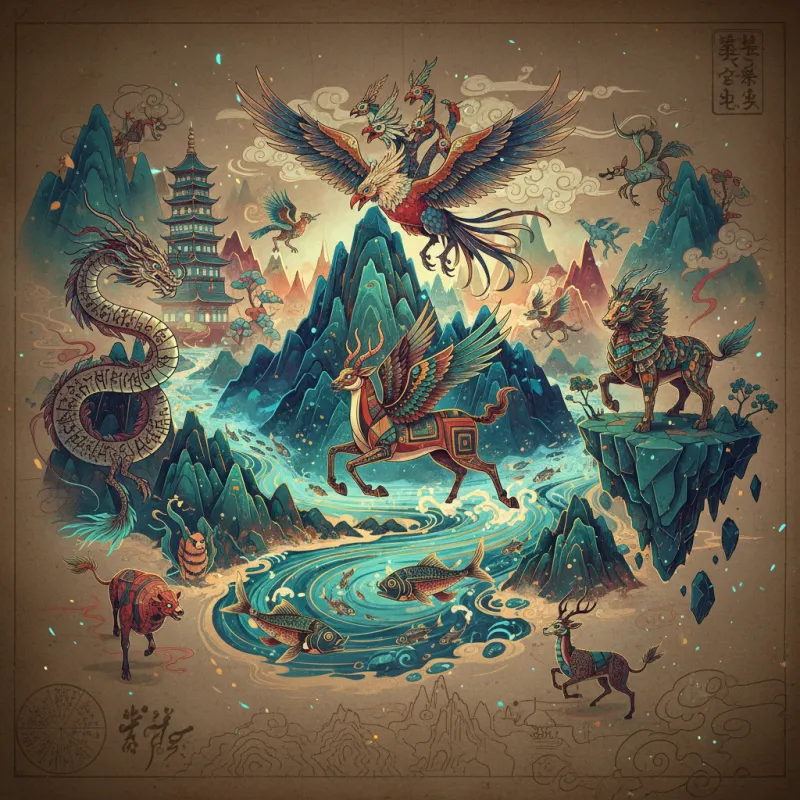
A nine-tailed fox rendered in neon gradients. The Zhuque (朱雀 Zhūquè) reimagined as a phoenix made of circuit boards. The Taotie (饕餮 Tāotiè) mask glitching across a digital canvas. Walk through any contemporary art exhibition in Beijing, Shanghai, or Taipei today, and you'll find the creatures of the Shanhaijing (山海经 Shānhǎi Jīng, Classic of Mountains and Seas) everywhere — but they look nothing like their Ming dynasty ancestors. Modern illustrators aren't just copying ancient beasts. They're having a conversation with them, two millennia in the making.
The Original Creative Brief
The Shanhaijing might be the most productive constraint in art history. Written between the 4th century BCE and 2nd century CE, it catalogs hundreds of mythical creatures with descriptions that are maddeningly sparse. "There is a beast that looks like a sheep with nine tails and four ears, and eyes on its back" (有兽焉,其状如羊而九尾四耳,其目在背). That's it. No color palette. No texture notes. No mood board. Just enough information to know something extraordinary exists, but not enough to pin it down.
This vagueness wasn't a bug — it was the feature. Ancient Chinese texts often prioritized essence over appearance, the shen (神 shén, spirit) over the xing (形 xíng, form). The Shanhaijing tells you what a creature is and what it does, but how it looks? That's your problem to solve. And artists have been solving it differently for two thousand years.
From Woodblock to Wacom Tablet
The earliest surviving illustrated editions emerged during the Ming dynasty (1368-1644), with Jiang Yinghao's 1597 compilation becoming the visual standard. Those woodblock prints established a visual language: creatures rendered in confident black lines, positioned in profile, surrounded by stylized mountains and waves. They looked authoritative, almost scientific — as if the artist had sketched them from life.
But here's what's fascinating: even those "classical" illustrations were already interpretations. The Bifang (毕方 Bìfāng), a one-legged bird associated with fire, appears differently across various Ming editions. Some show it with elaborate plumage, others keep it stark and simple. Some emphasize its human-like face, others make it more avian. The text says it's "like a crane with one leg, red markings and a white beak" — everything else is artistic license.
Contemporary illustrators understand they're part of this tradition of creative interpretation, not breaking from it. The difference is they're working with new tools, new visual vocabularies, and new cultural contexts. A modern artist might render the Bifang in the style of Studio Ghibli, or as a minimalist logo, or as a photorealistic 3D model. Each choice is valid because the Shanhaijing never demanded fidelity to a single vision.
The New Bestiary
Today's Shanhaijing illustrators fall into several camps, each with distinct approaches. The neo-traditionalists work in digital media but maintain classical composition and line work — think of artists like Zeng Xiaojun (曾小俊), whose creatures feel like they could have been painted during the Song dynasty, except the colors are impossibly vibrant and the details impossibly precise. Digital tools let them achieve what ancient artists might have dreamed of: perfect gradients, flawless symmetry, colors that seem to glow from within.
Then there are the fusion artists who deliberately mash up Eastern and Western visual traditions. The Qiongqi (穷奇 Qióngqí), traditionally described as a winged tiger that eats people, might be rendered with the anatomical precision of Western natural history illustration combined with the flat perspective and bold outlines of traditional Chinese painting. These artists aren't confused about their cultural identity — they're expressing it. They grew up watching both Journey to the West and Disney films, reading both classical texts and manga. Their Shanhaijing creatures reflect that hybrid consciousness.
The speculative realists take a different approach entirely. They ask: what if these creatures actually existed? What would their skeletal structure look like? How would their muscles attach? What evolutionary pressures would create a nine-tailed fox? Artists like Ah Zhong (阿钟) create Shanhaijing illustrations that look like they belong in a biology textbook from an alternate universe. It's the same impulse that drives paleontologists to reconstruct dinosaurs from fragmentary fossils — except the source material is mythology, not bone.
Why Now?
The explosion of contemporary Shanhaijing illustration isn't random. It's happening at a specific cultural moment when China is simultaneously looking backward and forward, trying to articulate a modern identity rooted in ancient traditions. The creatures of the Shanhaijing are perfect vehicles for this project because they're unmistakably Chinese but also fundamentally weird and wild — they resist easy commodification or nationalist appropriation.
You see this in how these illustrations circulate. They're not just in galleries or art books. They're on phone cases, in video games, as tattoos, in animated films. The Taotie mask shows up in League of Legends. The Jiuwei Hu (九尾狐 Jiǔwěi Hú, nine-tailed fox) appears in dozens of mobile games, each with a different design. The Shanhaijing has become a shared visual language, a common reference pool that artists can draw from and remix.
This democratization of Shanhaijing imagery would have been impossible twenty years ago. Digital tools and social media platforms mean that a teenager in Chengdu with a drawing tablet can create their version of the Kunpeng (鲲鹏 Kūnpéng) and share it with millions. No gatekeepers, no gallery system, no need for expensive printing. The barrier to entry has collapsed, and the result is an explosion of creativity and diversity in how these ancient creatures are visualized.
The Interpretation Problem
But this abundance creates its own challenges. When everyone can illustrate the Shanhaijing, how do you know which interpretations are "good"? What makes one version of the Xuanwu (玄武 Xuánwǔ, the black tortoise-snake hybrid) more compelling than another?
The answer isn't about accuracy to the text — that's impossible when the text is deliberately vague. Instead, the best contemporary Shanhaijing illustrations succeed by making strong, specific choices. They commit to a vision. A mediocre illustration tries to include every possible interpretation, hedging its bets. A great one picks a lane and floors it.
Take the Nian (年兽 Niánshòu), the New Year beast. The text describes it as a creature that emerges once a year to terrorize villages. Some modern illustrators make it cute and marketable, perfect for children's books. Others lean into body horror, creating something genuinely unsettling. Both approaches work because they're decisive. What doesn't work is trying to make it cute and scary, traditional and modern, faithful and innovative. The Shanhaijing rewards boldness.
Living Mythology
The most exciting contemporary Shanhaijing illustrations don't treat the text as a museum piece to be preserved. They treat it as a living mythology that can grow and change. This means sometimes taking liberties that would make classical scholars wince.
Artist Huang Jiabao (黄嘉宝) created a series imagining Shanhaijing creatures in modern urban environments — the Feiyi (飞鱼 Fēiyú, flying fish) navigating Shanghai's subway system, the Lushu (鹿蜀 Lùshǔ, a horse-like creature with a white tail) grazing in a parking lot. It's playful, but it's also making a serious point: these creatures belong to the present, not just the past. They can adapt to new contexts, new environments, new meanings.
This is how mythology stays alive. The Greek gods survived because each generation reimagined them — Renaissance painters, Romantic poets, modern novelists, Marvel movies. The Shanhaijing creatures are undergoing the same process. They're being pulled into the 21st century, sometimes gently, sometimes violently, but always with the understanding that they're flexible enough to survive the journey.
The Unfinished Bestiary
What makes the Shanhaijing such fertile ground for contemporary illustration is that it was never finished. The text itself is fragmentary, compiled from multiple sources, full of contradictions and gaps. It's less a complete encyclopedia than a collection of field notes from explorers who may or may not have been reliable.
Modern illustrators aren't corrupting some pure original vision — they're continuing a process that started thousands of years ago. Every illustrated edition of the Shanhaijing is someone's interpretation, someone's best guess at what these creatures might look like. The Ming woodblocks, the Qing paintings, the contemporary digital art — they're all part of the same ongoing project of visualization and imagination.
The Shanhaijing will never be definitively illustrated because it was never meant to be. It's a text that generates images rather than prescribing them, a creative brief that stays open forever. Two thousand years from now, if humans are still making art, they'll probably still be drawing these creatures, and they'll look nothing like what we imagine today. That's not a failure of the tradition — it's the whole point.
The ancient compiler who wrote "a beast like a sheep with nine tails" knew exactly what they were doing. They were handing future artists an impossible, irresistible challenge: show me something I've never seen before, but make me believe it's been there all along. Contemporary illustrators are still taking that challenge, armed with Wacom tablets instead of brushes, Photoshop instead of ink. The tools change. The conversation continues.
Related Reading
- Modern Artists Reimagining the Classic of Mountains and Seas
- Shanhaijing in Video Games and Anime
- Chinese Mythology in Hollywood: From Mulan to Shang-Chi — Shanhai Perspective
- Shanhai Jing Creatures in Modern Video Games — Shanhai Perspective
- Exploring the Enigmatic Creatures and Lands of Shanhaijing: A Cultural Journey
- Exploring the Enigmatic Creatures and Lands of the Shanhaijing
- Leviathans of the Eastern Sea: Giant Sea Creatures in Chinese Myth