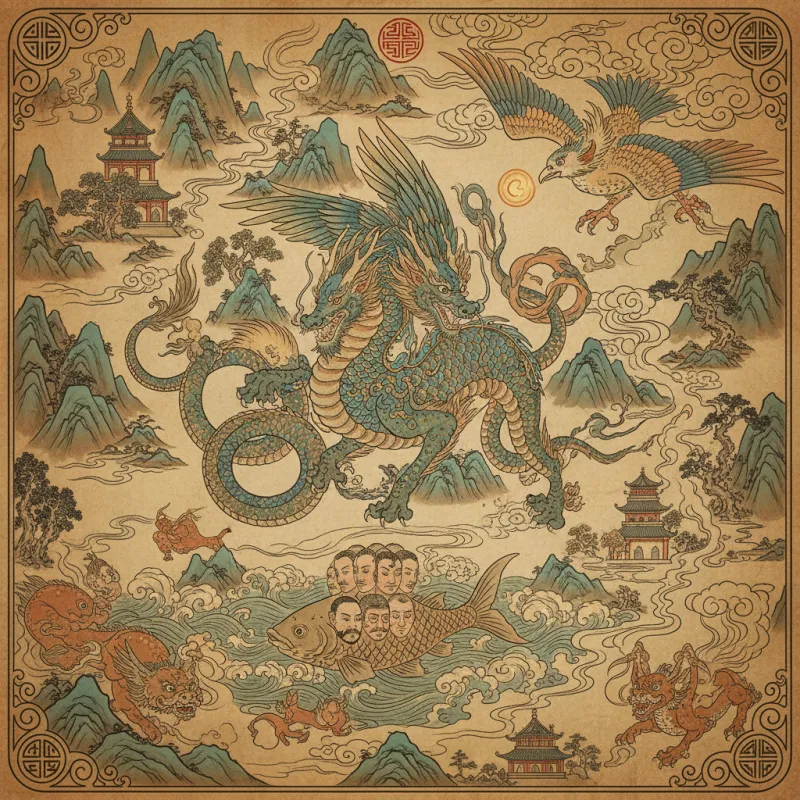
Picture this: a creature with nine human heads sprouting from a serpent's body, each face frozen in a different expression of ancient wisdom. Or a bird with three legs that carries the sun across the sky. These aren't fever dreams or modern fantasy—they're meticulous descriptions from the Shanhaijing (山海经, Shānhǎijīng), a text compiled over 2,000 years ago that reads like a field guide to impossible beings. What makes these hybrid creatures so captivating isn't just their bizarre anatomy, but what they reveal about how ancient Chinese scholars understood the boundaries between human, animal, and divine.
When Categories Collapse: The Logic Behind Hybrid Forms
The Western mind tends to compartmentalize: humans here, animals there, gods somewhere else entirely. But the Shanhaijing operates on different principles. Its hybrid creatures aren't violations of natural law—they're expressions of a worldview where transformation and fluidity are fundamental truths. Take the Kaiming (开明兽, Kāimíng shòu), the guardian of heaven's gate, described as having nine human heads on a tiger's body. This isn't random monster-making. Each head represents a direction of cosmic awareness, while the tiger body embodies the raw power needed to protect sacred boundaries. The hybrid form is the point—it's the only way to visualize a being that must simultaneously perceive all approaches while possessing the strength to repel threats.
What's fascinating is how specific these descriptions are. The text doesn't just say "weird creature." It gives you measurements, locations, behavioral patterns. The Yingzhao (英招, Yīngzhāo) on Mount Huai has a horse's body, human face, tiger stripes, and bird wings—and it specifically makes sounds like phoenixes. This precision suggests the compilers weren't inventing fantasies but documenting what they believed to be genuine geographic and zoological information about distant, unexplored regions. The hybridity wasn't the strange part to them; it was simply what existed beyond the known world.
The Human-Animal Spectrum: Degrees of Transformation
Not all hybrids in the Shanhaijing are created equal. There's a clear spectrum from mostly-human-with-animal-features to mostly-animal-with-human-elements, and where a creature falls on this spectrum matters. The Xihai (西海, Xīhǎi) region describes beings with human bodies but fish tails—essentially merfolk—who retain human intelligence and social structures. Compare this to the Feilian (飞廉, Fēiliǎn), which has a deer's body, bird's head, horns, leopard's tail, and snake patterns. It's described as a wind deity, but there's no mention of human-level consciousness or society.
This gradation reflects ancient Chinese philosophical debates about what makes something human. Is it the face? The ability to speak? Social organization? The Shanhaijing seems to argue that humanity isn't binary—it's a quality that can be partially present, mixed with other forms of being. The Xingtian (刑天, Xíngtiān), famously depicted with nipples for eyes and a navel for a mouth after being beheaded, retains his warrior spirit and continues fighting despite losing his human head entirely. His humanity persists through will and action, not anatomy.
The text also features creatures that seem to be humans caught mid-transformation, like the inhabitants of the Guannei (关内, Guānnèi) region who have human faces but bird beaks. Are they humans becoming birds, birds becoming humans, or a stable hybrid state? The Shanhaijing rarely explains, leaving us to wonder whether these forms are permanent conditions or snapshots of ongoing metamorphosis. This ambiguity might be intentional—a way of suggesting that identity itself is always in flux.
Divine Hybrids: When Gods Need Multiple Forms
The most powerful beings in the Shanhaijing are often the most hybrid. Nüwa (女娲, Nǚwā), the creator goddess who repaired the sky and fashioned humanity from clay, is depicted with a human upper body and serpent lower body in later iconography influenced by the text's descriptions. Her hybrid form isn't a limitation—it's a visual representation of her role as a bridge between the earthly (serpent, associated with the ground and fertility) and the celestial (human, associated with consciousness and creativity).
Then there's Zhulong (烛龙, Zhúlóng), the Torch Dragon, described as having a human face on a serpent body thousands of miles long. When he opens his eyes, it's day; when he closes them, night falls. His breathing creates the seasons. This isn't just a big snake with a face—it's a cosmological principle given physical form. The human face suggests intentionality and awareness; the serpent body represents the vast, cyclical forces of nature. Only a hybrid form can embody both the personal and the cosmic simultaneously.
What's striking is how these divine hybrids differ from the guardian creatures that protect specific locations. Guardian beings tend to have more animalistic features—they're fierce, territorial, instinctive. Divine hybrids retain more human characteristics because they need to interact with human consciousness, to be understood and petitioned. The Shanhaijing seems to suggest that the more a being needs to interface with humanity, the more human features it requires, even if its essential nature is something else entirely.
Regional Variations: Geography Shapes Hybridity
One of the most overlooked aspects of the Shanhaijing is how different regions produce different types of hybrids. The eastern regions, closer to the sea, feature more aquatic hybrids—fish-tailed humans, beings with scales, creatures that blur the line between marine and terrestrial life. The western mountains, by contrast, are home to bird-human hybrids and beings that combine mammalian features. This isn't random. The text reflects a belief that environment shapes form, that the creatures of a place emerge from and embody that place's essential character.
The southern regions are particularly rich in transformation myths, with beings that seem to shift between forms or possess multiple simultaneous natures. The Bingfeng (冰峰, Bīngfēng) region describes people with wings who can fly but also walk on land, suggesting a culture that valued adaptability and multiple modes of being. Meanwhile, the northern wastes feature more extreme hybrids—beings so far removed from familiar forms that they challenge comprehension entirely.
This geographic distribution suggests the Shanhaijing compilers understood hybridity as a response to environmental pressures. Just as real animals adapt to their habitats, mythical beings in the text develop features suited to their regions. It's a surprisingly ecological way of thinking about mythology—one that sees even impossible creatures as part of coherent ecosystems rather than random supernatural intrusions.
The Shadow Side: Monstrous Hybrids and Moral Warnings
Not all hybrids in the Shanhaijing are neutral or benevolent. Some are explicitly dangerous, their hybrid nature marking them as threats to human order. The Taowu (梼杌, Táowù) is described as having a human face on a tiger's body, with boar's teeth and a tail nine feet long. But unlike guardian hybrids, the Taowu represents stubbornness and ignorance—it's one of the Four Perils, creatures that embody negative human qualities taken to monstrous extremes.
This reveals another function of hybrid creatures in the text: they externalize internal human struggles. The Qiongqi (穷奇, Qióngqí), another of the Four Perils, has wings and a hedgehog's spines, and it specifically attacks righteous people while protecting the wicked. Its hybrid form—combining the mobility of flight with defensive spines—makes it a perfect physical metaphor for how evil can be both aggressive and self-protective, attacking virtue while defending vice.
These monstrous hybrids serve as warnings. They show what happens when certain qualities—stubbornness, wickedness, chaos—are allowed to develop unchecked. Their hybrid forms make them memorable, turning abstract moral lessons into vivid, unforgettable images. A child hearing about the Taowu wouldn't just learn "don't be stubborn"—they'd remember the tiger-faced monster with boar's teeth, and that visceral image would stick far longer than any lecture.
Living Legacy: Why These Hybrids Still Matter
Walk through any Chinese art museum, and you'll see echoes of Shanhaijing hybrids everywhere. The dragon, China's most iconic creature, is itself a hybrid—scales of a fish, claws of an eagle, body of a snake, face that's almost human. It's a Shanhaijing creature that escaped the text and became a cultural symbol. The same is true of the phoenix, the qilin, and dozens of other beings that started as entries in an ancient geographic text and became foundational to Chinese visual culture.
But the deeper legacy is philosophical. The Shanhaijing hybrids taught generations of Chinese thinkers to see boundaries as permeable, categories as fluid, and transformation as natural. This worldview influenced everything from Daoist alchemy (which sought to transform the human body into something more refined) to traditional Chinese medicine (which sees health as a balance of different elemental forces within a single body). The hybrid creatures weren't just stories—they were models for understanding reality itself.
Today, as we grapple with questions about artificial intelligence, genetic engineering, and human enhancement, the Shanhaijing feels oddly contemporary. Its hybrids ask: What makes something human? Can identity be multiple? Is transformation loss or evolution? These aren't ancient questions—they're the questions of our moment, and a 2,000-year-old text about impossible creatures might have more to teach us than we expect. The nine-headed serpent and the three-legged sun-bird aren't relics of a primitive past. They're sophisticated thought experiments about the nature of being, preserved in the form of a bestiary.
Related Reading
- Unearthing the Mythical Flora in Shanhaijing: A Journey Through Legendary Plants
- Exploring the Enigmatic Creatures and Lands of Shanhaijing: A Cultural Journey
- Giants and Gods: The Titans of the Shanhai Jing