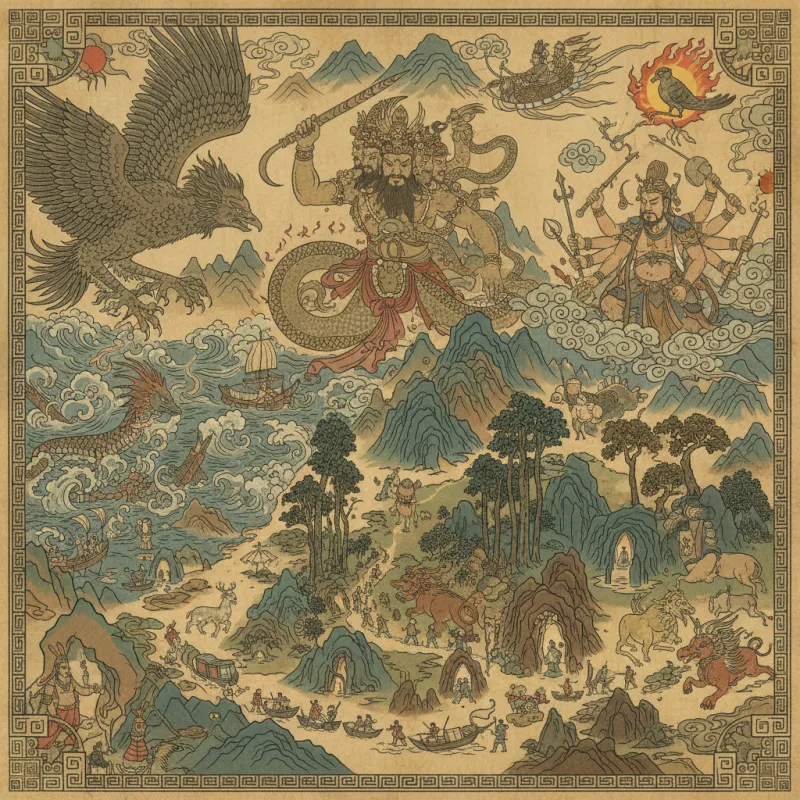
When Kua Fu (夸父, Kuā Fù) collapsed in the wilderness, his corpse didn't simply decay — it transformed the landscape itself. His abandoned walking staff sprouted into the Deng Forest (邓林, Dèng Lín), a vast peach grove that would feed travelers for generations. His body became mountains. This wasn't metaphor in the Shanhai Jing's worldview; it was geology. The titans of this ancient text don't just interact with nature — they are nature, their flesh and bone literally composing the world we inhabit.
The Physics of Mythic Bodies
The Shanhai Jing operates on a fundamentally different logic than later Confucian texts. Here, size isn't symbolic — it's structural. When the text describes Kua Fu drinking the Yellow River dry in his pursuit of the sun, it's not exaggerating for effect. It's explaining why certain rivers run shallow in summer, why peach forests grow in unexpected places, why mountain ranges have the shapes they do. These titans are etiological figures, their deaths and transformations providing origin stories for geographical features that ancient Chinese travelers actually encountered.
This stands in stark contrast to the more refined gods of later mythology. The Jade Emperor doesn't become a mountain when he dies because he's not supposed to die — he exists in a bureaucratic heaven, far removed from earthly concerns. But Kua Fu, Xing Tian, and their kin are of the earth, bound to it through their very substance. They're pre-civilizational forces, remnants of a wilder cosmos.
Kua Fu: Ambition Without Wisdom
The story of Kua Fu chasing the sun reads like a cautionary tale, but the Shanhai Jing never explicitly condemns him. He simply acts — driven by an impulse we might call hubris, or might call magnificent foolishness. He runs westward, pursuing the setting sun with single-minded determination. The Yellow River (黄河, Huáng Hé) and Wei River (渭河, Wèi Hé) disappear down his throat, yet his thirst remains unquenched. He turns north toward the Great Marsh (大泽, Dà Zé), but collapses before reaching it.
What's striking is the absence of divine punishment. Zeus would have struck him down with lightning for such presumption. But in the Shanhai Jing, Kua Fu's death comes from natural limits — dehydration, exhaustion, the simple physics of a body pushed beyond endurance. His transformation into landscape feels less like punishment and more like recycling, the cosmos efficiently repurposing his massive form. The peach forest that springs from his staff even serves a benevolent purpose, offering shade and fruit to future travelers. In death, Kua Fu becomes more useful than he ever was in life.
Xing Tian: Rage Without End
If Kua Fu represents doomed ambition, Xing Tian (刑天, Xíng Tiān) embodies pure, undying defiance. The Shanhai Jing's account is brutally concise: the Yellow Emperor (黄帝, Huáng Dì) decapitated him, burying his head in Changyang Mountain (常羊山, Cháng Yáng Shān). Most beings would consider this the end of the story. Xing Tian did not.
He transformed his body into a new form of existence — his nipples became eyes, his navel became a mouth. Wielding a shield and battle-axe, he continued fighting, headless but undefeated. The image is viscerally disturbing and strangely inspiring. Xing Tian doesn't accept the logic of mortality, doesn't acknowledge that decapitation should mean death. He simply continues, redefining what a body can be, what consciousness can inhabit.
Later poets, particularly Tao Yuanming in the Jin Dynasty, would celebrate Xing Tian as a symbol of indomitable spirit. But the original Shanhai Jing text offers no moral commentary — it simply reports this impossible fact, this titan who refused to stop existing. Like the strange peoples dwelling at the edges of the known world, Xing Tian represents a reality that doesn't conform to civilized expectations.
Gong Gong: The Flood-Bringer
Gong Gong (共工, Gòng Gōng) appears in multiple Chinese texts, but the Shanhai Jing version emphasizes his role as a destructive force of water. In his rage — sources vary on whether he was fighting the fire god Zhu Rong or the legendary emperor Zhuan Xu — he smashed his head against Mount Buzhou (不周山, Bù Zhōu Shān), one of the pillars holding up the sky.
The consequences were catastrophic and permanent. The sky tilted to the northwest, which is why the sun, moon, and stars move in that direction. The earth tilted to the southeast, which is why China's rivers flow eastward toward the Pacific. Gong Gong's tantrum literally broke the world's axis, fundamentally altering the planet's orientation. Later, the goddess Nüwa would have to smelt five-colored stones to repair the damaged sky, but the tilt remained — a permanent scar from the titans' wars.
What's fascinating is how this myth naturalizes China's geography. The eastward flow of rivers isn't random hydrology — it's the lasting consequence of divine violence. The movement of celestial bodies isn't astronomy — it's the visible evidence of a broken cosmic architecture. Gong Gong transforms natural phenomena into narrative, giving the physical world a biographical history.
The Titan's Paradox: Creation Through Destruction
These giants share a common pattern: their greatest impacts come through failure and death. Kua Fu creates the peach forest by dying. Xing Tian becomes a symbol of resistance by losing. Gong Gong shapes the world's geography through destructive rage. They're not wise culture-heroes like the Yellow Emperor or benevolent creators like Nüwa — they're forces of chaos whose very existence reshapes reality.
This reflects a deeper truth in the Shanhai Jing's cosmology. The text describes a world still in formation, where the boundaries between categories remain fluid. Giants can become mountains. Corpses can become forests. A headless body can continue fighting. The world isn't yet fixed into its final form — it's still being negotiated through conflict, transformation, and the sheer physical presence of enormous beings.
Compare this to the more orderly cosmos of later Chinese philosophy, where everything has its proper place in a hierarchical system. The titans of the Shanhai Jing predate that order. They're remnants of a wilder time, when the world was still being literally hammered into shape through the actions of beings too large and too powerful to be contained by social norms or moral categories.
Why Giants Matter Now
Modern readers might dismiss these stories as primitive explanations for natural phenomena — ancient people didn't understand geology, so they invented giants. But this misses the psychological power of the titan narrative. These stories acknowledge something true: that we live in a world shaped by forces vastly larger than ourselves, forces that operated long before human civilization and will continue long after.
When we look at a mountain range, we're seeing the result of tectonic forces operating over millions of years. When ancient Chinese travelers looked at the same mountains, they saw Kua Fu's body. Both perspectives recognize human smallness in the face of geological time and scale. The Shanhai Jing's version simply gives that recognition a face, a story, a name.
The titans also represent a kind of freedom that civilized mythology can't accommodate. They act without permission, without regard for consequences, without fitting into any cosmic bureaucracy. They're too big for the world they inhabit, and their very existence strains the boundaries of what's possible. In an era of increasing systematization and control, there's something appealing about beings who simply cannot be contained, who break the world through their sheer presence and leave it permanently changed.
The peoples and creatures of the Shanhai Jing remind us that the ancient Chinese imagination was vast enough to contain multitudes — not just orderly kingdoms and wise emperors, but also headless warriors who refuse to die, giants who drink rivers dry, and water gods whose rage tilts the entire world. These titans are the foundation stones of Chinese mythology, literally and figuratively. They're the bedrock upon which more refined stories would later be built, but they retain their raw power precisely because they were never refined, never domesticated, never made to fit comfortably into civilized narratives.
Related Reading
- The Peoples of the Shanhaijing: Foreign Nations at the Edge of the World
- The Feathered People: Winged Humans of the Shanhai Jing
- Strange Nations of the Shanhai Jing: A Catalog of Impossible Peoples
- Nüwa Creates Humanity: Sculpting People from Yellow Earth
- The Jade Palace of Kunlun: Home of the Queen Mother of the West — Shanhai Perspective
- Immersive Wonders of Shanhaijing: Exploring Mythical Birds and Enchanted Regions