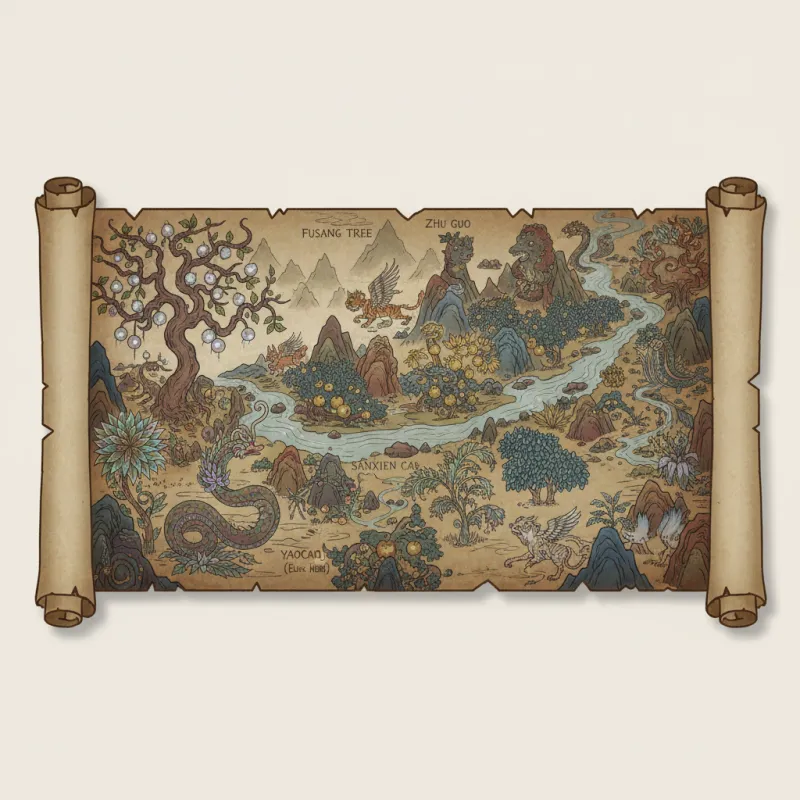
Deep in the mountains where jade grows like weeds and rivers run with liquid gold, the ancient compilers of the Shanhaijing stumbled upon something extraordinary: plants that could resurrect the dead, trees that bore pearls instead of fruit, and grasses that made men immortal. These weren't mere botanical curiosities—they were the living bridges between the mortal realm and the divine, carefully catalogued in what remains one of China's most enigmatic texts.
The Botanical Oddities That Defied Nature
The Shanhaijing (山海经, Shānhǎi Jīng), compiled between the 4th century BCE and the early Han dynasty, reads like a fever dream of a botanist who wandered too far into the wilderness. Unlike the practical herbals that would later dominate Chinese medical literature, this text revels in impossibility. Take the Xunmu (寻木, Xúnmù), a tree described in the Western Mountains section that supposedly allowed anyone who ate its fruit to bear many children. Not metaphorically—the text is frustratingly literal about these effects, as if the compilers expected readers to actually seek these plants out.
What strikes me most about these botanical entries is their specificity. The text doesn't just say "a magical tree exists somewhere." It tells you exactly which mountain, which direction, what the leaves look like, and what happens when you consume it. The Bugan tree (不敢树, Bùgǎn Shù) grows on Mount Kunlun, has leaves like those of a pear tree, and grants fearlessness to anyone who eats its fruit. This precision suggests something fascinating: either the compilers were creating an elaborate fantasy with internal consistency, or they were documenting genuine folk beliefs about real locations.
The Geography of Impossible Botany
The mythical plants of Shanhaijing aren't randomly scattered—they follow a distinct geographical logic. The most potent specimens cluster around Mount Kunlun (昆仑山, Kūnlún Shān), the axis mundi of Chinese cosmology. This makes sense when you consider that Kunlun was believed to be the dwelling place of the Queen Mother of the West, Xiwangmu (西王母, Xīwángmǔ), who herself tended gardens of immortality-granting peaches. The closer you get to divine territory, the more reality bends.
But here's where it gets interesting: many of these plants appear in regions that correspond to actual geographical features. The text describes the Zhimu grass (芝木, Zhīmù) growing in southern mountains where the climate is warm and humid—precisely where real medicinal fungi and rare herbs would thrive. Were the compilers encoding actual botanical knowledge within mythological frameworks? Some scholars argue that plants like the legendary Lingzhi mushroom (灵芝, Língzhī), which appears throughout Chinese medicine, might have originated from these Shanhaijing descriptions before being "rationalized" into real-world herbology.
Plants That Cheat Death
The most coveted category of Shanhaijing flora are those that promise immortality or resurrection. The Busi grass (不死草, Bùsǐ Cǎo)—literally "not-die grass"—appears multiple times across different mountain ranges, each time with slightly different properties. In one account, it grows on Mount Kunwu and can revive the recently deceased. In another, it merely extends life indefinitely. This variation isn't sloppy editing; it reflects the oral traditions from different regions that the compilers were trying to preserve.
The Huansheng tree (还生树, Huánshēng Shù) takes this concept further. According to the text, this tree's leaves, when placed on a corpse, can restore life regardless of how long the person has been dead. The Han dynasty scholar Guo Pu (郭璞, Guō Pú), in his 4th-century commentary, noted that people in his time still searched for this tree, suggesting these weren't just ancient myths but living beliefs that persisted for centuries. The desperation for immortality that drove emperors to consume mercury and seek the Penglai islands (蓬莱, Pénglái) had its roots in these botanical legends.
What fascinates me is how these plants mirror the mythical creatures of the Shanhaijing—both represent humanity's attempt to map the boundaries of the possible. Just as the text describes animals with human faces or birds with three heads, it presents plants that violate every rule of botany. They're thought experiments in biological form.
The Sensory Strangeness of Mythical Plants
The Shanhaijing doesn't just tell you what these plants do—it describes how they look, smell, and taste with unsettling vividness. The Mimi tree (迷迷树, Mímí Shù) has flowers that emit a fragrance so intoxicating that anyone who smells them forgets their troubles. The Zhuyu plant (朱萸, Zhūyú) bears fruit that tastes like honey but looks like coral. These sensory details suggest the compilers were either drawing from hallucinogenic experiences or creating a fully realized fantasy world with internal consistency.
Some plants in the text seem designed specifically to alter consciousness. The Xuancao (萱草, Xuāncǎo), often identified with the daylily, was said to make people forget their sorrows—a property that later Chinese poetry would reference for millennia. The line between mythical and medicinal blurs here. Was this plant's reputation built on actual psychoactive properties, or did the myth create the medicine?
The Dark Side of Paradise
Not all Shanhaijing plants are benevolent. The text includes numerous species that poison, curse, or transform those who encounter them. The Duzhong tree (杜仲, Dùzhòng) appears in the text as both a healing plant and a dangerous one, depending on how it's prepared—a duality that reflects the Chinese medical principle that all powerful medicines are also potential poisons.
The Guanmu tree (棺木, Guānmù)—literally "coffin tree"—grows in the northern wastes and is said to kill anyone who rests in its shade. This isn't just botanical horror; it's a warning about the dangers of the unknown. The Shanhaijing was, among other things, a survival guide for travelers in strange lands. If a tree seemed too inviting in a desolate region, maybe it was better to keep walking.
From Myth to Medicine
The most remarkable legacy of Shanhaijing's botanical fantasies is how many of them evolved into real Chinese medicine. The Ganoderma lucidum mushroom, now scientifically studied for its immunological properties, appears in the text as a divine fungus growing on sacred mountains. The Goji berry (枸杞, Gǒuqǐ), marketed today as a superfood, has roots in similar immortality-granting plants described in the text.
This transformation reveals something profound about how Chinese culture processes mythology. Rather than discarding these plants as pure fantasy, successive generations of herbalists and doctors attempted to identify real-world counterparts. The legendary geography of the Shanhaijing became a template for understanding actual landscapes, and its impossible plants became the aspirational targets for pharmaceutical research.
Why These Plants Still Matter
Walking through a traditional Chinese medicine shop today, you're surrounded by the descendants of Shanhaijing's botanical dreams. The dried herbs, the mushrooms, the roots—many carry names and reputations that echo the ancient text. The difference is that we've rationalized them, stripped away the claims of immortality and resurrection, and replaced them with talk of antioxidants and immune system support.
But something is lost in that translation. The Shanhaijing's plants weren't just medicine—they were portals to transformation, physical manifestations of humanity's deepest desires and fears. They represented a world where the boundary between plant and magic, between nature and divinity, was permeable. In our rush to categorize and scientifically validate, we've forgotten that these myths served a purpose beyond literal truth. They mapped the landscape of human longing.
The text reminds us that every culture needs its impossible plants, its gardens of Eden, its trees of life. Whether we call them mythical flora or simply dreams, they represent the same impulse: the belief that somewhere, in some hidden valley or on some distant mountain, nature holds secrets that could change everything. The compilers of the Shanhaijing knew they were documenting impossibilities. They did it anyway, because the act of cataloguing wonder is itself a form of hope.
Related Reading
- Mythical Plants of the Shanhaijing: Trees That Grant Immortality and Flowers That Kill — Shanhai Perspective
- The Peaches of Immortality: The Most Famous Fruit in Chinese Mythology — Shanhai Perspective
- Magical Plants of the Shanhai Jing: Trees That Grant Immortality — Shanhai Perspective
- Lingzhi: The Mushroom of Immortality from Myth to Medicine — Shanhai Perspective
- The Bizarre Plants of the Shanhaijing: Trees That Cure Death and Fruits That Grant Flight — Shanhai Perspective
- Kunlun Mountain: Home of the Immortals
- Exploring the Enigmatic Creatures and Lands of Shanhaijing: A Cultural Journey
- Mythical Lands of the Shanhaijing: Places That Should Not Exist