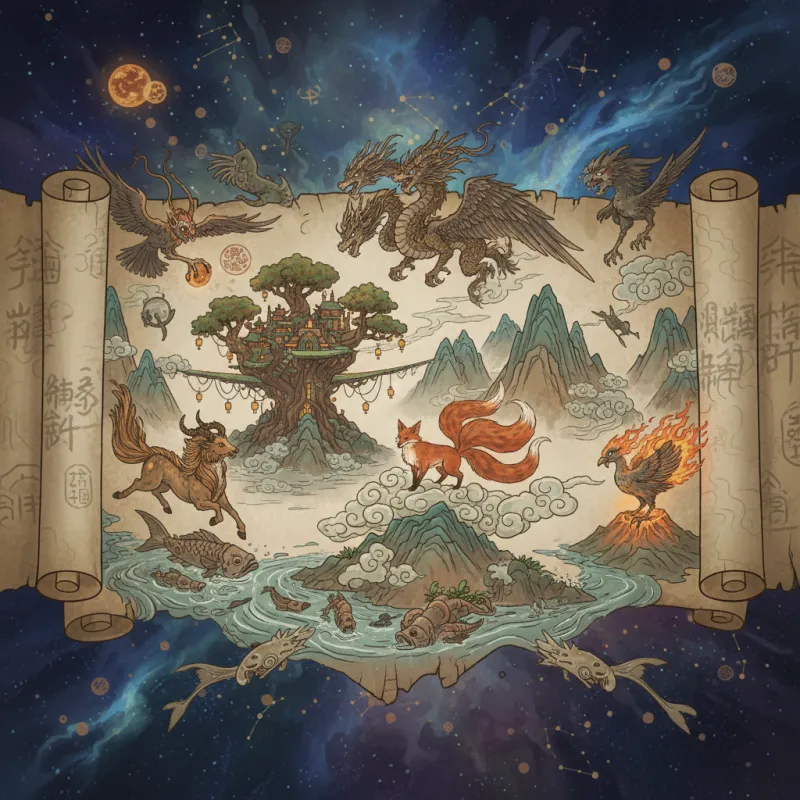
A three-headed bird circles a mountain that bleeds cinnabar. A fish with human hands crawls onto shore. A tree grows jade leaves that sing in the wind. These aren't fever dreams—they're careful observations recorded in the Shanhaijing (山海经, Shānhǎijīng), the Classic of Mountains and Seas, a text so strange that scholars still argue whether it's geography, mythology, or something we don't have a word for yet.
What Actually Is the Shanhaijing?
Compiled between the 4th century BCE and the early Han dynasty (around 2nd century CE), the Shanhaijing defies easy categorization. It's structured like a geographical survey—18 sections methodically cataloging mountains, rivers, minerals, plants, and animals across ancient China and beyond. But the "animals" include nine-tailed foxes, the "minerals" have magical properties, and the "geography" describes lands no expedition ever reached.
The text follows a relentless formula: travel X li (里, a unit of distance) in Y direction, find Z mountain, which contains A mineral and B creature with C abilities. This bureaucratic precision applied to the impossible creates an unsettling effect—like reading a field guide to a world that operates on different physics. The nine-tailed fox appears with the same matter-of-fact tone as descriptions of copper deposits.
What makes the Shanhaijing particularly fascinating is that ancient Chinese readers treated it seriously. The great historian Sima Qian referenced it. The poet Tao Yuanming wrote about its creatures. It wasn't filed under "fiction"—that category barely existed yet. It was simply knowledge, albeit knowledge about places most people would never see.
The Creatures: A Bestiary of the Impossible
The Shanhaijing catalogs over 400 creatures, and perhaps 200 of them appear nowhere else in Chinese literature. Some became famous—the fenghuang (凤凰, fènghuáng, phoenix), the qilin (麒麟, qílín, a chimeric hooved creature), the jiuwei hu (九尾狐, jiǔwěi hú, nine-tailed fox). But most remain obscure, one-time mentions that never made it into the broader mythological canon.
Take the zhuyin (烛阴, zhúyīn), described in the "Great Wilderness North" section: a creature with a human face and snake body, red skin, and eyes that never close. When it opens its eyes, day comes. When it closes them, night falls. It doesn't eat, sleep, or breathe—it just exists, controlling the cycle of light and dark for the northern regions. This isn't a monster to fight or a spirit to appease. It's a cosmological mechanism with a face.
Or consider the lushu (鹿蜀, lùshǔ), found on Mount Jigu: it has a horse's body, white head, tiger stripes, and a red tail. Wearing its hide prevents descendants from getting sick. The text offers no explanation for why this specific combination of animal parts produces this specific medical benefit. It simply reports the fact and moves on.
The creatures often serve as geographical markers—"when you see the three-headed bird, you've reached the western mountains"—or as resources. Many entries note that eating a particular creature cures specific ailments or grants abilities. The Shanhaijing treats mythical beasts the way a modern field guide treats edible plants: useful information for travelers, presented without wonder or skepticism.
The Lands Beyond: Geography or Fantasy?
The Shanhaijing describes China's actual mountains and rivers alongside places that clearly never existed. The "Classic of Mountains" sections (Shangjing, 山经) stick closer to reality—scholars have identified many of the mountains in modern Shaanxi, Shanxi, and Sichuan provinces. But the "Classic of Seas" sections (Haijing, 海经) venture into pure imagination.
The text describes the Kunlun (昆仑, Kūnlún) mountains as the axis of the world, home to the Queen Mother of the West (Xiwangmu, 西王母, Xīwángmǔ) and the source of the Yellow River. It's 800 li around, 10,000 ren high, with jade trees and immortality peaches. This mythical Kunlun coexists with the real Kunlun range in western China, creating a doubled geography where real and imaginary places share names and blur together.
The "Great Wilderness" (Dahuang, 大荒) sections describe lands beyond China's borders: countries where people have holes through their chests, where the sun and moon rise, where the world tree grows. These read less like travel guides and more like cosmological diagrams—attempts to map the structure of reality itself, not just physical terrain.
What's striking is the text's confidence. It never signals when it shifts from real to imaginary geography. The tone remains consistent whether describing the Yangtze River or the land where people eat air and live forever. This suggests the compilers didn't think in terms of "real" versus "fake" geography—just near versus far, known versus reported, accessible versus theoretical.
Shamanic Origins and Ritual Functions
Many scholars argue the Shanhaijing originated in shamanic traditions. The creatures, minerals, and plants often have ritual significance—they're ingredients for ceremonies, sources of spiritual power, or markers of sacred space. The Queen Mother of the West, who appears repeatedly, was a major figure in early Chinese shamanic practice before being domesticated into Daoist immortal mythology.
The text's structure supports this theory. It reads like a manual for ritual specialists who need to know which mountain contains which power, which creature grants which ability, which direction to travel for which purpose. The geographical precision serves magical ends—you need exact locations to perform effective rituals.
Some sections describe sacrificial procedures: "Use a white dog and a jade tablet" or "Sacrifice with a white rooster, no grain offerings." These ritual notes appear without context, suggesting the text assumed readers already understood the broader ceremonial framework. The Shanhaijing might be less a complete guide and more a reference work for initiated practitioners.
This shamanic reading explains the text's weird ontology. Shamans operate in multiple realities simultaneously—the physical world and the spirit world overlap and interact. A mountain is both a geological formation and a spiritual power center. A creature is both an animal and a manifestation of cosmic forces. The Shanhaijing maps this doubled reality without distinguishing between its layers.
Influence on Chinese Literature and Culture
Despite its obscurity and strangeness, the Shanhaijing profoundly influenced Chinese culture. Writers mined it for imagery and creatures. The fenghuang became the imperial phoenix. The qilin became an auspicious omen. The nine-tailed fox evolved through centuries of reinterpretation, from auspicious creature to seductive demon.
Lu Xun, the great 20th-century writer, loved the Shanhaijing as a child. He wrote about how its illustrations fired his imagination more than any other book. The surrealist quality of its creatures—their arbitrary combinations of parts, their matter-of-fact impossibility—appealed to modernist sensibilities. The text influenced Chinese fantasy literature, animation, and games, providing a native tradition of the fantastic that didn't rely on Western fantasy conventions.
The Shanhaijing also shaped how Chinese culture thinks about geography and cosmology. The idea that distant lands grow stranger, that the world has a center and increasingly weird peripheries, that geography and mythology intertwine—these concepts, reinforced by the Shanhaijing, became fundamental to Chinese spatial imagination.
Reading the Shanhaijing Today
Modern readers face challenges with the Shanhaijing. The text is repetitive, often boring, and deeply alien. It doesn't tell stories—it catalogs. It doesn't explain—it reports. The creatures appear once, do nothing, and vanish. There's no narrative arc, no character development, no drama.
But that's precisely what makes it valuable. The Shanhaijing shows us a worldview where mythology and geography haven't separated yet, where the strange and the mundane coexist without tension, where knowledge means accumulation rather than explanation. It's a window into how ancient Chinese culture organized reality before modern categories like "fiction" and "nonfiction" existed.
The best approach is to read it like poetry rather than prose—let the images accumulate, notice the patterns, appreciate the strangeness without demanding it make sense. The three-headed bird, the singing jade tree, the fish with human hands—they don't need to mean anything. They just need to exist, carefully recorded, waiting for readers who can appreciate a world stranger and richer than our own.
The Shanhaijing reminds us that reality is negotiable, that the line between observation and imagination is thinner than we think, and that sometimes the most valuable knowledge is the kind that doesn't fit our categories. In an age of Google Maps and satellite imagery, when every corner of Earth has been photographed and measured, the Classic of Mountains and Seas preserves a time when the world still had room for mystery—when you could travel far enough to find mountains that bleed cinnabar and trees that grow jade leaves that sing.
Related Reading
- Discovering the Enigmatic Hybrid Creatures of Shanhaijing
- Mystical Beasts of the Shanhaijing: A Journey Through Myth and Geography
- Unearthing the Cursed Beings of Shanhaijing: Myths, Creatures, and Lands