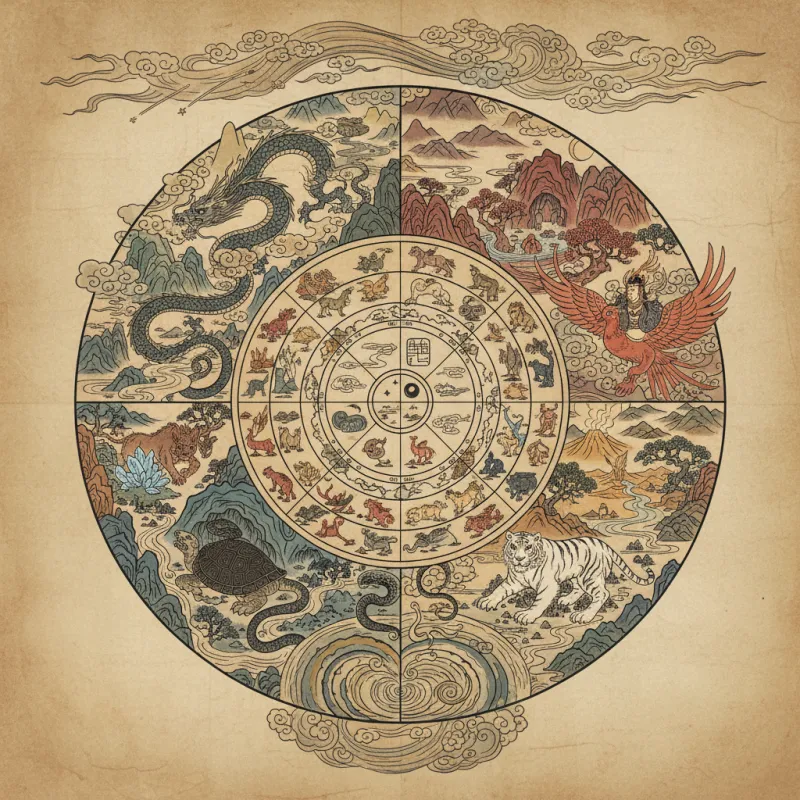
The ancient Chinese didn't just look up at the stars and wonder — they built an entire universe from scratch, complete with architectural blueprints. And at the heart of their cosmic construction project sat a mountain so tall it punched through the ceiling of reality itself.
The Geometry of Heaven and Earth
The Shanhaijing (山海经, Shānhǎijīng) operates on a cosmological principle that sounds almost childlike in its simplicity: tiān yuán dì fāng (天圆地方) — "round heaven, square earth." Picture it: above you, a vast dome of sky curves overhead like an upturned bowl. Beneath your feet, the earth spreads out in four cardinal directions, each edge meeting at perfect right angles. This isn't metaphor. This is literal cosmic architecture.
Modern readers often dismiss this model as primitive, but that's missing the point entirely. The ancient Chinese weren't stupid — they were empirical. Stand anywhere on earth and tell me the sky doesn't look like a dome. Walk in any direction and tell me the ground feels curved. The tiān yuán dì fāng model fails only when you zoom out to scales that no human eye could access before the age of satellites. For describing lived human experience, it's remarkably accurate.
What makes this cosmology fascinating isn't its wrongness by modern standards — it's how it shaped everything else. Because if earth is square with fixed cardinal directions, then geography becomes absolute. East isn't "to your right" — it's a fundamental property of space itself. This is why the Shanhaijing obsessively catalogs which mountains lie in which direction, which rivers flow east versus west. Direction isn't relative; it's ontological.
Kunlun: The Cosmic Pillar
At the exact center of this square earth rises Kunlun Mountain (昆仑山, Kūnlún Shān), and calling it a "mountain" is like calling the sun a "light bulb." Kunlun is the axis mundi, the world pillar, the cosmic elevator shaft connecting the mundane realm of humans to the celestial bureaucracy of heaven. The Shanhaijing describes it as impossibly tall — some passages suggest it rises 11,000 li (about 3,400 miles), which would put its peak well into outer space by modern measurements.
But Kunlun isn't just tall. It's layered. The mountain has multiple terraces, each one a threshold between different grades of reality. The lower slopes are accessible to exceptional humans — heroes, shamans, those with the right connections. The middle terraces house the palaces of lesser deities and immortals. The summit belongs to the Queen Mother of the West (西王母, Xīwángmǔ), who guards the peaches of immortality and controls access to the highest heaven.
This vertical cosmology matters because it makes the universe navigable. You can't just pray your way to heaven — you have to climb. And climbing requires knowing the route, the passwords, the proper offerings at each checkpoint. The Shanhaijing reads less like scripture and more like a travel guide for the cosmically ambitious. Related reading: The Queen Mother of the West: Guardian of Immortality.
The Four Seas and the Edge of Everything
If earth is square, it needs edges. The Shanhaijing provides them: four seas (四海, sìhǎi) that mark the boundaries of the known world. But these aren't oceans in the modern sense — they're cosmic moats, liminal zones where the ordered world dissolves into chaos. Beyond the four seas lie the wilderness regions, places where the normal rules stop applying and monsters roam freely.
Each sea has its own character and its own catalog of strange creatures. The Eastern Sea is relatively tame, home to islands where immortals dwell. The Southern Sea grows increasingly bizarre, with fish that have human faces and birds with three heads. The Western Sea, closest to Kunlun, contains the most potent magical geography. The Northern Sea is the darkest and coldest, a place of exile and punishment.
What's striking is how the Shanhaijing treats these boundaries not as hard limits but as gradients. The further you travel from the center, the weirder things get. It's not that the laws of nature change — it's that you're moving away from the organizing principle of Kunlun, the cosmic anchor that keeps reality stable. Distance from the center equals distance from order.
The Celestial Dome and Its Machinery
That round heaven overhead isn't just decorative — it's a working mechanism. The Shanhaijing and related texts describe the sky as a solid dome, possibly made of jade or crystal, with the sun, moon, and stars embedded in it or moving along its surface. This raises an obvious question: if the sky is solid, how do celestial bodies move?
The answer involves a complex system of cosmic machinery. Some texts describe the sun as being carried across the sky by a chariot driven by the deity Xihe (羲和, Xīhé). Others suggest the sun and moon travel through a series of gates or valleys at the edges of the world. The Huainanzi (淮南子), a Han dynasty text that elaborates on Shanhaijing cosmology, describes ten suns that take turns crossing the sky — until the archer Yi shot down nine of them, leaving us with the single sun we have today.
This isn't just mythology — it's mechanical cosmology. The ancient Chinese were trying to solve real observational problems: why does the sun rise in different places throughout the year? Why do the stars rotate? Why does the moon change shape? Their answers involved gears, gates, and divine charioteers, but the impulse was fundamentally scientific: observe the phenomena, propose a mechanism, refine the model.
The Underworld and the Roots of the World
If Kunlun reaches up to heaven, something must reach down into the earth. The Shanhaijing is less explicit about the underworld than about the celestial realms, but references scattered throughout the text suggest a mirror cosmology beneath our feet. Just as Kunlun connects earth to heaven, certain mountains and caves provide access to the Yellow Springs (黄泉, Huángquán), the realm of the dead.
This subterranean world isn't hell in the Christian sense — it's more like a bureaucratic extension of the earthly realm, where the dead continue a shadowy existence under the administration of underworld officials. The geography of the underworld mirrors the geography of the living world, with its own mountains, rivers, and administrative districts. Some texts suggest that the roots of Kunlun extend all the way down through the earth and into the underworld, making it a true axis connecting all three realms.
What's fascinating is how this creates a vertical stack: heaven above, earth in the middle, underworld below, all connected by the cosmic pillar of Kunlun. It's a universe you could theoretically traverse if you knew the right paths and had the right credentials. The Shanhaijing provides some of those paths, which is why it was read not just as geography but as a kind of cosmic roadmap.
Why This Cosmology Matters
The tiān yuán dì fāng model and its associated geography shaped Chinese thought for millennia. It influenced everything from city planning (capitals were often designed as squares with gates facing the four directions) to political philosophy (the emperor sat at the center, like Kunlun, organizing the realm around himself). Even after Chinese astronomers developed more sophisticated models, the basic imagery persisted in art, literature, and ritual.
But more than that, this cosmology represents a particular way of thinking about the universe — not as an abstract mathematical space but as a place with landmarks, routes, and destinations. The Shanhaijing doesn't ask "what are the laws of physics?" It asks "how do I get from here to there?" It's a cosmology built for travelers, not theorists. Related reading: Mapping the Mythical: How the Shanhaijing Organized Space.
And in that sense, it's not wrong at all. It's just answering a different question than modern cosmology. We've gained the ability to describe the universe at scales the ancient Chinese couldn't imagine. But we've lost something too — the sense that the cosmos is a place you could actually visit, if only you knew the way.
Related Reading
- Exploring Shanhaijing: Mythical Creatures and Ancient Lands of Chinese Cosmology
- Pangu and the Cosmic Egg: The Chinese Creation Myth
- The Four Divine Beasts: Guardians of the Compass
- Kunlun Mountain: The Axis of the Chinese Cosmos
- The Complete Guide to Shanhai Jing: China's Book of Mythical Creatures
- Exploring the Enigmatic Seas of the Shanhaijing: Mythical Creatures and Realms
- Mystical Beasts of the Shanhaijing: A Journey Through Myth and Geography
- Enigmatic Birds of the Shanhaijing: Myths, Legends, and Significance