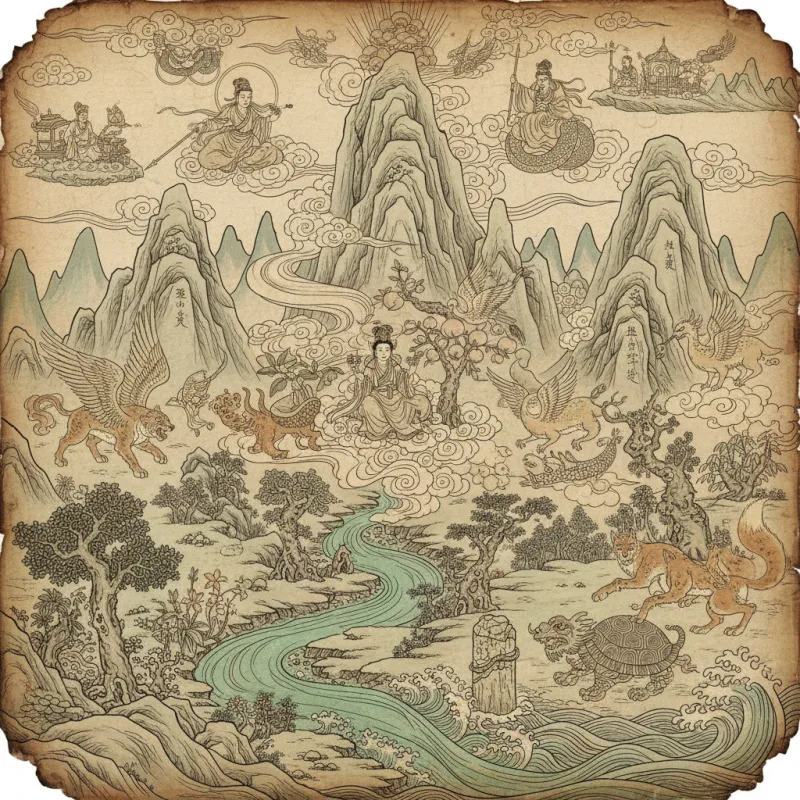
The Queen Mother of the West sits atop a mountain that shouldn't exist. Around her, peach trees bloom once every three thousand years. Below, a river of fire circles the jade terraces. And somewhere in the distance, the real Kunlun Mountains — those snow-capped peaks along the Tibetan Plateau — stand as pale imitations of this cosmic original. Chinese mythology has always understood something profound: the most important places aren't the ones you can reach by walking.
The Cosmic Architecture of Kunlun
The Shanhaijing (山海经, Shānhǎijīng) doesn't describe Kunlun Mountain (昆仑山, Kūnlún Shān) the way a geographer would. It describes it the way an architect of the cosmos would. The mountain rises in tiers — some texts say three, others nine — each level a distinct realm with its own inhabitants and rules. The lowest tier touches the mortal world. The highest pierces the heavens themselves.
This isn't metaphor. In the cosmology of ancient China, Kunlun functioned as the literal axis connecting the three realms: heaven, earth, and the underworld. The Yellow Emperor (黄帝, Huángdì) supposedly ascended to immortality from its peak. The goddess Nüwa gathered its five-colored stones to repair the broken sky. When you read that Kunlun is "the pillar of heaven," the texts mean it architecturally.
The mountain's guardian, Lushu (陆吾, Lùwú), embodies this cosmic function. Described as having a tiger's body, nine tails, and a human face, Lushu doesn't just guard a location — it guards the boundary between possible and impossible. The nine tails suggest the nine levels of heaven in some traditions. The human face indicates intelligence and judgment. This isn't a beast you fight past. It's a cosmic principle you must satisfy.
The Garden of Immortality
Every mythology has its forbidden garden, but Kunlun's is particularly specific about the economics of immortality. The peach trees of the Queen Mother of the West (西王母, Xī Wángmǔ) bloom once every three thousand years, fruit once every three thousand years after that, and ripen once every three thousand years beyond that. Do the math: a single harvest takes nine thousand years.
This detail matters. It transforms immortality from a simple binary — mortal or immortal — into a scarce resource with cosmic supply chains. The Journey to the West (西游记, Xīyóu Jì) from the Ming Dynasty understood this perfectly. When Sun Wukong crashes the Queen Mother's peach banquet, he's not just being mischievous. He's disrupting the entire celestial economy. Those peaches were allocated. Gods had been waiting millennia.
The garden itself is described with the precision of a landscape architect's dream. Jade pavilions. Terraces of precious stones. The Weak Water (弱水, Ruòshuǐ) that surrounds the mountain — water so weak it cannot support even a feather, making the mountain unreachable by boat. And circling everything, the Flaming Mountain (炎火之山, Yánhuǒ zhī Shān), a ring of fire that burns without fuel. You don't stumble onto Kunlun. The geography itself is a test.
Where Mythology Meets Geography
Here's where it gets interesting: there really is a Kunlun mountain range. It stretches over 3,000 kilometers along the northern edge of the Tibetan Plateau, with peaks exceeding 7,000 meters. The Kunlun Pass sits at 4,768 meters. The glaciers feed rivers that water much of western China.
Did the mythological Kunlun inspire the naming of the real mountains, or did the real mountains inspire the myth? The answer is probably both, in a feedback loop spanning millennia. The Shanhaijing was compiled during the Warring States period (475-221 BCE) and Han Dynasty (206 BCE - 220 CE), when Chinese geographical knowledge was expanding westward. Traders and explorers returned with tales of impossible mountains in the west — mountains so high they seemed to touch the sky.
The mythological Kunlun absorbed these reports and transformed them. It became the place where geography ends and cosmology begins. The real Kunlun Mountains became a kind of threshold marker: beyond here, the rules change. This is why so many Chinese myths locate their most important events "west of Kunlun" or "beyond Kunlun." It's not a location. It's a statement about the kind of story being told.
The Queen Mother's Court
If Kunlun is the axis mundi, the Queen Mother of the West is its sovereign. But calling her a "queen" undersells her significance. Xiwangmu (西王母, Xī Wángmǔ) is one of the oldest deities in Chinese mythology, appearing in texts from the Shang Dynasty (1600-1046 BCE) onward. Early depictions show her as wild and fearsome — a goddess with tiger's teeth and a leopard's tail. By the Han Dynasty, she'd been refined into the elegant hostess of the celestial peach banquets.
This transformation tells us something about how Chinese mythology evolved. The Queen Mother didn't become less powerful when she became more civilized. She became more central. Her court on Kunlun became the model for imperial courts on earth. The hierarchy of immortals attending her banquets mirrored the hierarchy of officials attending the emperor. When you read descriptions of her jade palace and its elaborate protocols, you're reading a mythological blueprint for Chinese statecraft.
The Mu Tianzi Zhuan (穆天子传, Mù Tiānzǐ Zhuàn), a text from around the 4th century BCE, describes King Mu of Zhou's legendary journey to meet the Queen Mother. They exchange poems. She shows him her gardens. He promises to return but never does — he's mortal, after all, and the journey takes years. It's one of the most melancholy moments in Chinese mythology: the recognition that even kings cannot truly reach Kunlun, not in any permanent sense.
The River That Flows Upward
The mythological geography of Kunlun includes one of the strangest details in the Shanhaijing: the source of the Yellow River. According to the text, the Yellow River originates from Kunlun, flowing down from the mountain's heights. But here's the problem: the real Yellow River's source is in the Bayan Har Mountains, hundreds of kilometers from the Kunlun range.
This "error" is actually profound mythological thinking. In ancient Chinese cosmology, water flows from heaven to earth, from the cosmic mountain to the mortal plains. The Yellow River, as the mother river of Chinese civilization, must therefore originate from the cosmic center. The myth isn't trying to describe hydrology. It's describing the flow of cosmic order itself — from the divine source at Kunlun down through the world of humans.
This connects to the broader theme of sacred waters in Chinese mythology, where rivers and lakes often serve as boundaries between realms. The Weak Water surrounding Kunlun is the ultimate example: water that cannot be crossed by normal means, water that defines the boundary of the possible.
Kunlun in Later Traditions
By the Tang Dynasty (618-907 CE), Kunlun had become thoroughly embedded in Chinese literary and religious imagination. Daoist texts described it as one of the ten great cave-heavens (洞天, dòngtiān) — paradises hidden within mountains where immortals dwelt. The mountain appeared in poetry as a symbol of unattainable perfection, of the distance between human aspiration and divine reality.
The Ming Dynasty novel Journey to the West places several key episodes near or on Kunlun, though it's often conflated with other mythical mountains by that point. The Flaming Mountain that blocks the pilgrims' path may be a displaced version of Kunlun's ring of fire. The various immortals they encounter often have connections to the Queen Mother's court. The novel treats Kunlun not as a single location but as a mythological ecosystem that has spread across the landscape.
Modern Chinese fantasy literature and film continue to mine Kunlun for imagery and plot devices. The mountain appears in everything from wuxia novels to video games, usually as the ultimate destination or the source of ultimate power. It's become a shorthand for "the place where the really important stuff happens" — which, in a way, brings it full circle to its original function in the Shanhaijing.
The Mountain You Cannot Climb
What makes Kunlun enduringly powerful as a myth is its fundamental unreachability. Unlike Mount Penglai, which at least floats somewhere in the eastern seas, Kunlun sits in a known direction but cannot be reached by traveling there. The real Kunlun Mountains exist, but they're not the mythological Kunlun. The mythological Kunlun exists, but not in a way that geography can map.
This paradox is the point. Kunlun represents the limits of the mortal world and the beginning of something else. It's the place where heaven meets earth, which means it's also the place where earth ends. The jade terraces, the peach trees, the Queen Mother's court — these aren't destinations for travelers. They're images of what lies beyond the horizon of human possibility.
And yet the myths insist that some people have reached it. The Yellow Emperor ascended from there. King Mu visited and returned. The implication is clear: Kunlun is unreachable by ordinary means, but not by extraordinary ones. It's not a place you walk to. It's a place you transform yourself to reach. The mountain that is not a mountain, guarded by a creature that is not quite a creature, where time moves differently and peaches take nine thousand years to ripen — this is where Chinese mythology locates the possibility of transcendence itself.
Related Reading
- Sacred Rivers in Chinese Mythology: The Yellow River and the Yangtze
- The Most Dangerous Lands in the Shanhai Jing
- The Four Seas and the Shape of the Ancient Chinese World
- Kunlun Mountain: The Paradise of Immortals
- The Fusang Tree: Where Ten Suns Rest
- Discovering the Guardians of Shanhaijing: Mythical Creatures and Legendary Lands
- Creation Myths of the Shanhaijing: How the World Was Made (Multiple Times)
- Human-Animal Hybrids in the Shanhai Jing: Gods with Beast Features