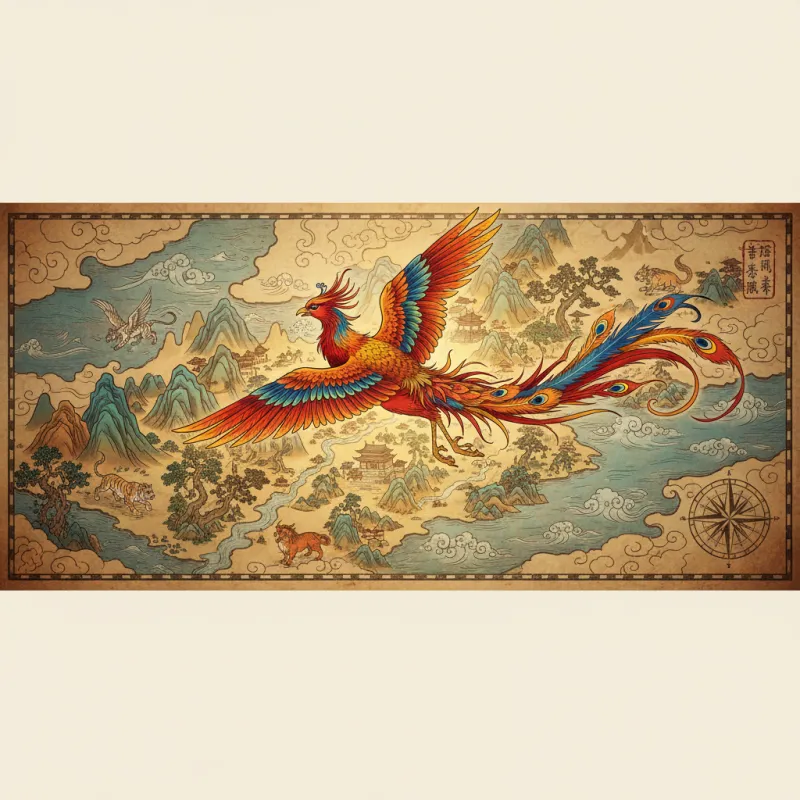
When the Fenghuang descends from the heavens, every creature in the forest falls silent. Not from fear, but from reverence. This is no ordinary bird — it's a living verdict on the state of the world, and its appearance means something has gone very, very right.
The Translation Problem
Let's address the elephant in the room: calling the Fenghuang (凤凰 fènghuáng) a "Chinese phoenix" is like calling a dragon a "big lizard." Technically you're pointing at the right creature, but you've missed everything that matters.
The Western phoenix burns itself to death and rises from the ashes. It's a symbol of death, rebirth, and cyclical renewal. The Fenghuang does none of this. It doesn't die. It doesn't burn. It doesn't need to be reborn because it never left in the first place — it's just been waiting for the world to deserve its presence again.
This isn't pedantry. The difference matters because it reveals two fundamentally different ways of thinking about virtue and cosmic order. The Western phoenix says "destruction leads to renewal." The Fenghuang says "virtue attracts harmony." One is about transformation through suffering. The other is about manifestation through righteousness.
A Composite Creature
The Shanhaijing (山海经 Shānhǎijīng, Classic of Mountains and Seas) and later texts describe the Fenghuang as a chimera — a creature assembled from the best parts of many animals. Its head resembles a golden pheasant's, its body a mandarin duck's. It has the neck of a snake, the tail of a fish, the forehead of a crane, the markings of a dragon, the back of a tortoise, and the hindquarters of a stag.
This isn't random. Each component carries symbolic weight. The snake's neck represents flexibility and wisdom. The fish tail connects it to water and fertility. The crane's forehead signals longevity. The dragon markings link it to imperial power and cosmic forces. The tortoise back grounds it in stability and endurance.
Some texts say its feathers display the five cardinal colors — black, white, red, yellow, and blue-green — representing the five virtues: benevolence (仁 rén), righteousness (义 yì), propriety (礼 lǐ), wisdom (智 zhì), and sincerity (信 xìn). When you see a Fenghuang, you're not just seeing a bird. You're seeing an illustrated textbook of Confucian ethics with wings.
The Gender Question
Here's where it gets interesting. Originally, Feng (凤 fèng) and Huang (凰 huáng) were two separate birds — male and female respectively. The Feng was the male phoenix, the Huang the female. Together they represented the cosmic balance of yang and yin, the masculine and feminine principles that govern all existence.
But sometime during the Han Dynasty (206 BCE - 220 CE), this distinction started to blur. The two birds merged into a single creature, and that creature became increasingly associated with the feminine, particularly with empresses and imperial consorts. Meanwhile, the dragon claimed the masculine imperial symbolism entirely.
This shift tells us something about how Chinese cosmology evolved. The early pairing of Feng and Huang reflected a dualistic worldview where masculine and feminine were separate but equal cosmic forces. The later merger and feminization of the Fenghuang reflected a more hierarchical view where the dragon-emperor stood above, and the phoenix-empress stood beside and slightly below.
You can still see this in traditional Chinese weddings, where the groom's attire features dragons and the bride's features phoenixes. The symbolism has softened from cosmic principles to marital roles, but the echo remains.
When the Fenghuang Appears
The Fenghuang is not a common sight. According to classical texts, it only appears during times of great peace and prosperity, when a truly virtuous ruler sits on the throne. Its appearance is a cosmic seal of approval — heaven's way of saying "this one, this ruler gets it right."
The Shanhaijing places the Fenghuang in the Kunlun Mountains (昆仑山 Kūnlún Shān), the mythical axis mundi of Chinese cosmology, where it feeds on the seeds of bamboo and drinks from the sweet springs. It doesn't descend to the mortal world unless conditions are perfect.
This makes the Fenghuang a powerful political symbol. When a new emperor claimed to have seen a Fenghuang, he was essentially claiming divine endorsement. When scholars wrote that the Fenghuang had not been seen in generations, they were making a pointed critique of current leadership without directly committing treason.
The absence of the Fenghuang is as meaningful as its presence. During the chaotic Warring States period (475-221 BCE), Confucius reportedly lamented that he had never seen a Fenghuang, implying that no ruler of his time was worthy. This wasn't just pessimism — it was a sophisticated form of political commentary wrapped in mythological language.
The Fenghuang's Song
Classical texts describe the Fenghuang's call as the most beautiful sound in existence — a five-note melody that embodies perfect musical harmony. Each note corresponds to one of the five tones of the ancient Chinese pentatonic scale, and together they represent cosmic order made audible.
When the Fenghuang sings, other birds fall silent and listen. The Erya (尔雅 Ěryǎ), an ancient Chinese dictionary from around the 3rd century BCE, claims that when the Fenghuang appears, it leads a procession of all other birds, who follow it in perfect formation. This image — the Fenghuang as conductor of an avian orchestra — captures its role as a harmonizing force in nature.
The connection between the Fenghuang and music runs deep in Chinese culture. The mythical Yellow Emperor (黄帝 Huángdì) supposedly created the first musical instruments after hearing the Fenghuang's song. Music, in classical Chinese thought, wasn't just entertainment — it was a tool for maintaining cosmic and social harmony. The Fenghuang, as the source of perfect music, was therefore the source of perfect order.
Fenghuang vs. Other Divine Birds
The Chinese mythological bestiary includes several other magnificent birds, and it's worth distinguishing the Fenghuang from its cousins. The Vermilion Bird (朱雀 Zhūquè) is one of the Four Symbols representing the cardinal directions — specifically, the south and the element of fire. While the Vermilion Bird is sometimes conflated with the Fenghuang, they're distinct creatures with different roles.
The Vermilion Bird is a directional guardian, a cosmic sentinel. The Fenghuang is a moral indicator, a virtue detector. One is about spatial order, the other about ethical order. The confusion arises because both are magnificent birds associated with fire and the color red, but their functions in the mythological ecosystem are completely different.
Then there's the Peng (鹏 péng), the massive bird from the Zhuangzi (庄子 Zhuāngzǐ) that transforms from a giant fish and flies so high it uses clouds as stepping stones. The Peng represents freedom, transformation, and the transcendence of ordinary limitations. The Fenghuang represents harmony, virtue, and the perfection of ordinary order. One breaks the rules, the other embodies them.
Living Symbol
Walk through any Chinatown in the world and you'll see Fenghuang imagery everywhere — on restaurant signs, wedding decorations, embroidered silk, carved jade. The creature has traveled far from the Kunlun Mountains of ancient texts.
But here's what's been lost in translation: the Fenghuang was never meant to be decorative. It was meant to be aspirational. Every image of a Fenghuang was a reminder that virtue attracts harmony, that good governance brings cosmic approval, that the world responds to righteousness.
In modern usage, the Fenghuang has become a generic symbol of Chinese culture, divorced from its original meaning. It's become the phoenix it was never supposed to be — a pretty bird with no particular message. But the old texts remember. They remember a creature that appeared only when the world deserved it, that sang only when harmony was real, that flew only when virtue reigned.
The Fenghuang hasn't been seen in a very long time. Make of that what you will.
Related Reading
- The Four Symbols: Azure Dragon, White Tiger, Vermillion Bird & Black Tortoise
- Divine Beasts of the Shanhaijing: The Four Guardians and Beyond
- The Qilin: China's Sacred Unicorn and Divine Messenger
- Chinese Dragons: Everything You Need to Know
- The Nine-Tailed Fox: From Divine Messenger to Demonic Seductress
- Exploring the Myths of Serpents in the Shanhaijing: Creatures of Power and Mystery
- Sacred Mountains: The Five Great Peaks
- The Nine-Headed Bird: Terror of the Skies