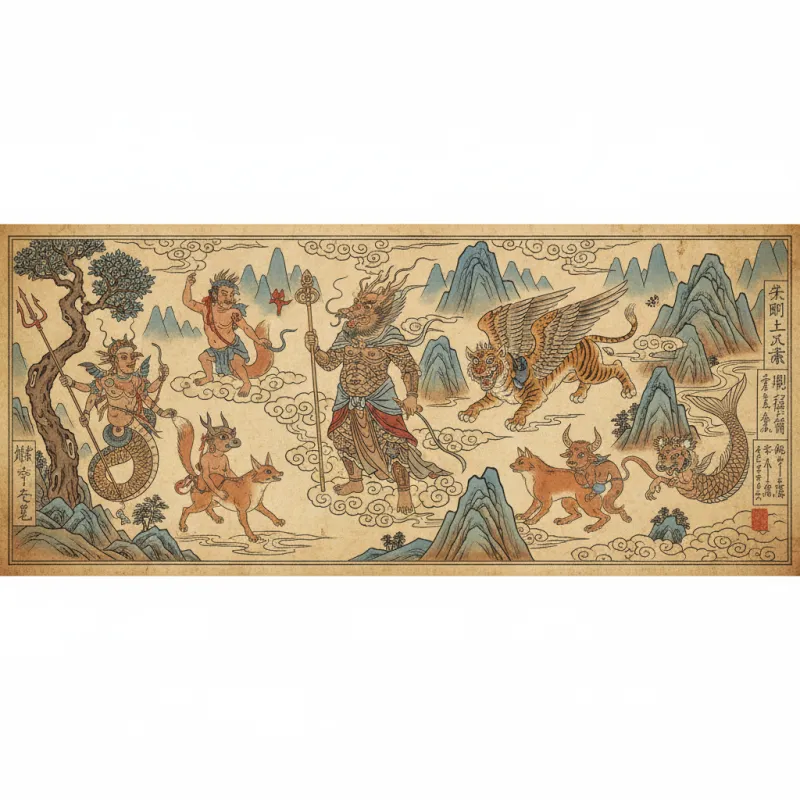
The goddess Nüwa (女娲 Nǚwā) stands at the edge of the world, her human torso rising from coiled serpent scales, patching holes in the sky with melted stones. Her brother-husband Fuxi (伏羲 Fúxī) measures the cosmos beside her, his own snake tail intertwined with hers in Han dynasty stone reliefs. These aren't monsters or mistakes — they're the architects of civilization itself, and their hybrid forms tell us something crucial about how ancient China understood power, divinity, and the boundaries between species.
The Logic of Divine Hybridity
The Shanhai Jing (山海经 Shānhǎi Jīng, Classic of Mountains and Seas) doesn't treat human-animal hybrids as aberrations. It catalogs them with the same matter-of-fact precision it uses for mountains and rivers: "The god of Mount Kunlun has a human face and tiger body." "The Queen Mother of the West has human form with leopard tail and tiger teeth." These descriptions aren't meant to shock — they're taxonomic facts about beings who exist beyond normal categories.
What makes these hybrids divine rather than monstrous is their specific combination of features. The snake-bodied creator gods connect heaven and earth through their elongated forms. Bird-headed deities like Jumang (句芒 Jùmáng), the god of spring and wood, combine human intelligence with avian associations of transcendence and seasonal migration. The hybrid form isn't random — it's a visual argument about what that deity controls or represents.
The Serpent-Bodied Pantheon
Beyond Nüwa and Fuxi, snake-human hybrids dominate the divine hierarchy. The god Gonggong (共工 Gònggōng), who caused catastrophic floods when he smashed his head against Mount Buzhou in a fit of rage, appears with a human face and serpent body. His rival Zhuanxu (颛顼 Zhuānxū), one of the Five Emperors, is sometimes depicted similarly. The god Xiangliu (相柳 Xiānglǐu) takes this further — nine human heads sprouting from a single serpent body, so venomous that his presence turns land into poisonous marshes.
The prevalence of serpent hybrids makes sense when you consider the snake's symbolic weight in ancient China. Snakes shed their skin and seem to renew themselves. They move between earth and water, underground and surface. They're associated with fertility, transformation, and the mysterious forces that animate the natural world. A god with a snake body isn't diminished by animal features — they're enhanced, given access to powers humans lack.
Feathered Bureaucrats and Beast-Faced Ministers
The Shanhai Jing's divine bureaucracy is staffed by hybrids who look like they wandered out of a fever dream. Jumang, the Minister of Wood, has a human face but the body of a bird, riding two dragons. Rushou (蓐收 Rùshōu), the god of autumn and metal, appears as a human face with white hair and tiger claws, also dragon-riding. These aren't just decorative details — they're job descriptions rendered in flesh.
The Queen Mother of the West (西王母 Xīwángmǔ) rules her mountain paradise with a human face, leopard tail, tiger teeth, and a talent for whistling. Early texts describe her as fearsome and wild, only later softening into the elegant goddess of Han dynasty art. Her hybrid form in the Shanhai Jing emphasizes her role as a boundary figure — human enough to interact with mortals, bestial enough to command the wild forces of the western mountains.
The Geography of Hybrid Bodies
The Shanhai Jing organizes its hybrids geographically, and patterns emerge. The further from the central plains you travel in the text, the stranger the combinations become. The overseas regions and distant mountains host beings with multiple heads, extra arms, or bodies that mix three or four species. The god Yanzi (奢比尸 Shēbǐshī) has a human face, dog ears, and a beast body. The deity of Mount Zhong has a human face with one arm and three eyes.
This geographic distribution isn't accidental. The text maps strangeness onto distance, using hybrid bodies to mark the boundaries of the known world. But these aren't hostile monsters — they're local deities, each ruling their own mountain or river. The hybrid form signals their power over that specific place, their deep integration with its particular ecology and spiritual character.
When Humans Become Hybrids
The Shanhai Jing also records transformations — humans who became hybrids through death, punishment, or apotheosis. Gun (鲧 Gǔn), the father of Yu the Great, failed to control the floods and was executed on Feather Mountain. His body didn't decay for three years, and when it was finally cut open, his son Yu emerged. Gun himself transformed into a yellow bear (or in some versions, a three-legged turtle) and plunged into the Feather Abyss.
These transformation stories suggest that the boundary between human and animal isn't fixed. Under extreme circumstances — divine punishment, heroic sacrifice, or cosmic necessity — bodies can shift into new configurations. The hybrid form becomes a record of that transformation, a permanent mark of having crossed between categories.
The Philosophical Weight of Mixed Forms
Chinese philosophy has always been comfortable with category-mixing. Yin and yang interpenetrate. The five elements transform into each other. Daoist texts celebrate the sage who becomes like uncarved wood, who flows like water, who sees with the eyes of heaven and earth. The hybrid deities of the Shanhai Jing embody this philosophical flexibility — they refuse to be limited by a single nature.
Compare this to Greek mythology's centaurs and minotaurs, who are often tragic figures, caught between two natures and at home in neither. The Shanhai Jing's hybrids aren't conflicted. They're powerful precisely because they combine multiple natures, accessing the strengths of each. Nüwa doesn't struggle with her serpent half — it's what allows her to reach across the cosmos and repair the sky.
Reading Hybrid Bodies Today
Modern readers often try to explain away these hybrid forms. Maybe they're totemic symbols of ancient tribes. Maybe they're misunderstood descriptions of people wearing animal masks or costumes. Maybe they're metaphors for psychological states or political allegiances. But these explanations miss something important: the ancient Chinese who recorded these beings took them seriously as descriptions of reality.
The Shanhai Jing presents itself as a geographic and spiritual atlas, not a collection of metaphors. When it says a god has a human face and tiger body, it means exactly that. The hybrid form is the point, not a puzzle to be solved. These beings exist at the intersection of categories because that's where divine power operates — in the spaces between human and animal, earth and heaven, known and unknown.
The snake-bodied creators, the bird-headed ministers, the leopard-tailed queen — they're not asking us to choose between their human and animal natures. They're showing us that the most powerful beings refuse to be limited by our categories at all. In a world obsessed with clear boundaries and fixed identities, the Shanhai Jing's hybrids offer a different vision: power comes from combination, from refusing to pick just one species, from embodying the full spectrum of existence in a single, impossible form.
Related Reading
- The Nine-Tailed Fox: From Divine Beast to Demonic Seductress
- The Four Guardian Beasts: Azure Dragon, White Tiger, Vermilion Bird, Black Tortoise
- Hybrid Beings of the Shanhaijing: When Animals Merge
- Half-Human Half-Beast: The Strangest Creatures of Shanhaijing
- Unearthing the Cursed Beings of Shanhaijing: Myths, Creatures, and Lands
- The Peaches of Immortality: The Most Famous Fruit in Chinese Mythology — Shanhai Perspective
- Immersive Wonders of Shanhaijing: Exploring Mythical Birds and Enchanted Regions