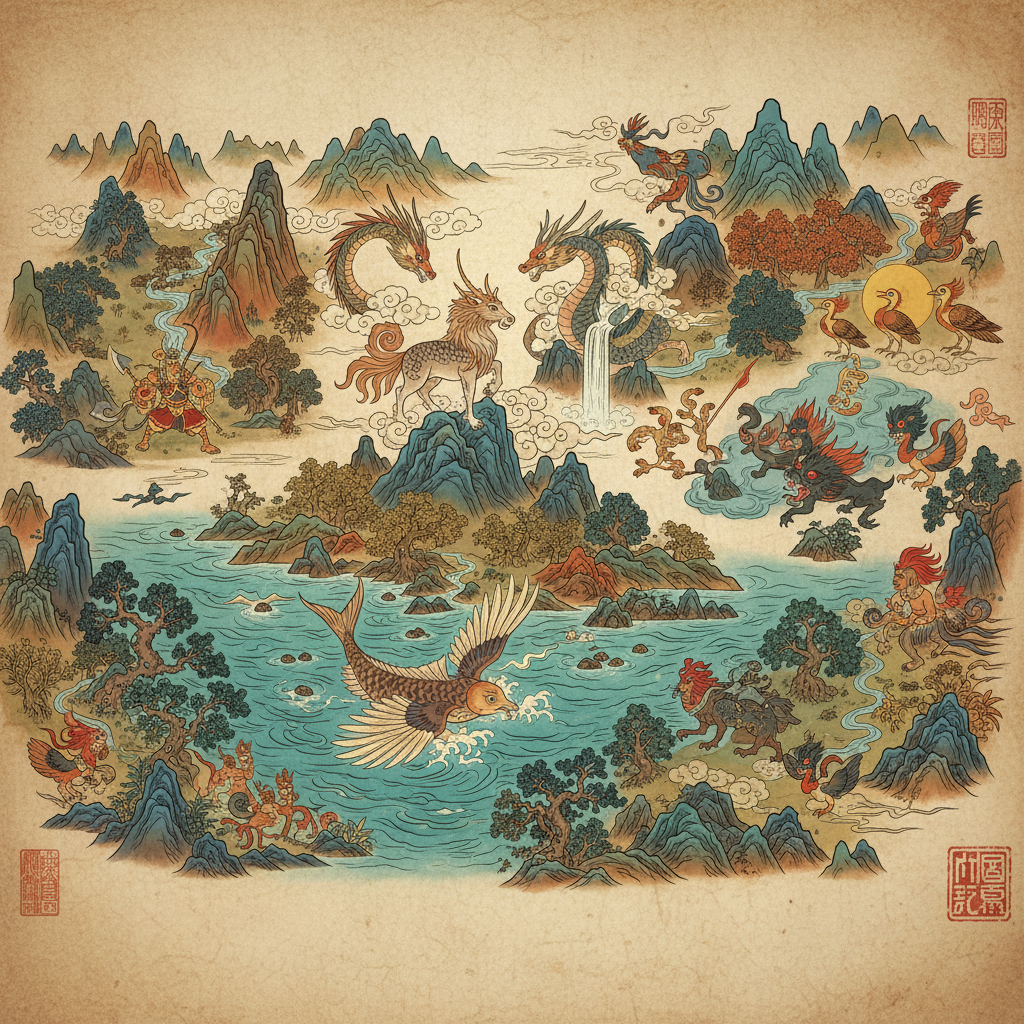
Introduction to Shanhaijing: A Window into Ancient Chinese Mythology
The Shanhaijing (Classic of Mountains and Seas) is a crucial ancient Chinese text compiling mythological geography, folklore, and fantastical creatures. Believed to be written during the Warring States period through to the early Han dynasty (roughly 4th century BCE to 1st century CE), it offers one of the oldest systematic recordings of mythical lands and beings in Chinese tradition. Unlike a simple myth collection, the Shanhaijing melds geography with legend, mapping imaginary mountains, rivers, and realms inhabited by supernatural beings. This fusion gives readers not only a sense of ancient Chinese cosmology but also insight into early cultural worldviews and mythology.
Understanding the Shanhaijing is pivotal for appreciating Chinese mythical heritage and the ways ancient peoples constructed their universe through stories of mysterious lands and creatures.
Mysterious Lands: The Otherworldly Realms of Shanhaijing
Spanning 18 chapters divided into sections on mountains, seas, and directions, the Shanhaijing describes strange and often dangerous lands beyond the known world. These lands are not just geographic features but serve as symbolic places representing spiritual or metaphysical boundaries. Some notable regions include:
- The Kunlun Mountains: Often portrayed as a cosmic mountain, Kunlun is considered the axis mundi, a connection between heaven and earth. It is depicted as a paradise guarded by wonderful animals and deities, tantalizing in its serenity but often unreachable.
- The Western Wilderness: A mysterious expanse inhabited by fantastical beasts and bizarre plants, this region encapsulates the unknown wilderness outside civilization’s reach.
- The South Seas: Home to strange islands and aquatic creatures, these regions evoke isolation and mystery, blending maritime exploration and myth.
These places often exemplify liminal spaces—thresholds between the human world and realms of gods, spirits, and monsters—reflecting notions of sacred geography deeply embedded in early Chinese cosmology.
Mythical Creatures: Icons of Wonder and Mystery
The Shanhaijing teems with a pantheon of mythical creatures, many unique to Chinese mythological traditions:
- Jingwei (精卫): A bird said to be the spirit of a young girl who drowned at sea, destined to fill the ocean with twigs and stones in an eternal quest to prevent others’ fate. Her tale symbolizes perseverance and the human desire to overcome natural disasters.
- Nine-tailed Fox (九尾狐): A mystical fox with nine tails often associated with transformation and magic. Unlike its later portrayal in folklore as a trickster, here it appears more as an awe-inspiring creature of power.
- Taotie (饕餮): A monstrous, gluttonous creature famously depicted in Bronze Age art but vividly described in the Shanhaijing. It symbolizes insatiable greed and is often interpreted allegorically in cultural contexts.
- Qilin (麒麟): A gentle, auspicious beast akin to a unicorn or dragon, associated with peace and prosperity. The Qilin’s presence in mythical lands delivers blessings and heralds wise rulers.
The creatures in the Shanhaijing do more than entertain; they often reflect human traits, moral ideas, or natural phenomena, attaching meaning to the fantastical.
Cultural Significance and Influence Through History
The Shanhaijing’s impact stretches beyond its ancient origins, influencing Chinese literature, art, and mythology for centuries. Scholars regard the text as a foundational mythographic work that shaped portrayals of the cosmos and the supernatural in East Asia. Its creatures have been reimagined in everything from classical poetry to modern fantasy, continuously reinventing the cultural understanding of these myths.
Moreover, the Shanhaijing provides valuable anthropological insight into how ancient Chinese people related to their environment, the unknown, and the divine. The mythical geography parallels real geographic knowledge while simultaneously offering allegorical or spiritual meaning. This blend of the empirical and mythic illustrates the formative cultural processes behind Chinese identity and worldview formation.
Fascinating Details: Lesser-Known Creatures and Places
Beyond the commonly known figures, the Shanhaijing offers an array of lesser-known beasts and regions that captivate both scholars and enthusiasts:
- Shanmu (山姆): A peculiar beast described with features combining a deer, a horse, and a bird, showcasing the text’s vivid imagination in hybrid creatures.
- The Lake of Jing: Said to be home to a luminescent fish that guides travelers at night, representing enlightenment and guidance in darkness.
- The Land of the Immortals: Located beyond the eastern seas, this mystical place appears in multiple chapters as a utopia where immortality is attainable, intertwining with Taoist themes of transcendence and eternal life.
Such details enrich an already complex mythical landscape, inviting continued interpretation and exploration.
Conclusion: The Enduring Legacy of Shanhaijing’s Mythical Creatures and Lands
The Shanhaijing remains a captivating blend of geography, mythology, and cultural imagination. Its mythical creatures and lands serve both as windows into ancient Chinese cultural psyche and as inspirations for ongoing storytelling traditions. By exploring these enigmatic beings and otherworldly realms, we gain a deeper understanding of the complex relationship between humans and the mystical in early Chinese civilization. The text continues to be not just a historical artifact but a living source of mythic wonder that bridges past and present cultural narratives.
For anyone intrigued by mythical lands and legendary creatures, the Shanhaijing offers an unparalleled journey through the ancient imagination of China’s mountains and seas.