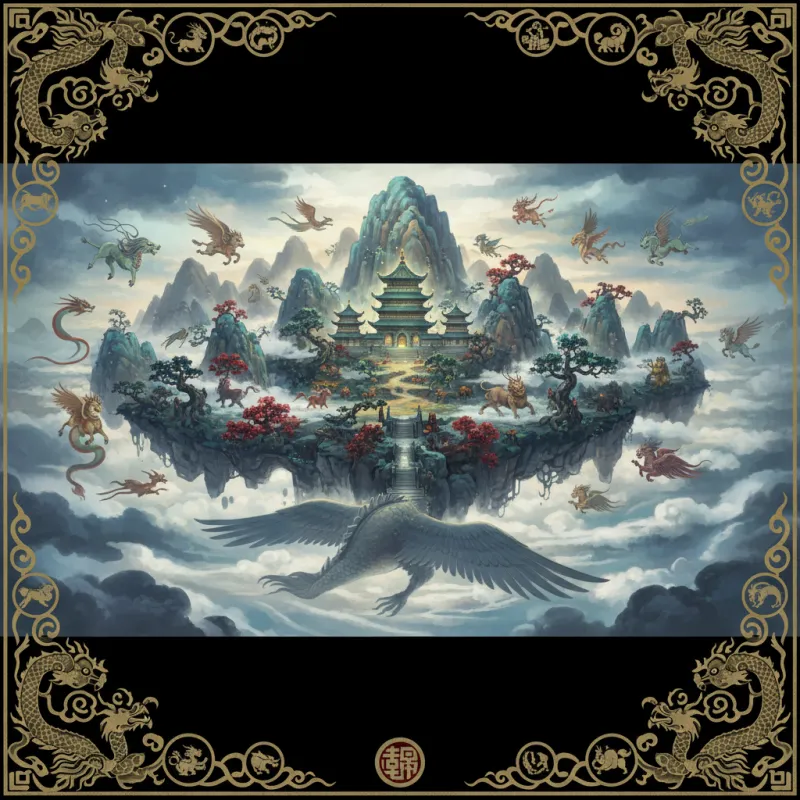
The first emperor of China sent thousands of young men and women to their deaths chasing a mirage. In 219 BCE, Qin Shi Huang (秦始皇 Qín Shǐhuáng) dispatched an expedition of three thousand youths across the Eastern Sea, commanded by the court sorcerer Xu Fu (徐福 Xú Fú), with a single mission: find Penglai Island and bring back the elixir of immortality. They never returned. Some say they founded Japan. Others claim they drowned. But the emperor died anyway, and Penglai remained exactly where it had always been — shimmering on the horizon, visible to anyone desperate enough to believe.
The Floating Archipelago of the Immortals
Penglai (蓬莱 Pénglái) wasn't alone in the eastern seas. According to the Liezi (列子 Lièzǐ), a Daoist text from the Warring States period, five immortal islands originally drifted across the ocean: Penglai, Fangzhang (方丈 Fāngzhàng), Yingzhou (瀛洲 Yíngzhōu), Daiyu (岱舆 Dàiyú), and Yuanqiao (员峤 Yuánqiáo). These weren't fixed landmasses but floating paradises, each carried on the backs of fifteen giant sea turtles working in rotating shifts.
The problem? A giant from the Longbo Kingdom (龙伯国 Lóngbó Guó) went fishing one day and caught six of the turtles in a single expedition. Without their support, Daiyu and Yuanqiao sank into the ocean, taking their immortal inhabitants with them. The Jade Emperor, furious at this cosmic vandalism, shrank the Longbo giants to normal human size as punishment and reduced their territory. This left three islands — Penglai, Fangzhang, and Yingzhou — still afloat, still unreachable, still taunting mortals with the promise of eternal life.
The Shanhaijing (山海经 Shānhǎi Jīng) itself is frustratingly vague about Penglai's exact location, mentioning only islands in the eastern seas where immortals dwell. Later texts filled in the details: palaces of gold and silver, trees bearing pearls instead of fruit, birds and beasts that were pure white, and most importantly, the mushroom of immortality (灵芝 língzhī) growing wild across the landscape.
What Made Penglai Different From Other Paradise Myths
Chinese mythology is crowded with otherworldly realms — the Kunlun Mountains where the Queen Mother of the West holds court, the underwater Dragon Palaces of the Four Seas, the bureaucratic heavens of the Jade Emperor. But Penglai occupied a unique psychological space: it was supposedly real, physically locatable, just perpetually out of reach.
Kunlun was explicitly supernatural, a cosmic axis connecting heaven and earth. The Dragon Palaces were underwater, requiring magical transformation to visit. But Penglai? Sailors claimed to have seen it. Fishermen swore they'd sailed close enough to smell the flowers. The island appeared on maps. Emperors funded expeditions. This wasn't abstract mythology — this was a treasure hunt that consumed actual resources and actual lives.
The genius of the Penglai myth was its built-in excuse for failure. The islands floated, you see. They drifted with the currents. They were surrounded by mists that confused navigation. As soon as your ship approached, the wind would shift and push you away. It wasn't that Penglai didn't exist — it was that you weren't worthy, weren't pure enough, weren't destined to find it. The myth blamed the seeker, not the sought.
The Expeditions That Never Came Back
Xu Fu's expedition in 219 BCE was the most famous, but hardly the first. King Wei of Qi (齐威王 Qí Wēi Wáng) sent explorers in the 4th century BCE. King Zhao of Yan (燕昭王 Yān Zhāo Wáng) dispatched his own fleet. These weren't small operations — we're talking hundreds of ships, thousands of people, years of provisions. The Han dynasty historian Sima Qian (司马迁 Sīmǎ Qiān) recorded these expeditions with a mixture of fascination and skepticism, noting that the explorers always returned with excuses or didn't return at all.
Xu Fu's story has the most interesting aftermath. According to Japanese legend, he landed in what is now Kumano and became the ancestor of several Japanese clans. Chinese sources suggest he settled in Korea. The truth is probably simpler: he took the emperor's money, sailed far enough to avoid immediate execution, and started a new life somewhere the emperor's agents couldn't reach. Smart man. The elixir of immortality was the friends he made along the way.
But here's what's genuinely fascinating: these expeditions continued for centuries. The Tang dynasty (618-907 CE) saw renewed interest in Penglai, with Daoist alchemists claiming they could guide seekers to the islands through meditation and spiritual cultivation rather than physical travel. The island had evolved from a geographical destination to a metaphysical state. You didn't sail to Penglai — you transcended to it.
Penglai in Literature and Art
By the time of the Tang and Song dynasties, Penglai had become a standard literary reference, shorthand for unattainable paradise or impossible dreams. The poet Li Bai (李白 Lǐ Bái) wrote: "Penglai articles are built of bones" (蓬莱文章建安骨 Pénglái wénzhāng Jiàn'ān gǔ), using the island as a metaphor for literary excellence. The phrase "Penglai is not far" (蓬莱不远 Pénglái bù yuǎn) became a way of saying that enlightenment or success was within reach, if only you had the wisdom to see it.
The Ming dynasty novel Journey to the West (西游记 Xīyóu Jì) places several immortals as residents of Penglai, though they seem to travel freely between the island and the mainland, suggesting that by the 16th century, Penglai had become more of a prestigious address than an unreachable destination. The Eight Immortals (八仙 Bāxiān), those beloved trickster-sages of Chinese folklore, are often depicted crossing the sea to Penglai, each using their magical implement as a boat — a story that spawned the idiom "the Eight Immortals cross the sea, each displaying their divine powers" (八仙过海,各显神通 bāxiān guò hǎi, gè xiǎn shéntōng).
Landscape paintings from the Song dynasty onward frequently depicted Penglai as a misty island with elaborate pavilions, often with cranes (symbols of longevity) flying overhead. These weren't meant to be realistic depictions but rather visual poems, capturing the essence of unattainable beauty. The island became a symbol of artistic aspiration itself — the perfect painting you can envision but never quite execute.
The Real Penglai: When Myth Meets Geography
Here's where it gets weird: there's an actual place called Penglai. The city of Penglai in Shandong Province has been trading on the mythical association for over two thousand years. Located on the northern coast of the Shandong Peninsula, it's one of the most likely departure points for those ancient expeditions to find the immortal islands.
The area experiences a phenomenon called a "mirage" (海市蜃楼 hǎishì shènlóu, literally "sea market mirage building") where atmospheric conditions create optical illusions of islands, cities, or mountains floating above the horizon. These mirages can last for hours and appear remarkably solid and detailed. It's not hard to imagine ancient sailors seeing these phantom islands and believing they'd glimpsed Penglai itself.
Modern Penglai has leaned into its mythological heritage with a vengeance. The Penglai Pavilion (蓬莱阁 Pénglái Gé), built during the Song dynasty, is one of China's four famous towers and attracts millions of tourists annually. The city's tourism board markets it as "the place where immortals gather" and "the origin of the Eight Immortals legend." It's a perfect example of how mythology and geography feed each other — the myth made the place famous, and the place keeps the myth alive.
Why We Still Need Penglai
The expeditions stopped centuries ago. No one seriously believes there's an island of immortals floating in the Yellow Sea. We've mapped the oceans, photographed them from satellites, sent submarines to the deepest trenches. There's no Penglai, no Fangzhang, no Yingzhou. The giant turtles, if they ever existed, have long since retired.
But the myth persists because it serves a function that has nothing to do with geography. Penglai represents the thing you can see but can't reach — the goal that motivates you precisely because it remains ahead of you. The moment you arrive, it wouldn't be Penglai anymore. It would just be another island.
The first emperor sent three thousand young people to their probable deaths chasing immortality, and we remember him as a tyrant and a fool. But how many of us are on our own Penglai expeditions, chasing the perfect career, the perfect relationship, the perfect life, always visible on the horizon, always just out of reach? The island hasn't moved. We have. And maybe that's the real secret the immortals were keeping all along — the journey is the destination, the search is the finding, and the only way to reach Penglai is to stop trying to get there.
The mist hasn't cleared. The island still floats somewhere in the eastern seas, carried by turtles, guarded by cranes, waiting for seekers who will never arrive. And that's exactly how it should be.
Related Reading
- Kunlun Mountain: The Paradise at the Center of the World — Shanhai Perspective
- Exploring the Enigmatic Mythical Creatures and Lands of Shanhaijing
- The Fusang Tree: Where the Suns Rise and the World Begins — Shanhai Perspective
- Mythical Lands of the Shanhaijing: Places That Should Not Exist
- The Ruomu Tree: Where the Suns Set
- Mountain Spirits of the Shanhaijing: The Gods Who Live in Peaks
- Unearthing the Cursed Beings of Shanhaijing: Myths, Creatures, and Lands
- Unraveling the Mysteries of Shanhaijing: Myths, Creatures, and Fantastic Realms