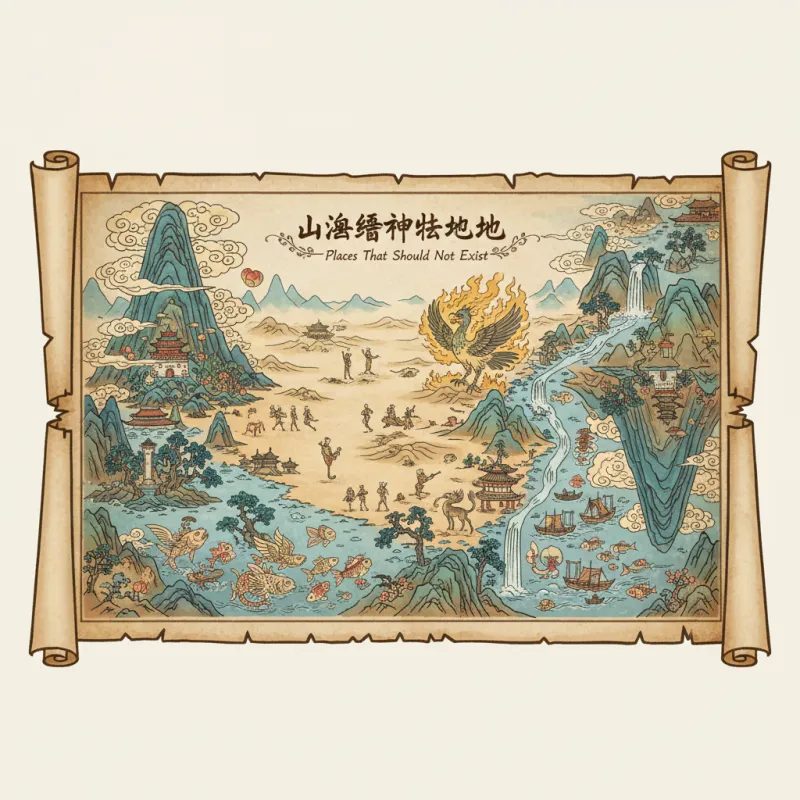
Mythical Lands of the Shanhaijing: Places That Should Not Exist
In 1760, a Qing dynasty scholar named Bi Yuan (畢沅) stood in his study, poring over an ancient text that had confounded readers for two millennia. The Shanhaijing (山海經, Shānhǎijīng, "Classic of Mountains and Seas") lay before him, its pages describing a world that seemed to exist in the space between memory and madness. One passage described a mountain where the sun and moon rose together. Another detailed an island where trees bore pearls instead of fruit. Bi Yuan spent three years attempting to map these locations onto the known geography of China, only to conclude what many before him had suspected: these places existed in a dimension that defied conventional cartography.
The Shanhaijing, compiled between the 4th and 1st centuries BCE during the Warring States period and early Han dynasty, remains one of China's most enigmatic texts. It catalogs 204 mountains, 258 mythical creatures, and dozens of impossible lands across its 31,000 characters. Unlike other ancient Chinese texts that ground themselves in historical events or philosophical discourse, the Shanhaijing presents its geography with the matter-of-fact tone of a surveyor's report—despite describing territories that violate every law of nature.
Kunlun: The Axis of Heaven and Earth
The most significant impossible place in the Shanhaijing is Kunlun Mountain (昆侖山, Kūnlún Shān), described in the "Xishan Jing" (西山經, Western Mountains Classic) section. The text states that Kunlun rises 11,000 li (approximately 5,500 kilometers) into the sky—higher than Earth's atmosphere extends. At its summit sits the palace of Huangdi (黃帝, the Yellow Emperor), guarded by Luwu (陸吾), a creature with a tiger's body, nine tails, and a human face.
What makes Kunlun particularly fascinating is its function as a cosmic axis. The Shanhaijing describes it as the point where heaven and earth connect, where the celestial river descends, and where immortals ascend and descend. The mountain has nine levels, each separated by gates of jade. The third level contains the Hanging Garden (懸圃, Xuánpǔ), where the peaches of immortality grow—the same peaches that appear in later myths about Xi Wangmu (西王母, Queen Mother of the West).
Scholar Gu Jiegang (顧頡剛, 1893-1980) argued in his 1926 work Gushi Bian (古史辨, "Debates on Ancient History") that Kunlun represented an attempt by ancient Chinese to conceptualize the source of their major rivers. The Yellow River, Yangtze, and other waterways were believed to originate from Kunlun's heights. But the mountain's impossible elevation suggests something beyond practical geography—it represents a vertical cosmology where physical and spiritual realms intersect.
Penglai and the Islands of Immortality
The "Haiwai Dong Jing" (海外東經, Classic of Regions Beyond the Eastern Seas) describes three islands in the Eastern Sea: Penglai (蓬萊, Pénglái), Fangzhang (方丈, Fāngzhàng), and Yingzhou (瀛洲, Yíngzhōu). These islands became so embedded in Chinese imagination that in 219 BCE, Emperor Qin Shi Huang dispatched the alchemist Xu Fu (徐福) with 3,000 young men and women to find them and retrieve the elixir of immortality.
The Shanhaijing describes these islands as floating on the backs of giant sea turtles, visible from the shore but unreachable. As ships approach, the islands drift away on ocean currents. The palaces on these islands are made of gold and silver, the birds and beasts are pure white, and the trees bear pearls and jade as fruit. Most significantly, everyone who lives there is immortal.
The physical impossibility of these islands—their floating nature, their recession from approaching vessels—suggests they function as a metaphor for the unattainability of immortality itself. Yet the Shanhaijing presents them with precise directional information: "Five thousand li east of the Eastern Sea." This specificity creates a peculiar tension between the mythical and the geographical.
Japanese scholar Izushi Yoshihiko (出石誠彦) proposed in 1943 that these islands might represent distorted accounts of Japan or the Ryukyu Islands, filtered through multiple retellings. But this interpretation fails to account for the text's insistence on their supernatural properties. The islands exist in a liminal space—close enough to see, impossible to reach, real enough to send expeditions after, mythical enough to never be found.
The Land of Xuangu: Where the Sun Bathes
In the "Dahuang Dong Jing" (大荒東經, Classic of the Great Eastern Wilderness), the Shanhaijing describes Xuangu (暘谷, Yánggǔ, "Valley of the Rising Sun"), also called Tanggu (湯谷, Tānggǔ, "Hot Valley"). This is where the ten suns bathe before their daily journey across the sky. The valley contains a massive tree called Fusang (扶桑, Fúsāng), which rises from a boiling sea. Nine suns rest in the lower branches while one ascends to illuminate the world.
The text provides specific details: the tree is several thousand zhang tall (one zhang equals approximately 3.3 meters), its trunk requires dozens of people holding hands to encircle it, and its leaves resemble mulberry leaves but glow with inner fire. The goddess Xihe (羲和), mother of the ten suns, bathes them in the valley each morning before they begin their celestial journey.
This myth became the foundation for the story of Houyi (后羿) shooting down nine suns, but the Shanhaijing's original description presents Xuangu as an actual location with geographical markers: "Beyond the Eastern Sea, in the wilderness, in the place where the sun and moon rise." The precision of "beyond the Eastern Sea" suggests the compilers believed this was a real place, albeit one beyond the reach of ordinary travelers.
Modern scholar Yuan Ke (袁珂, 1916-2001), who spent fifty years studying the Shanhaijing, argued in his 1980 annotated edition that Xuangu represents an ancient Chinese attempt to explain solar mechanics through geography. The valley becomes a physical location where celestial phenomena occur, collapsing the distinction between terrestrial and astronomical space.
Buzhou Mountain: The Broken Pillar
The "Xishan Jing" describes Buzhou Mountain (不周山, Bùzhōu Shān, "Incomplete Mountain"), one of the eight pillars supporting the sky. According to the text, this mountain once stood complete but was broken during a battle between the gods Gonggong (共工) and Zhuanxu (顓頊). When Gonggong, god of water, lost the battle, he smashed his head against Buzhou Mountain in rage, breaking the northwest pillar of heaven.
The consequences were catastrophic and permanent: the sky tilted toward the northwest, which is why the sun, moon, and stars move in that direction. The earth tilted toward the southeast, which is why China's rivers flow eastward and southward. The Shanhaijing describes the broken mountain as still standing, its jagged peak pointing accusingly at the tilted sky, surrounded by a wasteland where nothing grows.
What's remarkable is how this myth encodes actual geographical observations. China's major rivers do flow southeast. The celestial pole does appear in the northern sky. The Shanhaijing takes these observable facts and explains them through catastrophic geography—a mountain that once existed but was destroyed, leaving permanent scars on the world's structure.
The Qing dynasty scholar Hao Yixing (郝懿行, 1757-1825) noted in his commentary that Buzhou Mountain represents a uniquely Chinese cosmological concept: a world that bears the marks of divine violence, where geography itself is a record of mythological events. The mountain should not exist because it is broken, yet it must exist to explain why the world is the way it is.
The Land of Wuxian: Where Shamans Ascend
The "Haiwai Xi Jing" (海外西經, Classic of Regions Beyond the Western Seas) describes the Land of Wuxian (巫咸國, Wūxián Guó), home to the greatest shamans in the world. This country sits at the base of a mountain called Dengbao (登葆山, Dēngbǎo Shān), where shamans climb to communicate with heaven. The text states that in this land, everyone is a shaman, and they hold herbs in their right hands and herbs in their left hands—specifically, they hold the herb of immortality.
The Shanhaijing provides an unusual level of detail about Wuxian's inhabitants: they are all surnamed Wu (巫, meaning "shaman"), they can resurrect the dead, and they serve as intermediaries between the human and spirit worlds. The land itself is described as perpetually shrouded in mist, with the mountain peak visible only during certain celestial alignments.
Archaeological discoveries have added an intriguing dimension to this myth. In 1986, excavations at Sanxingdui (三星堆) in Sichuan Province uncovered bronze masks and figures that match descriptions of shamanic practices from the Shanhaijing period. Some scholars, including Sichuan University professor Zhao Dianzeng (趙殿增), have suggested that the Land of Wuxian might represent a distant memory of actual shamanic centers in ancient China, transformed through retelling into an impossible place where everyone possesses supernatural powers.
The Country of Giants and the Country of Dwarfs
The "Haiwai Nan Jing" (海外南經, Classic of Regions Beyond the Southern Seas) describes two neighboring countries that defy human biology: the Country of Giants (大人國, Dàrén Guó) and the Country of Dwarfs (小人國, Xiǎorén Guó). The giants are said to be thirty zhang tall (approximately 100 meters), while the dwarfs are only seven cun (about 23 centimeters). Both populations are described as fully functional societies with agriculture, governance, and culture—just at radically different scales.
The text provides practical details that make these impossible places feel tangible: the giants use trees as walking sticks and can wade across seas. The dwarfs live in fear of cranes, which hunt them like insects. They build their cities inside hollow trees and use blades of grass as boats. The Shanhaijing even describes trade between these countries and normal-sized humans, with specific exchange rates for goods.
These lands appear to function as thought experiments about the nature of civilization. If humans were thirty times larger or thirty times smaller, would they still be human? The Shanhaijing answers yes—they would still farm, build, trade, and organize themselves into nations. The impossibility of their biology becomes secondary to the assertion of their humanity.
Why These Places Matter
The lands described in the Shanhaijing occupy a unique position in world mythology. Unlike the clearly allegorical locations in Plato's Atlantis or the explicitly supernatural realms in Norse mythology's Yggdrasil, the Shanhaijing's impossible places are presented with the bureaucratic precision of a government survey. They have distances, directions, and neighboring territories. They exist on the same map as real mountains and rivers.
This creates what literary scholar David Hawkes (1923-2009) called "mythical realism"—a mode of writing that treats the impossible as merely distant. The Shanhaijing never signals to its readers that these places are metaphorical or allegorical. Kunlun is not a symbol of spiritual ascent; it is a mountain that happens to be impossibly tall. Penglai is not a metaphor for the unattainable; it is an island that happens to float away when approached.
This matter-of-fact treatment of the impossible influenced Chinese literature for two millennia. When Wu Cheng'en (吳承恩) wrote Journey to the West in the 16th century, he borrowed the Shanhaijing's technique of describing magical places with geographical precision. When Pu Songling (蒲松齡) wrote his ghost stories in Liaozhai Zhiyi (聊齋誌異) in the 17th century, he used the same bureaucratic tone to describe supernatural events.
The Shanhaijing's impossible lands remind us that ancient geography was not just about mapping physical space but about mapping the boundaries of the possible. These places should not exist, but their careful documentation in an ancient text suggests that for the compilers, the question was not whether they existed, but where they existed and how one might reach them. In that gap between the real and the impossible, Chinese mythology found its most distinctive voice.
Related Reading
- Exploring the Enigmatic Mythical Creatures and Lands of Shanhaijing
- Penglai Island: The Legendary Isle of Immortals — Shanhai Perspective
- The Ruomu Tree: Where the Suns Set
- Kunlun Mountain: The Paradise at the Center of the World — Shanhai Perspective
- The Fusang Tree: Where the Suns Rise and the World Begins — Shanhai Perspective
- Exploring the Enigmatic Creatures and Lands of the Shanhaijing
- The Four Dragon Kings: Rulers of China's Mythological Oceans
- Magical Artifacts of the Shanhaijing