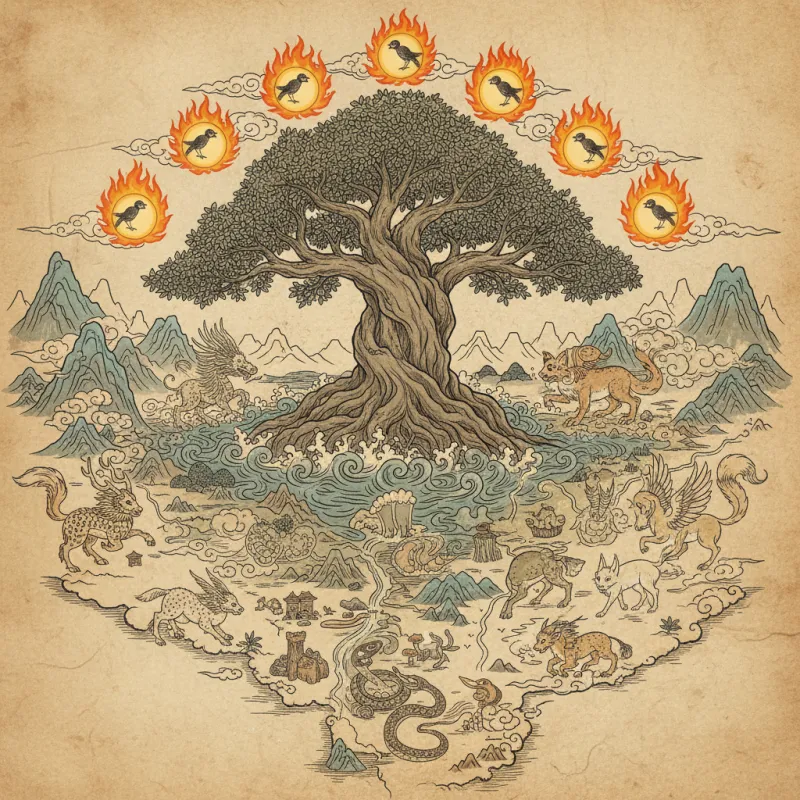
Picture this: every morning, one of ten suns climbs down from a tree the size of a mountain, bathes in boiling water, and rides a chariot across the sky while its nine siblings wait their turn on the branches. This isn't a fever dream — it's the cosmological operating system described in the Shanhaijing, where the Fusang Tree (扶桑 Fúsāng) serves as both cosmic parking garage and the eastern anchor of the known world.
The Geography of Dawn
The Fusang stands in the Tanggu Valley (汤谷 Tānggǔ, literally "Boiling Valley"), somewhere beyond the eastern edge of the world where the ocean waters perpetually simmer. The Shanhaijing treats this location with the same casual precision it uses for mundane mountains: "In the hot water there is the Fusang tree. The ten suns bathe there. It is north of the Black Tooth nation. In the water stands a great tree. Nine suns rest on its lower branches and one sun rests on its upper branch."
What strikes me about this passage is its bureaucratic tone — like a celestial DMV manual. There's no poetry here, no flowery language about the majesty of creation. Just: tree in hot water, ten suns, nine on bottom, one on top. Next question.
The tree itself defies normal botanical categories. Some texts describe it as a mulberry (桑 sāng), others as a hibiscus. The character 扶 (fú) means "to support" or "to help," suggesting the tree's function matters more than its species. This is infrastructure, not decoration. The Fusang doesn't just grow in the east — it is the east, the fixed point from which all directions are measured.
The Ten-Sun Rotation System
Here's where Chinese cosmology gets delightfully specific: the sky doesn't have one sun. It has ten. They work in shifts.
Each morning, one sun would descend from the Fusang, bathe in the Tanggu's hot springs (solar hygiene is important), and then ride across the sky in a chariot driven by their mother, the goddess Xihe (羲和 Xīhé). Meanwhile, the other nine suns lounged on the lower branches, presumably gossiping about mortals and playing celestial mahjong.
This rotation system explains something that puzzled ancient Chinese astronomers: why doesn't the sun get tired? Because it's not the same sun every day. Each one gets a nine-day vacation between shifts. It's the world's first documented labor union.
The system worked flawlessly until it didn't. The famous myth of Houyi (后羿 Hòuyì) the archer begins when all ten suns decide to clock in simultaneously — either as a prank, a rebellion, or because someone mixed up the schedule. The resulting heat scorched the earth, boiled rivers, and generally made life unpleasant. Houyi shot down nine of them, leaving us with our current single-sun situation and a lot of unemployed solar deities.
The Tree as World Axis
The Fusang functions as what scholars call an axis mundi — a cosmic pillar connecting heaven, earth, and the underworld. But unlike other world trees in global mythology (Yggdrasil, the Mayan ceiba), the Fusang is explicitly directional. It doesn't just connect vertical realms; it marks the eastern boundary of the civilized world.
Beyond the Fusang lay the lands of the extreme east: the Black Tooth nation (黑齿国 Hēichǐguó), whose people had black teeth and ate rice; the Gentleman's Country (君子国 Jūnzǐguó), where everyone was unfailingly polite; and various other nations that got progressively stranger the farther you sailed. The Fusang served as the last landmark before you fell off the edge of the known world into pure myth.
This geographical function explains why "Fusang" later became a poetic name for Japan, and why some fringe historians claim it refers to pre-Columbian Chinese contact with the Americas. When you're already at the edge of the world, any land further east must be really far away.
The Mulberry Connection
The character 桑 (sāng) in Fusang means mulberry, and this isn't arbitrary. Mulberry trees were sacred in ancient China because they fed silkworms, which produced silk, which was basically currency. The cosmic tree that births the sun shares its name with the tree that feeds the worms that make the fabric that clothes emperors. Everything connects.
Some versions of the myth describe the Fusang as having leaves that glow red at dawn and white at dusk, like a natural traffic light for celestial navigation. The tree supposedly grew to a height of several thousand li (a li being roughly half a kilometer), making it visible from anywhere in the eastern ocean — assuming you had really good eyesight and the curvature of the earth didn't exist yet.
The Huainanzi (淮南子), compiled in the 2nd century BCE, adds another detail: the Fusang has a companion tree called the Ruomu (若木 Ruòmù) in the far west, where the sun sets. Together, these trees form a cosmic circuit — the sun rises from one and sets into the other, presumably traveling underground at night to get back to the Fusang for its next shift. It's an elegant system, assuming you don't think too hard about the logistics.
The Fusang in Later Literature
By the Tang Dynasty (618-907 CE), the Fusang had become a standard poetic reference for the east, dawn, and new beginnings. Li Bai (李白 Lǐ Bái), never one to resist a good cosmic metaphor, wrote about "the Fusang where the sun bathes" in several poems, using it as shorthand for the exotic, the distant, and the impossibly beautiful.
The tree also appears in Daoist immortality texts as a destination for spiritual seekers. If you could reach the Fusang, some texts suggested, you could drink the water the suns bathed in and achieve immortality — though presumably you'd need asbestos lips. This connects the Fusang to other mythical eastern locations like Penglai Mountain, where immortals supposedly lived and magical herbs grew.
The Ming Dynasty novel Journey to the West (西游记 Xīyóu Jì) mentions the Fusang in passing, treating it as common knowledge — the way a modern novel might reference the North Pole without explanation. By this point, the tree had become part of the cultural furniture, a shared reference point that needed no introduction.
What the Fusang Tells Us About Ancient Cosmology
The Fusang myth reveals something crucial about how ancient Chinese thinkers understood the cosmos: it was organized, scheduled, and fundamentally orderly. The universe wasn't chaos — it was a well-run bureaucracy with clear procedures and designated parking spots for celestial bodies.
This contrasts sharply with Greek mythology, where the sun god Helios drives his chariot across the sky every day in what seems like a solo operation with no backup plan. What happens if Helios gets sick? The Greeks didn't say. The Chinese system, with its ten-sun rotation and designated bathing facilities, shows a culture that valued redundancy and proper infrastructure even in their cosmic myths.
The tree's location in boiling water also suggests an early understanding that the sun generates heat — it needs to be in hot water because it is hot. The bathing ritual might represent a primitive theory of solar energy renewal: the sun depletes its heat crossing the sky and needs to recharge in the thermal waters before its next shift.
The Fusang Today
Modern Chinese still use "Fusang" as a poetic reference for Japan, though the connection has become so abstracted that most people don't think about the original tree myth. The phrase "扶桑之国" (Fúsāng zhī guó, "the country of Fusang") appears in formal writing about Japan, carrying connotations of the exotic east and the rising sun — which is, of course, exactly what Japan calls itself.
The tree also appears in contemporary fantasy novels and video games, usually as a mystical location or a source of solar-themed magic. The mobile game Onmyoji features the Fusang as a raid location where players can battle sun-themed demons, which would probably confuse the original myth-makers but makes perfect sense in context.
What persists is the core image: a tree so vast it connects worlds, standing at the edge of everything known, where the sun begins its daily journey. In a culture that values roots, family trees, and the connection between heaven and earth, the Fusang remains a powerful symbol of cosmic order — even if we now know the sun doesn't actually sleep in a tree between shifts.
The Fusang reminds us that ancient people weren't naive. They were trying to explain observable phenomena — the sun rises in the east, it generates heat, it follows a predictable pattern — using the conceptual tools available to them. A cosmic tree with a ten-sun rotation system might not be scientifically accurate, but it's internally consistent, elegantly organized, and frankly more interesting than "the Earth rotates on its axis." Sometimes the old explanations, even when wrong, contain truths about how we understand our place in the cosmos.
Related Reading
- Exploring the Enigmatic Mythical Creatures and Lands of Shanhaijing
- Kunlun Mountain: The Paradise at the Center of the World — Shanhai Perspective
- Mythical Lands of the Shanhaijing: Places That Should Not Exist
- Penglai Island: The Legendary Isle of Immortals — Shanhai Perspective
- The Ruomu Tree: Where the Suns Set
- Nuwa Creates Humanity from Clay
- Discovering the Guardians of Shanhaijing: Mythical Creatures and Legendary Lands
- Mountain Spirits of the Shanhaijing: The Gods Who Live in Peaks