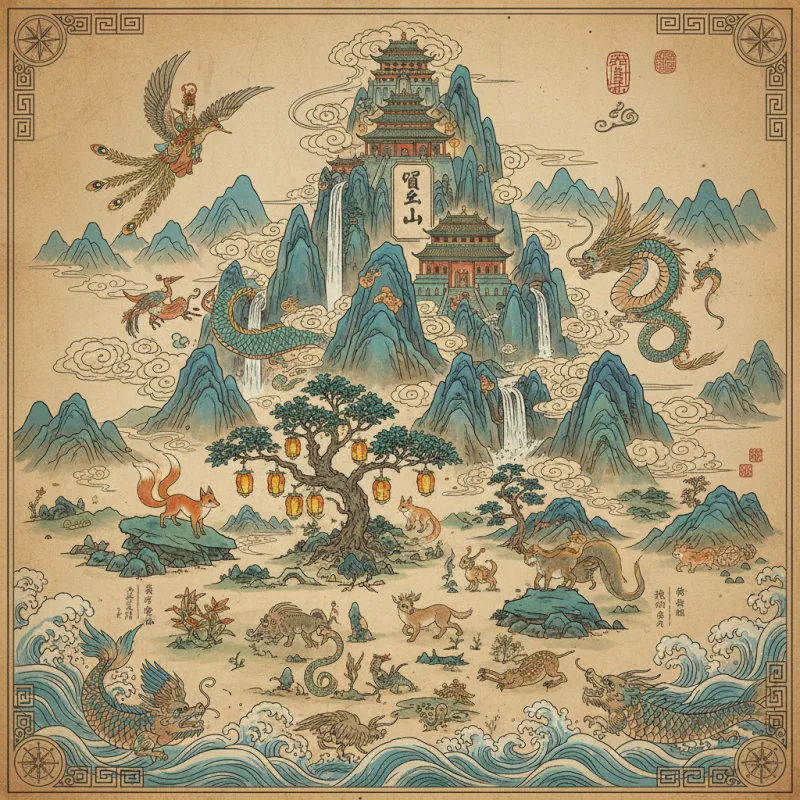
Picture this: a mountain so tall it pierces the boundary between mortal earth and celestial heaven, its peak lost in clouds that taste of immortality. Nine gates guard its slopes, each watched by a beast with the body of a tiger and nine human heads. At its summit sits a palace of jade where the Queen Mother of the West holds court, dispensing peaches that grant eternal life to those brave or foolish enough to reach her. This is Kunlun Mountain (昆仑山 Kūnlún Shān), and if you're looking for the center of the Chinese mythological universe, you've found it.
The Cosmic Pillar
Kunlun isn't just a mountain in the Shanhaijing — it's the axis mundi, the world's spine, the point where heaven and earth meet and exchange their essences. The text describes it rising 11,000 li into the sky (that's roughly 5,500 kilometers, or about 430 Mount Everests stacked on top of each other). At this height, the mountain's peak enters the realm of the immortals, a place where the laws of physics bend to accommodate divine will.
What makes Kunlun different from other sacred mountains in world mythology is its function as a cosmic bureaucracy. This isn't Olympus, where gods lounge around drinking nectar and meddling in human affairs. Kunlun is where the celestial administration manages the flow of qi (气 qì) between heaven and earth, where immortals cultivate their essence, and where the very fabric of reality is woven and maintained. The Shanhaijing describes it as having multiple terraces, each representing a different level of spiritual attainment — you can't just climb to the top; you have to earn your way up through cultivation and merit.
The mountain's base is surrounded by the Weak Water (弱水 Ruòshuǐ), a river so lacking in buoyancy that even a feather will sink. This isn't just a physical barrier; it's a metaphysical one. The Weak Water represents the dissolution of earthly attachments — cross it, and you leave behind everything that makes you mortal. Only those who have transcended their human nature can pass.
The Queen Mother's Domain
At Kunlun's summit reigns Xiwangmu (西王母 Xīwángmǔ), the Queen Mother of the West, and she is not the benevolent grandmother figure later Daoist tradition would make her. In the Shanhaijing, she's described as having a human face, a leopard's tail, tiger's teeth, and a talent for whistling that can summon disasters. She wears a sheng headdress (a ceremonial crown) and commands the spirits of plague and punishment.
Her most famous possession is the Garden of Immortal Peaches (蟠桃园 Pántáo Yuán), where trees bear fruit once every 3,000 years. Eat one of these peaches, and you gain immortality — but the Queen Mother doesn't hand them out freely. The most famous story involves King Mu of Zhou (周穆王 Zhōu Mù Wáng), who made the arduous journey to Kunlun around 976 BCE. The Queen Mother received him with courtesy, they exchanged poems, and she showed him her realm. But she didn't give him a peach. The message was clear: even emperors must die.
Later, during the Han Dynasty, Emperor Wu (汉武帝 Hàn Wǔdì) became obsessed with reaching Kunlun and obtaining immortality. He sent expeditions westward, built temples, performed elaborate rituals. According to legend, Xiwangmu did visit him once, bringing seven peaches. He ate them and asked for the seeds to plant his own trees. She laughed — the peaches of Kunlun don't grow in mortal soil. The emperor died at 70, having spent a fortune chasing a dream that was never meant to be caught.
The Geography of the Impossible
The Shanhaijing's description of Kunlun's geography reads like a fever dream mapped by a cartographer on psychedelics. The mountain has nine gates, each guarded by Kaiming (开明 Kāimíng), a beast with a tiger's body and nine human heads, all facing different directions so nothing can approach unseen. These aren't metaphorical gates — they're actual checkpoints in the spiritual journey toward transcendence.
The mountain's terraces are described in meticulous detail. The lowest level, called the Cool Breeze Terrace (凉风台 Liángfēng Tái), is where the wind from heaven first touches earth. Climb higher and you reach the Hanging Garden (悬圃 Xuánpǔ), a plateau where plants grow without soil, nourished directly by celestial qi. Higher still is the Upper Heaven (上天 Shàngtiān), where the gods themselves reside.
What's fascinating is how the Shanhaijing treats these impossible features as simple geographic facts. There's no sense of wonder or disbelief in the text — it describes Kunlun's 11,000-li height with the same matter-of-fact tone it uses for ordinary mountains. This suggests that for the text's original audience, Kunlun existed in a different category of reality. It wasn't a place you could visit with a good map and sturdy boots; it was a spiritual destination that required transformation of the self.
The Daoist Transformation
By the time Daoism emerged as an organized religion during the Han Dynasty, Kunlun had undergone a significant makeover. The wild, dangerous mountain of the Shanhaijing became the ultimate destination for immortality seekers, and Xiwangmu transformed from a fearsome deity of plague into a gracious hostess who taught the secrets of eternal life.
Daoist texts like the "Huainanzi" (淮南子 Huáinánzǐ) describe Kunlun as having a palace of jade and pearl, with gardens where the grass is made of precious stones and the trees bear jewels instead of fruit. The Queen Mother became the head of a celestial bureaucracy of female immortals, teaching meditation techniques, alchemical formulas, and breathing exercises to those who reached her realm.
This transformation reflects Daoism's project of systematizing the path to immortality. The Shanhaijing's Kunlun was mysterious and arbitrary — you either made it or you didn't, based on factors beyond your control. Daoist Kunlun offered a roadmap: cultivate your inner nature, refine your qi, follow the proper practices, and you too can ascend the mountain. It democratized transcendence, even if the actual practice remained impossibly difficult.
The connection between Kunlun and other mythical locations in Chinese cosmology also became more explicit. Daoist texts describe it as the source of the Yellow River (黄河 Huáng Hé), which flows down from the mountain's base and nourishes the Central Plains. This links Kunlun to Penglai, the island of immortals in the Eastern Sea — both are sources of immortality, but Kunlun represents the western, mountainous path while Penglai represents the eastern, oceanic route.
The Real Mountain Problem
Here's where things get complicated: there is an actual mountain range called Kunlun, running along the northern edge of the Tibetan Plateau. It's impressive — peaks over 7,000 meters, glaciers, the works. But it's clearly not the 5,500-kilometer cosmic pillar described in the Shanhaijing.
So what's the relationship between the mythical and geographical Kunlun? Scholars have debated this for centuries. Some argue that ancient Chinese explorers heard tales of the Kunlun range and, through a game of mythological telephone, transformed it into the cosmic mountain. Others suggest the mythical Kunlun came first, and the name was later applied to the real mountain range because it seemed appropriately impressive.
My take? The mythical Kunlun was never meant to be found on a map. It's a spiritual geography, a place that exists in the realm of cultivation and transformation. When the Shanhaijing says Kunlun is in the northwest, it's not giving you directions — it's telling you about the symbolic significance of that direction in Chinese cosmology. Northwest is where the sun sets, where yin energy accumulates, where the boundary between worlds grows thin. Of course the mountain of immortality would be there.
The real Kunlun range got its name because it occupied the right symbolic position and had the right impressive features. It became a physical anchor for a metaphysical concept, a way for people to point at something and say, "That's where the gods live," even if they knew the truth was more complicated.
Kunlun in Literature and Culture
Kunlun's influence on Chinese literature is impossible to overstate. Qu Yuan (屈原 Qū Yuán), the great poet of the Warring States period, wrote about journeying to Kunlun in his "Li Sao" (离骚 Lí Sāo), using the mountain as a metaphor for political and spiritual transcendence. When he describes ascending to the Queen Mother's palace, he's not writing fantasy — he's describing the soul's journey beyond the corruption of the mortal world.
The "Journey to the West" (西游记 Xīyóu Jì) features Kunlun prominently, though by the Ming Dynasty when the novel was written, the mountain had become part of a larger mythological landscape. Sun Wukong steals peaches from the Queen Mother's garden, an act of rebellion that sets the entire plot in motion. The novel treats Kunlun as one of several celestial realms, but it's still the most prestigious, the place where the real power resides.
Modern Chinese fantasy literature continues to use Kunlun as shorthand for ultimate spiritual achievement. Cultivation novels (修真小说 xiūzhēn xiǎoshuō) often feature Kunlun sects as the most powerful and prestigious, the Harvard of immortality schools. The mountain represents not just power but legitimacy — if you trained at Kunlun, you're the real deal.
The Center That Holds
What makes Kunlun endure as a mythological concept is its function as a center. Not a geographic center — China's actual geographic center is nowhere near the Kunlun range — but a spiritual and cosmological one. It's the point from which all other sacred geography radiates, the standard against which all other mountains are measured.
The Shanhaijing describes numerous other sacred mountains, each with their own gods and wonders. But Kunlun is always the reference point, the mountain that defines what a sacred mountain should be. When the text describes Mount Buzhou, the broken pillar that once held up the sky, it's implicitly comparing it to Kunlun, the pillar that still stands.
This centrality extends beyond geography into philosophy and religion. Kunlun represents the possibility of transcendence, the idea that humans can become something more than human. It's the ultimate goal of Daoist cultivation, the destination of shamanic journeys, the place where emperors go to legitimize their rule by communing with heaven.
But it's also fundamentally unreachable, and that's the point. Kunlun exists to remind us that there are heights we cannot climb, transformations we cannot achieve, at least not in our current state. It's both inspiration and humility, promise and warning. The mountain stands at the center of the world, eternal and unchanging, while we mortals circle its base, looking up at peaks we can barely imagine.
The Shanhaijing never promises that anyone can reach Kunlun's summit. It simply describes the mountain in all its impossible glory and leaves us to wonder what it would take to stand where the gods stand, to breathe the air of immortality, to see the world from the center of everything. That wondering, that yearning for transcendence, is perhaps the real gift Kunlun offers — not the peaches of immortality, but the dream of them.
Related Reading
- The Ruomu Tree: Where the Suns Set
- Exploring the Enigmatic Mythical Creatures and Lands of Shanhaijing
- Penglai Island: The Legendary Isle of Immortals — Shanhai Perspective
- The Fusang Tree: Where the Suns Rise and the World Begins — Shanhai Perspective
- Mythical Lands of the Shanhaijing: Places That Should Not Exist
- Exploring the Enigmatic Mountains and Creatures of the Shanhaijing
- The Enigmatic Fish of Shanhaijing: Mythical Creatures of Chinese Lore
- Mystical Beasts of the Shanhaijing: A Journey Through Myth and Geography