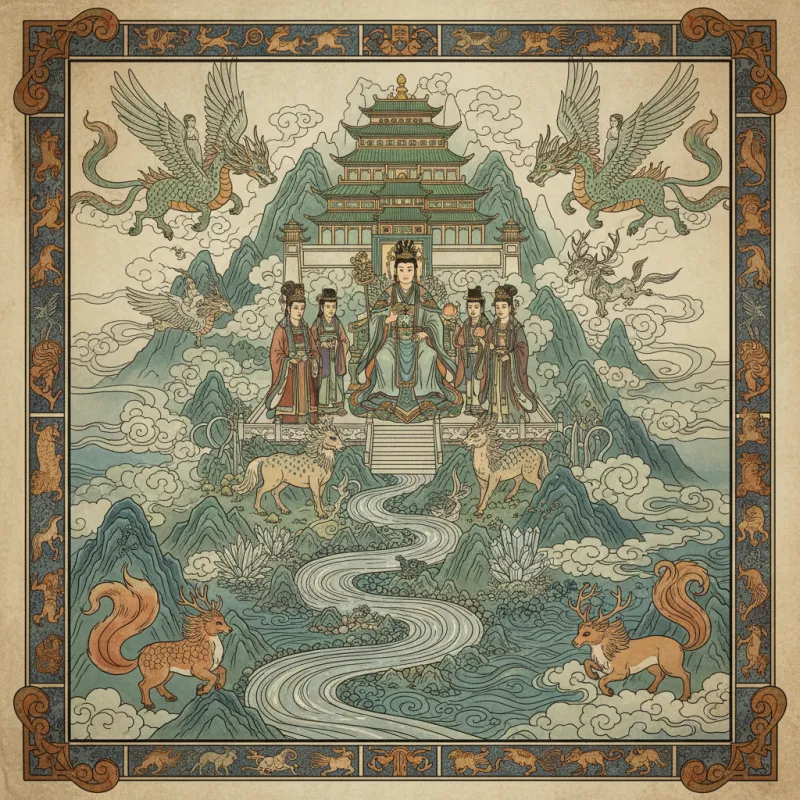
The peach trees bloom once every three thousand years. When they do, the Queen Mother of the West throws a party that makes Olympus look like a backyard barbecue. Gods scramble for invitations. Immortals polish their best robes. And at the center of it all stands a palace carved entirely from jade, perched atop Kunlun Mountain where the sky meets something beyond sky.
The Architecture of Eternity
The Jade Palace (瑶池宫 Yáochí Gōng) isn't described in exhaustive architectural detail in the Shanhaijing (山海经 Shānhǎi Jīng), and that's precisely what makes it fascinating. What we get instead are fragments, glimpses, the kind of descriptions that suggest something too magnificent for complete documentation. The palace is made of jade — not decorated with jade, not jade-trimmed, but constructed from it. We're talking walls, pillars, floors, all hewn from the stone that Chinese culture associates with purity, immortality, and heaven itself.
The Classic of Mountains and Seas places this palace at the summit of Kunlun Mountain (昆仑山 Kūnlún Shān), which functions as the cosmic axis, the world's spine. This isn't metaphor. In the mythological geography of ancient China, Kunlun literally connects the mortal realm to the heavens. The palace sits at this junction point, making it less a residence and more a cosmic customs office where the traffic between worlds is regulated.
Later texts, particularly those from the Han Dynasty, elaborate on the palace grounds. There's the Jade Pool (瑶池 Yáochí) itself, a lake of liquid jade or perhaps water so pure it appears jade-like. The famous Peaches of Immortality grow in orchards surrounding the palace, their three-thousand-year growth cycle making them the ultimate slow food. The palace complex includes gardens where phoenixes nest and nine-tailed foxes serve as attendants — though these foxes are divine servants, not the trickster spirits they'd become in later folklore.
The Queen Mother: Deity, Not Decoration
Xi Wangmu (西王母 Xīwángmǔ), the Queen Mother of the West, is often softened in popular retellings into a benevolent grandmother figure who hands out peaches and longevity. This is a profound misreading. The earliest descriptions in the Shanhaijing present her as something far more primal and powerful: a deity with a human face, leopard's tail, tiger's teeth, and a howl that could shake mountains. She commanded plagues and punishments alongside her gifts of immortality.
By the Han Dynasty, her image had been refined — made more palatable, more courtly. She became beautiful, regal, the perfect hostess for celestial banquets. But this domestication shouldn't fool us. The Queen Mother controls access to immortality itself. She decides who receives the peaches, who gets invited to the banquets, who crosses the threshold from mortal to eternal. That's not soft power. That's absolute authority over the one thing every human wants and cannot have.
Her palace reflects this dual nature. It's beautiful, yes, but it's also a fortress. Kunlun Mountain is surrounded by the Weak Water (弱水 Ruòshuǐ), a river so lacking in buoyancy that even feathers sink in it. Beyond that are rings of fire. The palace isn't just exclusive — it's deliberately inaccessible. Only those the Queen Mother permits can reach it, and she permits very few.
The Peach Banquet: Politics at the End of the World
The Peach Banquet (蟠桃会 Pántáo Huì) is the Jade Palace's most famous event, though most of what we know about it comes from the 16th-century novel Journey to the West rather than ancient texts. In that story, Sun Wukong (孙悟空 Sūn Wùkōng) crashes the party, eats all the peaches, drinks the immortality wine, and generally causes chaos that requires Buddha himself to sort out.
But strip away the novel's embellishments and you find something interesting: the banquet as a mechanism of cosmic order. Immortality isn't freely given in Chinese mythology — it's rationed, controlled, distributed according to hierarchy and merit. The Queen Mother's banquets enforce this system. Who gets invited matters. Who sits where matters. Who receives which peach matters, because the peaches themselves vary in potency depending on which tree they came from.
This makes the Jade Palace not just a residence but a seat of government. The Queen Mother isn't merely hosting parties; she's maintaining the structure of the divine bureaucracy. Her palace is where the pecking order of heaven gets reinforced every three millennia, where gods are reminded of their place, where the system perpetuates itself through the distribution of the one resource that matters: time.
Mortal Visitors and Their Fates
Very few mortals have reached the Jade Palace, and their stories are telling. King Mu of Zhou (周穆王 Zhōu Mù Wáng), who ruled around 976-922 BCE, supposedly made the journey. The Mu Tianzi Zhuan (穆天子传 Mù Tiānzǐ Zhuàn), a text from around the 4th century BCE, describes his visit in detail. He brought gifts, exchanged poetry with the Queen Mother, and was treated with honor. But he didn't receive immortality. He went home, aged, and died like any other man.
The message is clear: visiting the palace doesn't guarantee transformation. The Queen Mother's hospitality has limits. She might entertain you, might even like you, but immortality is hers to grant or withhold. The palace itself doesn't confer its benefits automatically. You can stand in the presence of eternity and still remain mortal.
Compare this to the story of the Eight Immortals (八仙 Bāxiān), who did achieve immortality but through various means — alchemy, cultivation, divine favor. Some traditions place their final transformations at or near Kunlun, suggesting the mountain and its palace serve as a kind of graduation site for those who've earned their immortality elsewhere. The palace doesn't make immortals; it recognizes them.
The Palace in Daoist Cultivation
Daoist practitioners adopted the Jade Palace as a meditation focus and spiritual destination. In internal alchemy (内丹 nèidān) practices, Kunlun Mountain and the Queen Mother's palace become interior landscapes. The mountain is the spine, the palace is a point in the head, the Jade Pool is a reservoir of vital essence. Practitioners visualize ascending Kunlun, meeting the Queen Mother, receiving her teachings.
This internalization is brilliant because it solves the accessibility problem. You can't physically reach Kunlun — it's mythological, or if it's real, it's protected by impossible barriers. But you can reach it internally through meditation and cultivation. The palace becomes a state of consciousness rather than a place, immortality becomes a transformation of being rather than endless biological life.
Yet even in these practices, the palace retains its exclusivity. You don't just visualize your way there on a whim. It requires years of preparation, purification, cultivation. The internal Jade Palace is as hard to reach as the external one, which maintains the mythological logic: immortality is difficult, rare, and reserved for the exceptional.
Kunlun's Competitors and Cousins
The Jade Palace doesn't exist in isolation. Chinese mythology includes other divine residences, other mountains where immortals dwell. The Five Sacred Mountains (五岳 Wǔyuè) each have their own divine bureaucracies. Mount Penglai (蓬莱山 Pénglái Shān) and the other islands of immortality float somewhere in the eastern sea, home to different immortals with different peaches.
But Kunlun maintains primacy. It's older in the textual tradition, more fundamental to the cosmic structure. Penglai is where immortals live after achieving immortality; Kunlun is where immortality itself resides. The Queen Mother of the West predates most other Chinese deities in the written record, and her palace predates their residences. Other divine mountains are branches; Kunlun is the root.
This hierarchy matters because it reflects how Chinese mythology organized itself. Unlike Greek mythology with its single Mount Olympus, Chinese tradition developed multiple sacred peaks, multiple divine residences, a distributed system of celestial power. But even in this distributed system, Kunlun and its Jade Palace remain the axis, the center, the place where the cosmic order originates.
What the Palace Tells Us
The Jade Palace reveals something essential about Chinese approaches to immortality and divinity. It's not democratic. It's not accessible through faith alone. It's not even accessible through good behavior, necessarily. The palace and its mistress represent immortality as an exclusive club with strict membership requirements, where the bouncer is a goddess who's been saying "you're not on the list" since before recorded history.
This might seem harsh, but it's also honest. The mythology doesn't promise that everyone can become immortal, doesn't suggest that wanting it badly enough is sufficient. Instead, it presents immortality as rare, difficult, and controlled by powers that operate according to their own logic. The Jade Palace, beautiful and terrible, sits at the top of the world as a reminder that some things remain forever out of reach — unless you're extraordinary enough, cultivated enough, or lucky enough to receive an invitation.
And even then, you'd better hope the peaches are ripe.
Related Reading
- Weapons of the Gods in Chinese Mythology
- The Hetu and Luoshu: Magical Diagrams from the Rivers — Shanhai Perspective
- Hetu and Luoshu: The Cosmic Diagrams
- Sacred Objects of Chinese Mythology: Seals, Mirrors, and Cauldrons — Shanhai Perspective
- Peaches of Immortality: The Most Coveted Fruit
- Unearthing the Cursed Beings of Shanhaijing: Myths, Creatures, and Lands
- The Nine-Tailed Fox: From Divine Messenger to Demonic Seductress
- Exploring the Enigmatic Mountains and Creatures of the Shanhaijing