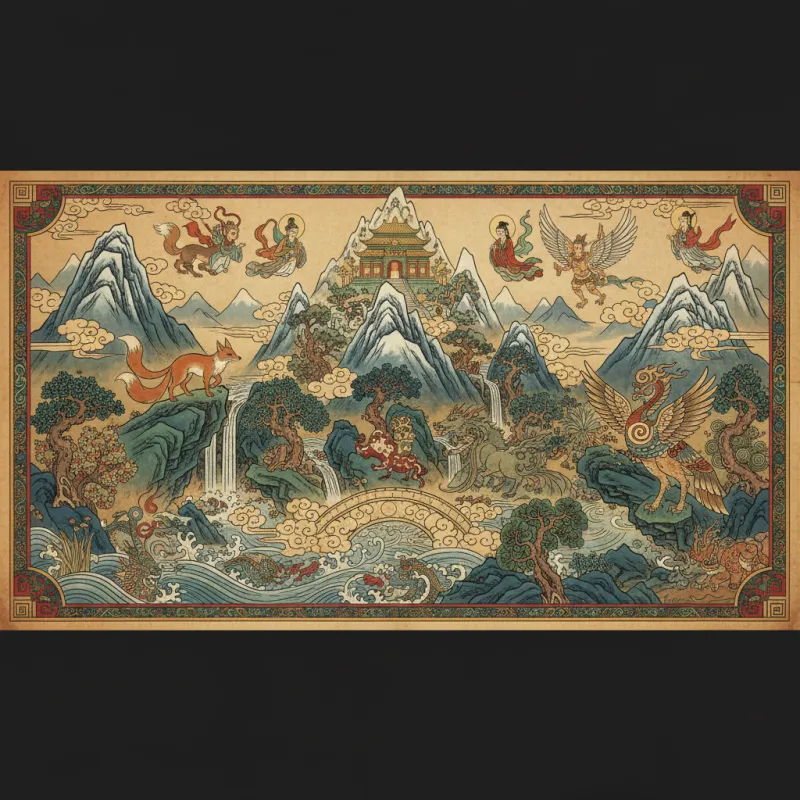
Every mythology needs a center, a cosmic axis where heaven touches earth. The Greeks had Olympus. The Norse had Asgard. The Chinese had Kunlun (昆仑山, Kūnlún Shān) — and here's where things get weird. Unlike those other sacred mountains, Kunlun might actually exist. There's a real mountain range called Kunlun stretching 3,000 kilometers across western China, and for two millennia, scholars have been tearing their hair out trying to figure out if the mythological paradise and the geographical landmark are the same place. Did ancient Chinese mystics stumble upon this remote range and decide it must be the home of immortals? Or did the mountain get named after the myth? The answer matters more than you'd think, because Kunlun isn't just another sacred peak — it's the architectural blueprint of Chinese cosmology itself.
The Geography of Paradise
The Shanhaijing (山海经, Classic of Mountains and Seas) describes Kunlun with the precision of a surveyor and the imagination of a fever dream. It's 800 li around (roughly 250 miles), rises 80,000 feet into the sky, and sits at the exact center of the earth. The mountain has nine levels, each separated by gates guarded by supernatural beings. At its base flows the Yellow River, which circles the mountain before heading east to nourish civilization. The peak is crowned by a jade palace where the Queen Mother of the West (西王母, Xī Wángmǔ) holds court, surrounded by gardens of immortality-granting peaches that ripen once every 3,000 years.
Here's what makes this description fascinating: it's both completely fantastical and oddly specific. The Shanhaijing doesn't just say "there's a magic mountain somewhere." It gives measurements, cardinal directions, and geographical relationships to known landmarks. The text treats Kunlun like a real place you could theoretically visit — if you could survive the journey through territories inhabited by nine-tailed foxes and other creatures that would happily eat you.
The real Kunlun Mountains do sit at a kind of geographical center — they form the northern boundary of the Tibetan Plateau and separate it from the Tarim Basin. They're remote, forbidding, and perpetually snow-capped. If you were an ancient Chinese traveler hearing tales from the far west, these mountains would sound like the edge of the world. Which is exactly where you'd expect to find the home of immortals.
The Queen Mother's Domain
You can't talk about Kunlun without talking about its ruler. The Queen Mother of the West isn't some minor deity — she's one of the most important figures in Chinese mythology, and Kunlun is her power base. In the earliest texts, she's described as a wild, fearsome creature with a leopard's tail, tiger's teeth, and a talent for whistling up disasters. By the Han Dynasty (206 BCE - 220 CE), she'd undergone a complete makeover into an elegant goddess of immortality, but she never lost her edge.
Her palace on Kunlun's summit is called the Jade Capital (瑶池, Yáochí), and it's where she keeps the Peaches of Immortality. These aren't your grocery store peaches. They take 3,000 years to bloom, another 3,000 to fruit, and 3,000 more to ripen. When they finally mature, the Queen Mother throws a banquet called the Pantao Hui (蟠桃会, Pántáo Huì), inviting all the immortals and worthy deities. Miss the invitation, and you're nobody. Get invited, and you're guaranteed another few millennia of existence.
The Journey to the West (西游记, Xīyóujì), written by Wu Cheng'en in the 16th century, features one of literature's most entertaining party crashes when Sun Wukong (孙悟空, Sūn Wùkōng), the Monkey King, discovers he wasn't invited to the peach banquet. His response? Eat all the peaches, drink all the wine, steal the pills of immortality, and trash the place. It takes the entire celestial bureaucracy to bring him down. The episode reveals something crucial about Kunlun's role in Chinese mythology — it's not just a location, it's a symbol of cosmic order and hierarchy. The Queen Mother decides who gets immortality and who doesn't, making her palace the ultimate gatekeeper between mortality and transcendence.
The Immortals' Training Ground
Kunlun isn't just where immortals live — it's where they're made. In Daoist tradition, the mountain serves as the ultimate cultivation site, a place where the boundary between physical and spiritual realms grows thin enough to cross. The mountain's nine levels correspond to stages of spiritual advancement, and climbing them isn't a matter of physical endurance but spiritual refinement.
The Huainanzi (淮南子), compiled around 139 BCE, describes Kunlun as having three tiers: the Hanging Garden (悬圃, Xuánpǔ) at the lower level where immortals begin their training, the Cool Breeze Mountain (凉风山, Liángfēng Shān) at the middle level where they refine their practice, and the Jade Capital at the summit where they achieve full immortality. Each level requires mastering different arts — alchemy, meditation, breath control, and the ability to subsist on nothing but dew and moonlight.
Historical figures claimed to have visited Kunlun, though their accounts should be taken with several grains of salt. King Mu of Zhou (周穆王, Zhōu Mù Wáng), who ruled around 976-922 BCE, supposedly made a pilgrimage to Kunlun where he met the Queen Mother of the West. They exchanged poetry, drank wine, and he returned with tales of the mountain's wonders. Whether this actually happened or was later propaganda to legitimize his rule is anyone's guess, but the story established a pattern: legitimate rulers had connections to Kunlun.
The Pharmacopoeia of Paradise
The plants growing on Kunlun aren't your typical alpine flora. According to the Shanhaijing, the mountain hosts the Jade Tree (玉树, Yùshù), whose fruit grants immortality; the Immortality Mushroom (灵芝, Língzhī), which still features prominently in traditional Chinese medicine; and the Vermillion Grass (朱草, Zhūcǎo), which glows with an inner light and can resurrect the dead if prepared correctly.
The most famous botanical resident is the Peach Tree of Immortality (蟠桃树, Pántáo Shù), but Kunlun's gardens contain an entire ecosystem of supernatural plants. The Baopuzi (抱朴子), written by Ge Hong in the 4th century CE, catalogs dozens of plants found on Kunlun, complete with preparation instructions. Want to fly? Eat the root of the Flying Herb (飞草, Fēicǎo) for 100 days. Want to become invisible? Grind the Shadow-Hiding Flower (隐形花, Yǐnxíng Huā) into powder and mix it with morning dew.
These weren't just fantasy ingredients — they formed the basis of actual alchemical practice. Daoist practitioners spent centuries trying to recreate Kunlun's conditions in their laboratories, believing that if they could replicate the mountain's unique environment, they could produce its miraculous plants. This led to the development of Chinese alchemy, which eventually contributed to discoveries like gunpowder (ironically, while searching for immortality elixirs).
The Architectural Impossibility
Let's talk about the physical structure of mythological Kunlun, because it's architecturally bonkers. The mountain is described as having nine levels, but these aren't terraces or plateaus — they're separate worlds stacked on top of each other, each with its own climate, inhabitants, and rules of physics. The base level connects to the mortal world and experiences normal time. The middle levels exist in a kind of temporal flux where years pass like days. The summit exists outside time entirely.
The gates between levels aren't just doors — they're guarded by specific creatures. The Shanhaijing names some of them: the Kaiming Beast (开明兽, Kāimíng Shòu), a nine-headed tiger that guards the lower gates; the Luwu (陆吾, Lùwú), a creature with a tiger's body, nine tails, and a human face that oversees the middle levels; and various divine birds that patrol the upper reaches. You can't just walk past these guardians — you need either divine permission or sufficient spiritual cultivation to convince them you belong there.
The architecture itself defies normal construction. Buildings are made from jade, gold, and precious stones, but they're not built — they grow from the mountain itself, as if Kunlun is a living organism that produces palaces the way trees produce fruit. The Queen Mother's palace supposedly has pillars made from single pieces of jade 1,000 feet tall. Where did they come from? They've always been there, part of the mountain's essential nature.
The Real Mountain's Shadow
Now we need to address the elephant in the room — or rather, the mountain range in western China. The actual Kunlun Mountains stretch from the Pamir Mountains in Tajikistan to the Qilian Mountains in Qinghai Province. They're massive, remote, and genuinely impressive. The highest peak, Kongur Tagh, reaches 7,649 meters (25,095 feet). The range forms a natural barrier between the Tibetan Plateau and the Tarim Basin, making it one of the most significant geographical features in Asia.
Did ancient Chinese people see these mountains and decide they must be the mythological Kunlun? Or did the mythological Kunlun exist first, and later geographers applied the name to these mountains because they seemed appropriately impressive? The evidence points in both directions. The earliest references to Kunlun in texts like the Shanhaijing describe a mythological place with no clear geographical coordinates. But by the Han Dynasty, Chinese explorers were pushing westward, encountering these massive mountains, and the identification seems to have been made.
The problem is that the real Kunlun Mountains don't match the mythological description. They're not at the center of the earth (they're quite far west). The Yellow River doesn't circle them (it rises in the Bayan Har Mountains to the south). And despite extensive exploration, nobody has found the Queen Mother's jade palace or any 9,000-year-old peach trees.
The Enduring Mystery
What makes Kunlun fascinating isn't whether it's real or mythological — it's that Chinese culture has never felt the need to definitively choose. The mountain exists in a superposition of states: it's both a real geographical feature and a mythological paradise, and somehow that contradiction doesn't bother anyone. You can visit the Kunlun Mountains today, drive through the Kunlun Pass, and buy postcards. But you can also read Daoist texts that treat Kunlun as a spiritual destination accessible only through meditation and cultivation.
This dual nature reflects something fundamental about Chinese cosmology. Unlike Western traditions that tend to separate the physical and spiritual into distinct realms, Chinese thought allows them to coexist and interpenetrate. Kunlun can be both a mountain range in Qinghai and the axis mundi of the universe. The Queen Mother of the West can be both a mythological figure and a real presence accessible through spiritual practice. The contradiction is the point.
Modern Chinese culture continues to reference Kunlun constantly. It appears in wuxia novels as the home of powerful martial arts sects, in video games as a mystical location players can visit, and in everyday language as a metaphor for any remote, difficult-to-reach place of great value. The mountain has transcended its origins to become a cultural touchstone, a shared reference point that connects ancient mythology to contemporary life.
The real question isn't whether Kunlun exists — it's what kind of existence we're talking about. As a physical mountain range, it's undeniably real. As the cosmic center of Chinese mythology, it's equally real in the cultural imagination. And perhaps that's the most immortal thing about Kunlun: not the peaches or the jade palace, but its ability to exist simultaneously in multiple states of reality, refusing to be pinned down to just one.
Related Reading
- Mountain Spirits and Local Worship
- Mountain Spirits of the Shanhaijing: The Gods Who Live in Peaks
- The Mountain Gods of Ancient China
- Sacred Mountains: The Five Great Peaks
- Exploring the Enigmatic Seas of the Shanhaijing: Mythical Creatures and Realms
- Sacred Rivers in Chinese Mythology: The Yellow River and the Yangtze
- The Peoples of the Shanhaijing: Foreign Nations at the Edge of the World