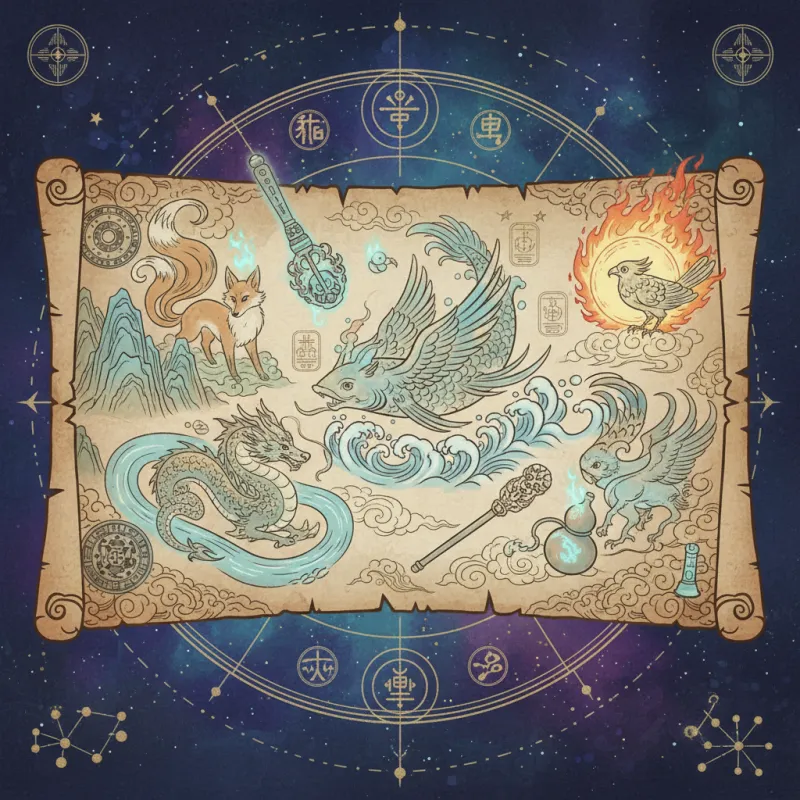
There's a passage in the Classic of the Western Mountains (西山经, Xī Shān Jīng) that has always struck me as oddly specific. It describes a stone found on Mount Zhongqu that, when carried, prevents the bearer from getting lost. Not a grand weapon. Not a world-ending talisman. Just a rock that keeps you oriented. That's the thing about the Shanhaijing's artifacts — they're not all thunderbolts and flaming swords. Some are profoundly practical. Others are terrifyingly powerful. And a few are so strange that scholars have spent centuries arguing about what they actually do.
The Text as Catalog
The Shanhaijing (山海经, Shān Hǎi Jīng) — usually translated as the Classic of Mountains and Seas — is not a novel. It's not really a religious text either. It's something closer to an ancient encyclopedia, compiled between roughly 400 BCE and 200 CE, though parts may be older. The text systematically catalogs mountains, rivers, regions, and the creatures and materials found in each location. And among these entries, scattered like gems in geological strata, are descriptions of objects with extraordinary properties.
What makes these artifacts fascinating is their matter-of-fact presentation. The text doesn't pause to marvel. It simply states: this mountain has jade that glows at night. This river contains stones that cure deafness. This creature's hide, when worn, grants immunity to poison. The tone is clinical, almost bureaucratic, which paradoxically makes the claims feel more credible. These aren't legends being embellished around a campfire. They're inventory lists.
The artifacts fall into rough categories: stones and minerals with medicinal or protective properties, plants with transformative effects, animal parts that confer abilities, and occasionally, crafted objects of unclear origin. But the boundaries blur. Is the flesh of the Zhūyàn (朱厌) — a creature whose appearance heralds war — an artifact if consuming it grants strength? The text doesn't philosophize about such distinctions.
Stones That Heal and Protect
The Shanhaijing is obsessed with stones. Jade (玉, yù) appears constantly, but not as mere decoration. Different mountains yield jade with different properties. The jade of Mount Zhongqu, for instance, can be eaten to prevent hunger. Mount Yuwu produces a jade that, when worn, prevents nightmares. This isn't metaphorical — the text presents these as practical applications.
Then there's the Xuānshí (玄石, "dark stone") from Mount Guishan, which the text claims can cure deafness when ground and applied. Or the Dānshā (丹砂, cinnabar) from various mountains, used not just for its mercury content but described as having life-extending properties. Modern readers might dismiss this as superstition, but cinnabar was indeed central to early Chinese alchemy and medicine, even if its actual effects were... different than advertised.
The most intriguing protective stone might be the Línshí (磷石, "phosphorescent stone") from Mount Yuwu. The text says it glows in darkness and, when carried, wards off evil spirits. Phosphorescent minerals do exist — certain sulfides and phosphates exhibit luminescence. Whether ancient observers connected this natural phenomenon to spiritual protection, or whether something else is being described, remains unclear. But the specificity is striking: not just "a magic rock," but a rock with observable physical properties that also confers protection.
Some stones are more ominous. Mount Yuwu also yields a stone that, when thrown into water, causes drought. The text doesn't explain the mechanism. It doesn't need to. In a worldview where natural phenomena and spiritual forces are continuous, a drought-causing stone is no stranger than a lodestone that points north.
Plants of Transformation
The botanical artifacts are where things get genuinely weird. The Shanhaijing describes plants that don't just heal or poison — they fundamentally alter the person who consumes them.
Take the Zhūyú (朱萸) from Mount Fuyao. Eating it supposedly makes you immune to poison and prevents epidemics. This might sound like standard medicinal claims, except the text is specific about the plant's appearance: red stems, white flowers, fruit like rabbit ears. Someone was describing an actual plant, even if its properties were... optimistic.
More dramatic is the Shìwēi (视肉, "meat that can be looked at"), described in the Classic of Overseas Regions. It's a plant that looks like meat, regenerates when cut, and can be eaten indefinitely. This has fascinated scholars for centuries. Some argue it's describing a fungus — perhaps a large polypore or slime mold. Others think it's purely mythical. But the detail that it "looks like meat" suggests someone saw something that violated their categories. Not quite plant, not quite animal.
Then there's the grass from Mount Guishan that makes you forget your worries when eaten. The text calls it Wàngyōu (忘忧, literally "forget worry"). Is this describing a psychoactive plant? Ancient China certainly knew about such things — cannabis, datura, and various mushrooms were documented. Or is this wishful thinking, the kind of plant you'd invent if you were cataloging an ideal world?
The most unsettling might be the plant from Mount Yuwu that, when eaten, makes you good at deceiving people. Not "eloquent" or "persuasive" — specifically good at deception. The text doesn't moralize about this. It's just another property, like "prevents hunger" or "cures deafness." The casual amorality is very Shanhaijing.
Creature Parts as Power
If you want to understand how the Shanhaijing thinks about artifacts, look at how it treats animal parts. The text rarely describes crafted weapons or tools. Instead, power comes from the creatures themselves — their hides, their flesh, their bones.
The hide of the Bófù (駮父), a creature that looks like a horse with a white body and black tail, protects against weapons when worn. The text is clear: this isn't armor in the conventional sense. The hide itself has the property. Similarly, wearing the skin of the Fèifèi (狒狒) — a creature that looks like a human with pig-like features — makes you unafraid of thunder.
Some creature parts grant abilities rather than protection. Eating the flesh of the Dāngkāng (当康), a pig-like creature with tusks, prevents worry and anxiety. The meat of the Héluó (合罗) fish makes you immune to fire. These aren't metaphors. The text presents them as straightforward cause and effect: consume this, gain that ability.
The most powerful creature-derived artifacts come from the great beasts. The Qilin, though rarely seen, is said to have a hide that no weapon can pierce and horns that can detect poison. The Fenghuang — the phoenix-like bird — has feathers that, according to some interpretations of the text, can be woven into garments that make the wearer immune to fire.
But here's what's interesting: the text almost never describes anyone actually using these artifacts. It catalogs their properties the way a modern field guide catalogs species. The implication is that these things exist in the world, available to those who can find them, but not necessarily in anyone's possession. They're potential artifacts, waiting to be claimed.
The Weapons That Aren't
When the Shanhaijing does describe crafted objects, they're often tools rather than weapons. There's a bronze mirror from Mount Yuwu that can summon wind and rain. A drum made from the hide of the Kuí (夔) — a one-legged creature — that can be heard for five hundred li and strikes terror into enemies.
The most famous crafted artifact is probably the Xuānyuán Sword (轩辕剑, Xuānyuán Jiàn), though its description in the Shanhaijing is frustratingly brief. Later texts would elaborate it into one of China's legendary swords, but in the original, it's mentioned almost in passing as a weapon used by the Yellow Emperor. The text is more interested in the mountains and creatures than in the tools of heroes.
This is revealing. The Shanhaijing isn't interested in the artifacts of civilization — the swords, the armor, the tools of war and craft. It's interested in the raw materials of power, the things that exist in the world before human hands shape them. A stone that prevents getting lost is more valuable than a compass because it doesn't require human ingenuity to work. It just works.
There's a philosophical point here, though the text never makes it explicit. In the Shanhaijing's worldview, power doesn't come from what humans make. It comes from what humans find. The world is full of potent materials and creatures. The challenge isn't creation — it's discovery and recognition.
The Problem of Verification
Here's the uncomfortable question: did anyone in ancient China actually believe these artifacts existed?
The answer is complicated. The Shanhaijing was treated as a serious geographical text for centuries. Scholars cited it. Commentators annotated it. But even early readers seemed uncertain about its more fantastic claims. Guo Pu (郭璞), who wrote the most influential commentary in 276 CE, sometimes notes that he hasn't personally verified certain claims. His tone suggests skepticism, but not outright dismissal.
By the Tang Dynasty (618-907 CE), educated readers were treating the Shanhaijing as a mix of genuine geography and fantastic elaboration. But they didn't dismiss it entirely. The assumption seemed to be that the text contained real information, but that some of it had been corrupted, exaggerated, or misunderstood over centuries of transmission.
Modern scholars have tried to identify real objects behind the descriptions. Some jade types mentioned in the text correspond to actual minerals found in the regions described. Certain plants can be tentatively identified with known species. But many artifacts remain mysterious. Is the stone that prevents getting lost describing some kind of magnetic mineral? Or is it pure invention? We don't know.
What we do know is that the artifacts of the Shanhaijing influenced Chinese culture for millennia. Later novels and stories are full of magical objects that echo the Shanhaijing's catalog: stones that grant abilities, plants that transform, creature parts that confer power. The text established a template for how Chinese fantasy would think about magical objects — not as crafted by wizards, but as natural products of a world stranger than we imagine.
The Artifacts We've Lost
The saddest thing about the Shanhaijing's artifacts is that we can't verify them because we can't find them. The text describes specific mountains, specific rivers, specific locations. But two thousand years of geographical change, political upheaval, and environmental transformation mean that even when we can identify the locations, we can't find the objects.
Did Mount Zhongqu really have a stone that prevented getting lost? We'll never know. The mountain might not exist anymore, or we might not be able to identify it with certainty. Even if we could, the stone — if it ever existed — is long gone.
This gives the Shanhaijing's artifacts a peculiar quality. They're simultaneously concrete and unreachable. The text describes them with specificity — this mountain, this stone, this property — but they exist in a past we can't access. They're artifacts in both senses: objects of power and remnants of a lost world.
Maybe that's why they continue to fascinate. They represent a version of reality where the world was more generous with its wonders, where you could climb a mountain and find a stone that solved your problems, where eating the right plant could fundamentally change who you were. The Shanhaijing catalogs a world of potential, where power wasn't locked away in the hands of gods or emperors but scattered across the landscape, waiting to be discovered.
That world is gone, if it ever existed. But the catalog remains, a list of wonders we can no longer verify but can't quite dismiss. And maybe that's enough. Maybe the real artifact is the text itself — a stone that, when carried, prevents us from forgetting that the world was once stranger than we remember.
Related Reading
- Weapons of the Gods in Chinese Mythology
- Peaches of Immortality: The Most Coveted Fruit
- The Jade Palace of Kunlun: Home of the Queen Mother of the West — Shanhai Perspective
- Sacred Objects of Chinese Mythology: Seals, Mirrors, and Cauldrons — Shanhai Perspective
- The Hetu and Luoshu: Magical Diagrams from the Rivers — Shanhai Perspective
- Exploring the Enigmatic Mountains and Creatures of the Shanhaijing
- Discovering the Guardians of Shanhaijing: Mythical Creatures and Legendary Lands
- Exploring Shanhaijing’s Most Enigmatic Mythical Creatures and Mysterious Lands