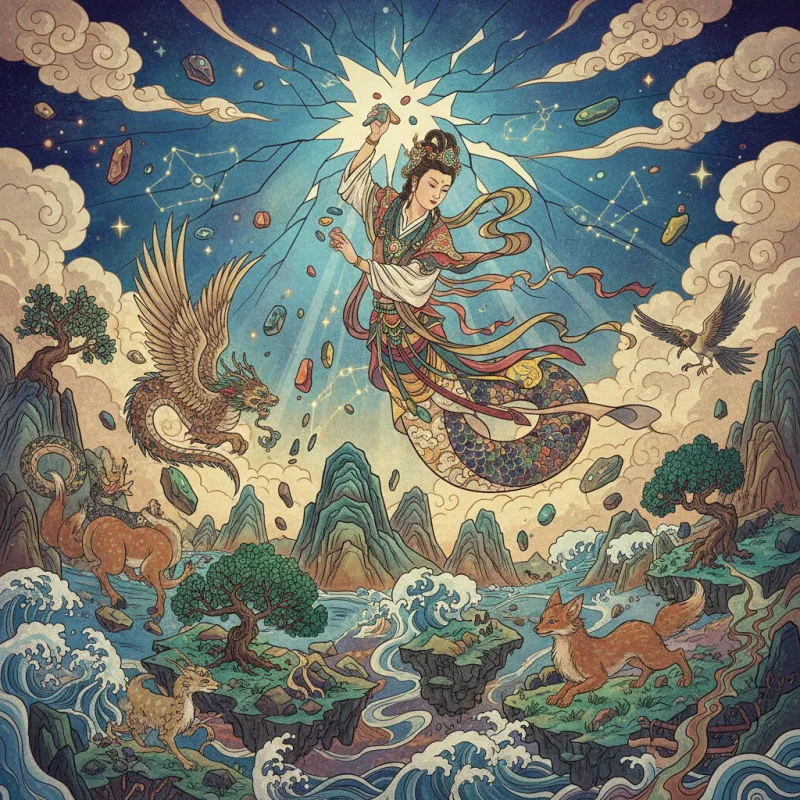
The sky was falling—literally. Chunks of the celestial dome crashed to earth, unleashing floods that swallowed mountains and fires that scorched the land. In this moment of cosmic catastrophe, when the pillars holding up heaven had shattered and the world teetered on the brink of annihilation, one goddess stepped forward with molten stones and an iron will. Her name was Nüwa (女娲, Nǚwā), and what she did next would become the most audacious repair job in Chinese mythology.
The Serpent Goddess Who Shaped Humanity
Before we dive into the sky-mending drama, let's talk about who Nüwa actually was. The Shanhai Jing (山海经, Shānhǎi Jīng) describes her with a human head and torso flowing into a serpent's body—a form that appears repeatedly in ancient Chinese art and texts. This wasn't just aesthetic choice; the serpent symbolized her connection to the primal forces of earth and transformation. Some scholars argue her serpentine form links her to even older dragon worship traditions, making her one of the most ancient deities in the Chinese pantheon.
Nüwa's most famous pre-crisis accomplishment? Creating humanity itself. According to the Huainanzi (淮南子), compiled during the Western Han dynasty around 139 BCE, she molded the first humans from yellow clay. The wealthy nobles came from carefully sculpted figures, while commoners were mass-produced by dipping a rope in mud and flinging it around—each droplet becoming a person. It's a creation myth with a surprisingly frank acknowledgment of social hierarchy, and it tells us something important: Nüwa was already established as a creator goddess before she became a cosmic repairwoman.
When Heaven Broke: The Catastrophe Begins
So what exactly went wrong with the sky? The most detailed account comes from the Huainanzi, which describes a cosmic battle between two gods: Gonggong (共工, Gònggōng), the water god, and Zhuanxu (颛顼, Zhuānxū), one of the legendary Five Emperors. In his rage after losing the fight, Gonggong smashed his head against Mount Buzhou (不周山, Bùzhōu Shān)—one of the eight pillars supporting the heavens.
The result was apocalyptic. The northwestern section of the sky collapsed, tilting the entire celestial dome. This explains, according to ancient Chinese cosmology, why rivers in China flow southeast—the land itself tilted when the sky fell. Fires erupted from the earth's wounds. Floods surged from broken waterways. Mythical beasts and monsters emerged from the chaos to prey on terrified humans. The Shanhai Jing mentions that during this period, creatures like the nine-headed Xiangliu (相柳, Xiāngliǔ) ran rampant, poisoning everything they touched.
This wasn't just a natural disaster—it was a fundamental breakdown of cosmic order, the kind of existential threat that makes modern apocalypse movies look quaint.
The Five-Colored Stones: Nüwa's Solution
Faced with universal destruction, Nüwa didn't panic or despair. She got to work. Her solution involved several monumental tasks, each requiring divine power and unwavering determination.
First, she gathered five-colored stones—blue, yellow, red, white, and black—from riverbeds across the land. These weren't ordinary rocks; they represented the five elements (wǔxíng, 五行) that formed the basis of Chinese cosmological thought: wood, fire, earth, metal, and water. By selecting stones of all five colors, Nüwa was essentially gathering the fundamental building blocks of reality itself.
Then came the technical challenge: melting these stones into a substance that could patch the sky. The Huainanzi states she smelted 36,500 stones, though she only needed 36,501 to complete the repairs—leaving one stone unused. This leftover stone appears in later literature, most famously in Cao Xueqin's 18th-century novel Dream of the Red Chamber (Hongloumeng, 红楼梦), where it becomes the sentient Stone of Spiritual Understanding that experiences human life. It's a beautiful example of how one myth seeds another across millennia.
The actual repair process required Nüwa to ascend to the broken sections of heaven and apply the molten stone mixture like cosmic mortar. Imagine the scale: a goddess with a serpent's body coiling through the air, pressing glowing, multicolored paste into cracks in the sky itself, sealing the wounds between heaven and earth.
Killing the Black Dragon and Stabilizing the Earth
But patching the sky wasn't enough. The floods still raged, and the earth remained unstable. Nüwa's next move was more violent: she hunted down and killed a black dragon that was terrorizing the Central Plains. Some versions identify this creature as related to Gonggong's forces, suggesting Nüwa was also cleaning up the political aftermath of the divine war.
She used the dragon's body practically—nothing went to waste in ancient mythology. Its remains helped dam the floodwaters and restore balance to the waterways. This detail reveals something crucial about Nüwa's character: she was both creator and destroyer, capable of nurturing life and taking it when necessary.
The most ingenious part of her solution involved the legs of a giant turtle (áo, 鳌). After killing this massive creature—and yes, ancient Chinese mythology is surprisingly violent—she used its four legs as replacement pillars to support the corners of heaven. This is why you'll sometimes see references to "turtle pillars" in classical Chinese poetry and art. The image of the world literally resting on a turtle's legs became embedded in Chinese cosmological imagination, influencing everything from architecture to creation myths about how the universe formed.
The Tilted World: Permanent Consequences
Here's what makes Nüwa's story more sophisticated than typical "hero saves the day" narratives: she didn't restore everything to its original state. She couldn't. The damage was too severe, and even divine power has limits.
The sky remained slightly tilted toward the northwest, which is why—according to this mythological framework—the sun, moon, and stars appear to move from east to west. The earth tilted southeast, explaining why China's great rivers flow in that direction. These weren't failures; they were the best possible outcomes given the circumstances. Nüwa saved the world, but the world was permanently changed.
This acceptance of imperfect solutions feels remarkably mature for an ancient myth. It acknowledges that some catastrophes leave lasting scars, that restoration doesn't always mean returning to the way things were. The tilted world became the new normal, and life adapted.
Nüwa's Legacy in Chinese Culture
The sky-mending story resonated through Chinese culture for thousands of years. During the Tang dynasty (618-907 CE), poets invoked Nüwa when writing about natural disasters or political chaos, using her as a symbol of hope and restoration. The phrase "refining stones to mend the sky" (liànshí bǔtiān, 炼石补天) became an idiom meaning to remedy a desperate situation through extraordinary effort.
Temples dedicated to Nüwa appeared across China, particularly in Hebei Province, where legend claimed she performed her sky-mending work. Even today, the Nüwa Palace in Shexian County attracts pilgrims and tourists who want to honor the goddess who saved the world.
What's fascinating is how Nüwa's story intersects with other cosmological narratives in the Shanhai Jing. She exists in the same mythological universe as Pangu, who separated heaven and earth, and the various divine beings who inhabit Kunlun Mountain. These stories don't always fit together perfectly—Chinese mythology wasn't systematized like Greek mythology—but they create a rich, layered understanding of how the ancient Chinese imagined cosmic forces and divine intervention.
Why This Myth Still Matters
Strip away the supernatural elements, and Nüwa's story is about facing impossible odds with creativity and determination. It's about taking responsibility when the world is falling apart, about making difficult choices and accepting imperfect outcomes. The goddess who molded humans from clay became the goddess who literally held the sky together—a progression from creator to preserver that mirrors humanity's own journey from building civilizations to maintaining them.
In our current age of climate crisis and social upheaval, there's something oddly comforting about a myth that acknowledges both the possibility of catastrophic breakdown and the potential for heroic repair. Nüwa didn't prevent the disaster, but she limited the damage and made survival possible. She worked with what she had—stones, turtle legs, dragon corpses—and improvised solutions that, while imperfect, were good enough.
The unused stone from her repairs, the one that became sentient in Dream of the Red Chamber, serves as a reminder that even our greatest efforts leave something behind, some potential unrealized. But that's not failure—it's just the nature of existence in a tilted world, one that a serpent goddess once saved with molten stones and unshakeable resolve.
Related Reading
- The Four Divine Beasts: Guardians of the Compass
- The Cosmology of the Shanhaijing: How Ancient Chinese Mapped the Universe
- Kunlun Mountain: The Axis of the Chinese Cosmos
- The Complete Guide to Shanhai Jing: China's Book of Mythical Creatures
- Enigmatic Birds of the Shanhaijing: Myths, Legends, and Significance
- Exploring the Enigmatic Creatures and Lands of Shanhaijing: A Cultural Journey
- Unearthing the Cursed Beings of Shanhaijing: Myths, Creatures, and Lands