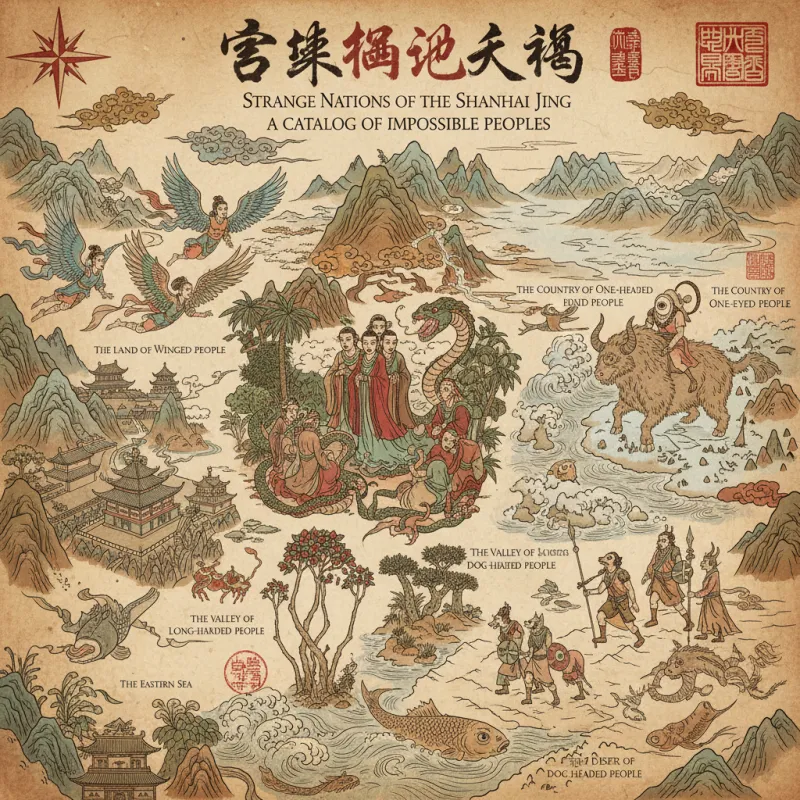
Deep in the fourth-century BCE text of the Shanhaijing (山海经 Shānhǎi Jīng), between descriptions of nine-tailed foxes and mountains that bleed jade, lies something far stranger than any monster: a bureaucratic census of impossible human beings. Not metaphors. Not allegories. Actual nations of people, carefully cataloged with their geographic coordinates, whose bodies operate on principles that would make Gray's Anatomy spontaneously combust.
The Taxonomic Problem
The compilers of the Shanhaijing faced a classification crisis. They had beasts—those belonged in the bestiary sections. They had gods and spirits—those got their own chapters. But what do you do with the people of the Guǐguó (鬼国 Ghost Nation), who are human in every social sense but happen to lack physical substance? Or the residents of the Yǔmín Guó (羽民国 Feathered People Nation), who possess fully functional wings alongside their arms?
The solution was elegant: treat them as foreign nations. Give them territories. Describe their locations relative to known landmarks. The "Classic of Regions Beyond the Seas" (海外经 Hǎiwài Jīng) and "Classic of the Great Wilderness" (大荒经 Dàhuāng Jīng) sections read like a diplomatic gazetteer written by someone who'd eaten the wrong mushrooms. "To the east of the Land of Black-Toothed People lies the Land of Xuányuán," the text reports with the same matter-of-fact tone a modern atlas uses to note that Belgium borders France.
This wasn't fantasy worldbuilding in the Tolkien sense. The Shanhaijing's compilers genuinely seemed to believe these nations existed somewhere beyond the edges of the known world, in that foggy zone where geography dissolves into rumor and wishful thinking.
Bodies That Break the Rules
The Chángbì Guó (长臂国 Long-Armed Nation) people possess arms that extend to their ankles—useful for fishing, the text notes, as they can simply reach into the water while standing on shore. The Cháng Guó (长国 Tall Nation) residents measure over thirty feet in height. The Jūnzǐ Guó (君子国 Gentleman Nation) inhabitants are described as unfailingly polite, which is perhaps the strangest mutation of all.
But the real anatomical chaos begins with the nations that challenge basic bilateral symmetry. The Yīmù Guó (一目国 One-Eyed Nation) people have a single eye in the center of their faces—not cyclopes in the Greek sense, but humans whose facial architecture simply evolved differently. The Sānshǒu Guó (三首国 Three-Headed Nation) residents possess three heads on a single body, which raises fascinating questions about consciousness and decision-making that the text politely declines to address.
The Guànxiōng Guó (贯胸国 Pierced-Chest Nation) might be the most unsettling: their people have natural holes through their chests, large enough to thread carrying poles through. The text describes this as a practical adaptation for transportation, as if evolution optimized humans for being cargo. Meanwhile, the Qīngqiū Guó (青丘国 Green Hill Nation) residents have nine tails each, blurring the line between the fox spirits that haunt Chinese folklore and human society.
The Geography of Impossibility
What makes these descriptions particularly strange is their geographic specificity. The Shanhaijing doesn't place these nations in a vague "far away." It provides directions. The Xuányuán Guó (轩辕国 Xuanyuan Nation) lies "north of the Land of Qióngshí." The Dàrén Guó (大人国 Giant Nation) is "in the wilderness beyond the northwest seas." These are coordinates for the impossible.
Some scholars argue this reflects genuine geographic knowledge corrupted by distance and translation—that the "Long-Armed Nation" might have been expert fishermen using nets, misunderstood by travelers who'd never seen such techniques. But this theory falls apart when you reach the Wúqǐ Guó (无启国 Headless Nation), whose people have faces on their chests and see through their nipples. There's no fishing technique that explains that.
The more interesting interpretation is that the Shanhaijing's compilers were mapping conceptual space rather than physical space. These nations exist at the edges of the known world because they represent the edges of the knowable. They're thought experiments in human variation, testing how far you can stretch the definition of "human" before it snaps.
The Social Lives of Monsters
Here's what separates the Shanhaijing's strange nations from typical monster catalogs: they have cultures. The Jūnzǐ Guó people don't just look different—they've built a society around Confucian virtue. The Nǚzǐ Guó (女子国 Women's Nation) is an all-female society that reproduces through a magical pool. The Bùsǐ Guó (不死国 Deathless Nation) residents have achieved immortality, which the text treats as just another ethnic characteristic, like having red hair.
This insistence on treating biological impossibility as cultural diversity is what makes the catalog so disorienting. The text never gasps or marvels. It simply reports: "The people of this nation have wings. They eat fish." The same tone you'd use to note that Norwegians eat a lot of salmon.
The divine beings of the Shanhaijing get dramatic origin stories and cosmic significance. These strange nations get census data. It's the bureaucratic mundanity that makes them haunting.
The Catalog as Mirror
By the time you reach the Quǎnróng Guó (犬戎国 Dog-Rong Nation), whose people have canine heads on human bodies, a pattern emerges. Many of these "impossible" nations seem designed to invert or exaggerate Chinese cultural norms. The Gentleman Nation is too polite. The Women's Nation has no men. The Deathless Nation has conquered death itself—the ultimate Daoist fantasy.
The strange nations function as a hall of mirrors, reflecting Chinese anxieties and aspirations back in distorted form. What if people had no need for Confucian hierarchy because they were naturally virtuous? What if women didn't need men? What if bodies were as mutable as social customs?
Some nations seem to encode specific historical encounters. The Hēichǐ Guó (黑齿国 Black-Toothed Nation) people, who lacquer their teeth black, might reflect actual Southeast Asian customs observed by Chinese traders. But then you get the Zhìrén Guó (支人国 Propped-Up People Nation), whose residents are so lazy they need sticks to hold themselves upright, and you're back in the realm of pure xenophobic fantasy.
The Persistence of the Impossible
These catalogs influenced Chinese literature for millennia. When Wu Cheng'en wrote Journey to the West in the 16th century, he populated his fantasy landscape with nations clearly descended from the Shanhaijing's template. When Qing dynasty scholars compiled geographic encyclopedias, they sometimes included the strange nations alongside real foreign countries, unable to fully dismiss them as fiction.
The catalog's deepest legacy might be its radical proposition: that humanity is not a fixed category but a spectrum. The people of the Feathered Nation are human despite their wings. The people of the Pierced-Chest Nation are human despite their holes. The people of the Three-Headed Nation are human despite their heads.
In an era obsessed with defining who counts as fully human—who gets rights, citizenship, moral consideration—the Shanhaijing's strange nations offer a peculiar kind of wisdom. They suggest that the boundaries of humanity are far more elastic than we imagine, that "human" is a social category as much as a biological one, and that the real monsters might be those who insist on drawing the lines too narrowly.
The census of the impossible remains open. The nations still wait at the edges of the map, impossible and human, challenging us to explain exactly where we'd draw the line, and why.
Related Reading
- The Peoples of the Shanhaijing: One-Eyed Nations, Winged Tribes, and the Edges of Humanity
- The Feathered People: Winged Humans of the Shanhai Jing
- The Peoples of the Shanhaijing: Foreign Nations at the Edge of the World
- Giants and Gods: The Titans of the Shanhai Jing
- Discovering the Enigmatic Hybrid Creatures of Shanhaijing
- Kuafu Chases the Sun: The Giant Who Ran After Light
- Exploring the Enigmatic Mountains and Creatures of the Shanhaijing