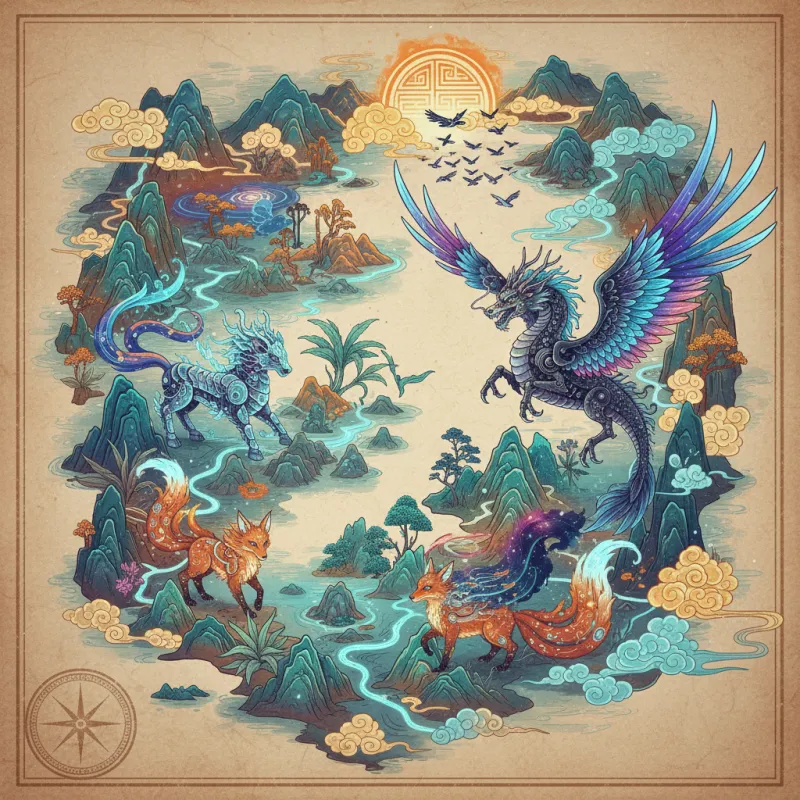
A nine-tailed fox rendered in neon pink and electric blue glows on a gallery wall in Beijing's 798 Art District. Its body dissolves into digital particles, each tail trailing streams of code. Beside it hangs a traditional ink painting of the same creature — elegant, restrained, barely there. The artist, Chen Wei, calls the installation "Shanhai 2.0." She's not alone in her obsession.
The Shanhaijing 山海经 (Shānhǎi Jīng, Classic of Mountains and Seas) has become the unlikely muse of contemporary Chinese art. What was once a reference text with crude woodblock illustrations — circles for faces, triangles for bodies — is now fueling everything from augmented reality installations to fashion collaborations with Gucci. The transformation didn't happen gradually. It exploded around 2015, when a critical mass of artists trained in both traditional techniques and digital media simultaneously discovered that the text's bizarre creatures were perfect for our weird, hybrid moment.
The Woodblock Problem
Let's be honest: the original illustrations are terrible. The earliest surviving editions from the Ming Dynasty show creatures that look like they were drawn by someone who'd only heard them described over a bad phone connection. The zouyu 騶虞 — described in the text as a tiger-like beast with five colors — appears as a lumpy cat with stripes. The bingfeng 鳳凰, a divine bird that brings peace, looks like a chicken having a bad day.
This wasn't incompetence. It was purpose. The Shanhaijing was a geographical catalog, possibly a ritual manual. Its illustrations existed to identify, not to beautify. A scholar needed to recognize a qiongqi 窮奇 if he encountered one (unlikely), not to admire its rendering. The woodblock artists were making diagrams, not art.
For centuries, this was fine. Then photography happened, then cinema, then Instagram. Our visual standards changed. Those stiff Ming Dynasty woodblocks started looking not just old but inadequate. The creatures described in the text — shape-shifting, multi-headed, reality-bending beings — deserved better.
The Digital Renaissance
Zhang Xu's 2016 series "Creatures Unbound" marked a turning point. Using 3D modeling software typically reserved for video game design, he reconstructed thirty Shanhaijing creatures with anatomical precision. His jiuying 九嬰 (nine-headed bird-serpent hybrid) has individually articulated vertebrae, feathers that follow actual avian patterns, and scales that reflect light like real reptile skin. It's simultaneously more realistic and more fantastical than anything in the original text.
What makes Zhang's work significant isn't just technical skill — it's interpretive courage. The Shanhaijing describes the jiuying in exactly seventeen characters. Zhang had to invent everything else: How do nine heads attach to one body? Do they think independently? How does it fly with that weight distribution? His answers are speculative but grounded in biology, mythology, and aerodynamics. The result feels both ancient and newly discovered.
This approach — rigorous imagination — defines the current wave of Shanhaijing-inspired art. Artists aren't just illustrating; they're extrapolating. They're asking: What would these creatures actually look like if they existed? How would they move, hunt, sleep, die?
Ink Painting's Quiet Revolution
While digital artists grabbed headlines, traditional ink painters were conducting their own experiments. Liu Miao's "Mountain Spirits" series (2018-2021) uses classical techniques — brush, ink, rice paper — but abandons classical restraint. Her creatures bleed across the page, their forms dissolving into landscape. A taowu 檮杌 (described as a stubborn, unteachable beast) becomes a mountain range. Its fur is pine forests. Its breath is mist.
This isn't decoration. Liu is making an argument about the Shanhaijing itself. The text never clearly separates creatures from geography. Mountains have personalities. Rivers have intentions. Beasts are also places. Liu's paintings visualize this ontological confusion. You can't tell where the creature ends and the landscape begins because in the Shanhaijing's worldview, they're the same thing.
Compare this to the work of Zhao Bingwen, whose 2020 series "Bestiary" takes the opposite approach. His creatures are hyperreal, almost photographic, rendered in ink with such precision they look like scientific illustrations. Each painting includes annotations in classical Chinese, mimicking the format of Qing Dynasty natural history texts. The effect is unsettling: these impossible creatures presented as if they're real, documented, studied.
Both artists understand something the Ming woodblock carvers didn't need to: in contemporary art, how you depict something is an argument about what it is. Liu says Shanhaijing creatures are landscape spirits. Zhao says they're undiscovered species. Both are more interesting than "here's a weird bird."
Installation and Immersion
The most ambitious Shanhaijing art isn't hanging on walls. It's surrounding you.
"Shanhai Realm," a 2019 installation by the collective Studio Drift, transformed a Shanghai warehouse into a walk-through version of the text. Visitors entered through a tunnel lined with mirrors and projections — the journey through the mountains. Inside, animatronic creatures moved through artificial fog. A feiyi 飛鼠 (six-legged flying squirrel) hung from the ceiling, its wings slowly beating. A lushu 鹿蜀 (horse-bodied, bird-headed creature) stood in a pool of water, its reflection distorted by ripples.
The installation lasted three months and attracted over 200,000 visitors. More importantly, it demonstrated something: Shanhaijing creatures work in three dimensions. They're not just images; they're presences. The text describes them moving through space, and experiencing them spatially — walking around them, seeing them from different angles — activates something the flat page can't.
This insight has influenced everything from theme park designs to virtual reality experiences exploring mythical landscapes. The Shanhaijing isn't just being illustrated anymore. It's being built.
Fashion and the Wearable Bestiary
In 2021, designer Guo Pei (known for Rihanna's 2015 Met Gala yellow gown) debuted "Shanhai Collection" at Paris Fashion Week. Models walked the runway in garments covered with embroidered Shanhaijing creatures. A coat featured a qilin 麒麟 in gold thread, its scales made from actual fish scales lacquered and sewn on. A dress depicted the kunpeng 鯤鵬 transformation — fish on the front, bird on the back, the metamorphosis happening at the seams.
Fashion's embrace of Shanhaijing imagery might seem superficial, but it's actually revealing. These creatures have always been about transformation, hybridity, boundary-crossing. They're perfect metaphors for contemporary identity — fluid, multiple, refusing simple categories. Wearing a nine-tailed fox isn't just aesthetic; it's aspirational.
Streetwear brands have noticed. Hypebeast collaborations with Chinese artists now routinely feature Shanhaijing creatures. A 2022 Nike Dunk featured a bixie 辟邪 (evil-warding beast) on the heel. Supreme released a hoodie with a taotie 饕餮 (gluttonous monster) design. These aren't careful, respectful adaptations. They're loud, irreverent, sometimes garish. And they're introducing the Shanhaijing to audiences who'll never read the text.
Animation and the Moving Image
Chinese animation studios have been mining the Shanhaijing for decades, but recent works show new sophistication. "Fog Hill of Five Elements" (2020), though not directly based on the text, draws heavily on its aesthetic — creatures that are part animal, part landscape, part weather phenomenon. The animation style blends 2D and 3D, traditional ink painting and digital effects, creating a visual language that feels both ancient and futuristic.
More directly, "Yao-Chinese Folktales" (2021), an anthology series, dedicated multiple episodes to Shanhaijing stories. The episode "Goose Mountain" reimagines the text's creatures in a style inspired by Dunhuang murals — flat, decorative, richly colored. Another episode uses paper-cut animation, another uses clay. The series argues that there's no single correct way to visualize these creatures. Every artistic tradition offers different insights.
This pluralism matters. For too long, the Shanhaijing was trapped in a single visual register — those stiff woodblock prints. Contemporary artists have liberated it. The creatures can be realistic or abstract, beautiful or grotesque, reverent or playful. The text is old enough and strange enough to support infinite interpretations.
The International Dimension
Non-Chinese artists are joining the conversation. British illustrator Victo Ngai's 2022 series "Mountain Seas" reinterprets Shanhaijing creatures through the lens of European fairy tale illustration — detailed, jewel-toned, slightly sinister. Her zhulong 燭龍 (torch dragon that lights the world) looks like something from a medieval manuscript, all gold leaf and careful crosshatching.
American artist James Jean, known for his work on DC Comics covers, created a Shanhaijing-inspired series that blends the creatures with contemporary surrealism. His paintings are dreamlike, unsettling, more concerned with psychological resonance than mythological accuracy. A xingtian 刑天 (headless giant with face on torso) becomes a meditation on consciousness and embodiment.
These cross-cultural interpretations raise questions. Is the Shanhaijing being diluted or enriched? Are non-Chinese artists appropriating or appreciating? The answers aren't simple, but the phenomenon itself is significant. The text is escaping its national boundaries, becoming part of global visual culture. Whether that's good depends on who's doing it and how.
Why Now?
The Shanhaijing has existed for over two millennia. Why is it suddenly everywhere in contemporary art?
Part of the answer is technological. Digital tools make it easier to render complex, hybrid creatures. 3D modeling, digital painting, animation software — these technologies are perfect for visualizing beings that are part tiger, part bird, part fish, part mountain.
But technology alone doesn't explain it. The deeper reason is cultural. We live in an age of hybridity. Our identities are multiple. Our realities are mixed (physical and digital, local and global). Our categories are collapsing. The Shanhaijing, with its shape-shifting creatures and blurred boundaries, speaks to this moment. It's a text about a world where nothing is purely one thing, where transformation is constant, where the map doesn't match the territory because the territory keeps changing.
Contemporary artists recognize this. They're not just illustrating an old text. They're using it to think through contemporary problems: What does it mean to have a body? What's the relationship between human and animal, natural and artificial, real and imagined? The Shanhaijing doesn't answer these questions, but it provides a vocabulary for asking them.
The Unfinished Project
The explosion of Shanhaijing-inspired art shows no signs of slowing. If anything, it's accelerating. New exhibitions open monthly. New artists discover the text and add their interpretations. The creatures multiply, mutate, evolve.
This is appropriate. The Shanhaijing itself is unfinished, contradictory, impossible to pin down. It describes creatures that don't exist in a geography that never was. It's a text that invites completion, demands interpretation, refuses to stay still.
Modern artists aren't just reimagining the Shanhaijing. They're continuing it. Every new painting, sculpture, installation, or animation is another entry in the catalog. Another creature added to the bestiary. Another mountain mapped.
The project that began thousands of years ago — documenting the strange, the hybrid, the impossible — is still ongoing. It will never be finished. That's the point.
Related Reading
- Shanhai Jing in Modern Art: Contemporary Illustrations of Ancient Beasts — Shanhai Perspective
- Chinese Mythology in Hollywood: From Mulan to Shang-Chi — Shanhai Perspective
- Shanhai Jing Creatures in Modern Video Games — Shanhai Perspective
- Shanhaijing in Video Games and Anime
- Exploring Shanhaijing’s Most Enigmatic Mythical Creatures and Mysterious Lands
- Hundun: The Faceless Creature of Chaos
- Fenghuang: The Chinese Phoenix and Its True Meaning