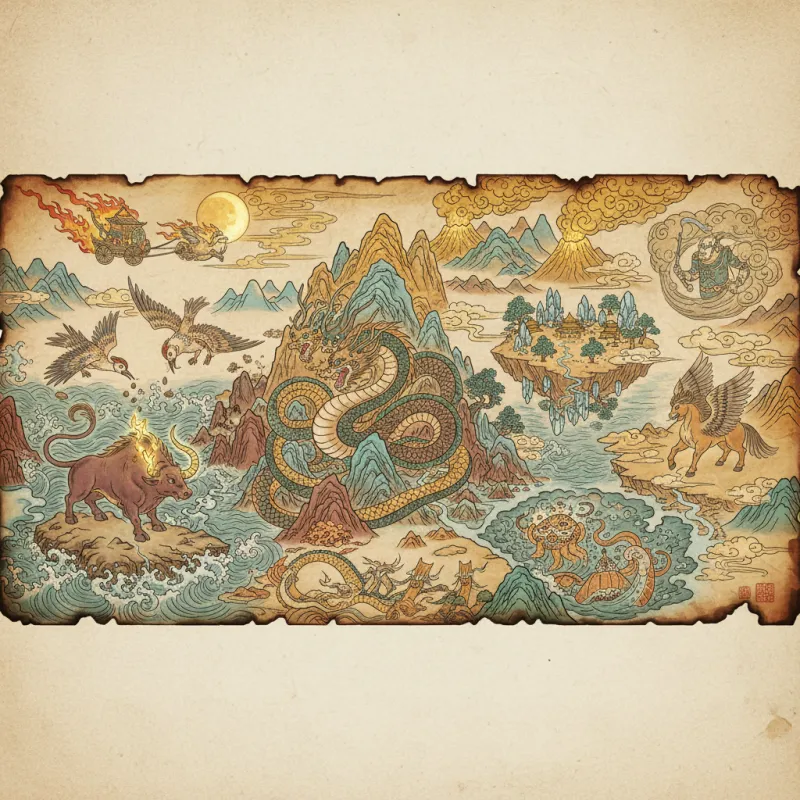
A nine-tailed fox dances across a mountain peak, its crimson fur blazing against the twilight sky. In the valleys below, a creature with the body of a tiger and nine human heads prowls through bamboo groves, while overhead, a bird with three heads and six eyes circles endlessly. This isn't fever dream or fantasy novel—these beings populate the pages of the Shanhaijing (山海经, Shānhǎijīng), a text so strange that scholars still debate whether its authors intended it as geography, mythology, or something altogether different.
The Text That Defies Classification
The Shanhaijing emerged somewhere between the 4th century BCE and the early Han dynasty, compiled by unknown hands across generations. Unlike the orderly Confucian classics or the poetic Daodejing, this text reads like an expedition journal written by someone who never let reality constrain their observations. It catalogs 277 mountains, 258 rivers, and over 400 creatures—many of which defy biological possibility. The text's matter-of-fact tone makes it even more unsettling: "Three hundred li to the east is Mount Qingqiu, where the nine-tailed fox dwells. It sounds like an infant crying. It eats people." No elaboration, no moral lesson, just clinical documentation of the impossible.
What makes the Shanhaijing particularly fascinating is its refusal to distinguish between the mundane and the marvelous. A passage might describe ordinary deer and wild boar, then casually mention a creature called the zhuyin (烛阴, Zhúyīn)—a thousand-li-long serpent with a human face whose opened eyes create daylight and whose closed eyes bring night. The text treats both with identical authority, suggesting that for its compilers, the boundary between natural and supernatural was far more porous than our modern categories allow.
Creatures That Haunt the Margins
The jiuying (九婴, Jiǔyīng) exemplifies the Shanhaijing's genius for nightmare fuel. This nine-headed monster could spew both water and fire, terrorizing the lands until the legendary archer Yi shot it down. But the text doesn't present this as heroic myth—it's listed alongside geographic features, as if to say "this mountain has copper deposits, that valley has a nine-headed water-and-fire-breathing monster." The casual horror is what lingers.
Then there's the qiongqi (穷奇, Qióngqí), one of the Four Perils that plagued ancient China. Described as a winged tiger with hedgehog quills, it had a peculiar sense of justice—it would eat the righteous and reward the wicked, literally devouring anyone who argued honestly and feeding meat to those who lied. This inverted morality makes the qiongqi more disturbing than simple monsters; it represents a world where virtue becomes vulnerability. The creature appears in later texts like the Zuo Zhuan, where it's associated with the degenerate son of the legendary emperor Shaohao, suggesting the Shanhaijing influenced mainstream historical writing more than we might expect.
The taotie (饕餮, Tāotiè) has achieved lasting fame through its depiction on ancient bronze vessels. The Shanhaijing describes it as a creature with a sheep's body, human face, eyes under its armpits, and tiger's teeth. Its defining characteristic? Insatiable hunger. It would eat everything in sight until it consumed itself—a perfect metaphor for greed that Shang and Zhou dynasty artisans transformed into a protective symbol. The irony of using a monster of consumption to guard food vessels and ritual bronzes speaks to the complex relationship ancient Chinese had with their mythical bestiary. For more on creatures that blur the line between protection and threat, see The Paradox of Guardian Beasts in Chinese Mythology.
Lands Beyond the Known World
The Shanhaijing doesn't just catalog creatures—it maps an entire cosmology of impossible places. The text describes the Kunlun (昆仑, Kūnlún) mountains as the axis mundi of Chinese mythology, home to the Queen Mother of the West (Xiwangmu, 西王母) and her garden of immortality peaches. But the Shanhaijing's Kunlun isn't the mystical paradise of later Daoist texts—it's a specific geographic location, complete with measurements, surrounding peaks, and resident fauna. This grounding of the fantastic in pseudo-geographic precision gives the text its peculiar authority.
The Country of Gentlemen (Junzi Guo, 君子国) appears in the text as a land where people never argue, always yield to others, and wear swords they never draw. It sounds utopian until you consider the Shanhaijing's deadpan style—is this admiration or subtle mockery? The text offers no judgment, leaving readers to wonder whether these "gentlemen" represent an ideal or a cautionary tale about excessive civility.
More disturbing is the Country of the Corpse-Headed People, where inhabitants have human bodies but the heads of corpses. The text provides no explanation for this condition, no origin story, no moral framework—they simply exist, as matter-of-factly as any other ethnic group described in the text. This refusal to explain or justify is quintessentially Shanhaijing: the world is strange, deal with it.
The Geography of Impossibility
What distinguishes the Shanhaijing from pure mythology is its obsessive geographic precision. Each entry typically follows a formula: direction, distance, mountain name, resources (minerals, plants, animals), and resident creatures or peoples. "Three hundred li to the northeast is Mount Gouwu. Many jade deposits. The Gouwu River originates here, flowing east into the Yellow River. Many luyu fish, which have the body of a fish and the wings of a bird." This systematic approach creates an illusion of empirical observation, as if the compilers were dutifully recording field research rather than spinning fantasies.
The text's measurements—always in li (里), an ancient Chinese unit of distance—add to this pseudo-scientific veneer. Modern scholars have attempted to map the Shanhaijing's geography onto real locations, with limited success. Some mountains and rivers clearly correspond to known features, while others seem to describe places that never existed or perhaps existed only in the cultural imagination. The Shanhaijing might be better understood as a mental map rather than a physical one—a representation of how ancient Chinese conceived of space, danger, resources, and the unknown.
Why These Creatures Still Matter
The Shanhaijing's influence on Chinese culture extends far beyond academic interest. Its creatures populate everything from modern video games to contemporary fantasy novels. The Shanhaijing provided the bestiary for Journey to the West, influenced the monster designs in Strange Tales from a Chinese Studio, and continues to inspire artists and writers today. When you see a nine-tailed fox in anime or a taotie motif in modern jewelry, you're witnessing the Shanhaijing's cultural longevity.
But the text's real significance lies in what it reveals about how ancient Chinese processed the unknown. Rather than creating a neat cosmology with clear hierarchies and moral lessons—like Greek mythology with its Olympian order or Norse mythology with its apocalyptic structure—the Shanhaijing presents a world of radical diversity and strangeness. Creatures aren't necessarily evil or good; they simply are. Lands aren't rewards or punishments; they're locations with their own logic. This acceptance of irreducible strangeness feels remarkably modern, even postmodern.
The text also demonstrates how mythology and geography intertwined in ancient thought. The Shanhaijing doesn't distinguish between mapping physical space and mapping conceptual space—both are equally real, equally worthy of documentation. This holistic worldview, where the material and mythical occupy the same plane of existence, offers an alternative to our modern insistence on categorical boundaries. For insights into how these mythical geographies influenced later Chinese literature, explore Mythical Landscapes in Classical Chinese Poetry.
Reading the Shanhaijing Today
Approaching the Shanhaijing requires abandoning expectations of narrative coherence or systematic philosophy. This isn't the Iliad or the Epic of Gilgamesh—there's no plot, no character development, no dramatic arc. Instead, it offers something rarer: a window into a radically different way of organizing knowledge and experience. The text's power lies in its accumulation of strange details, its refusal to explain or moralize, its treatment of the impossible as merely unusual.
Modern readers might find the Shanhaijing frustrating or bewildering, but that bewilderment is precisely the point. The text reminds us that our ancestors inhabited a world far stranger and more various than our rationalized modernity typically acknowledges. Every nine-tailed fox and corpse-headed person represents not just imaginative fancy but a genuine attempt to make sense of a world that exceeded understanding—a world where the next valley might contain wonders or horrors, where the boundaries of the known were always provisional, always subject to revision.
The Shanhaijing endures because it captures something essential about human consciousness: our need to map the unmappable, to catalog the uncategorizable, to make sense of a world that persistently refuses to make sense. In its pages, ancient Chinese compilers created not just a bestiary or a geography but a monument to the human capacity for wonder, terror, and the stubborn insistence on documenting both. That project continues today, every time we encounter something that defies our categories and reach for words to describe it anyway.
Related Reading
- Enigmatic Beasts and Mystical Lands in the Shanhaijing Classic of Mountains and Seas
- Immersive Wonders of Shanhaijing: Exploring Mythical Birds and Enchanted Regions
- The Four Seas and the Shape of the Ancient Chinese World
- The Nine-Tailed Fox: From Divine Messenger to Demonic Seductress