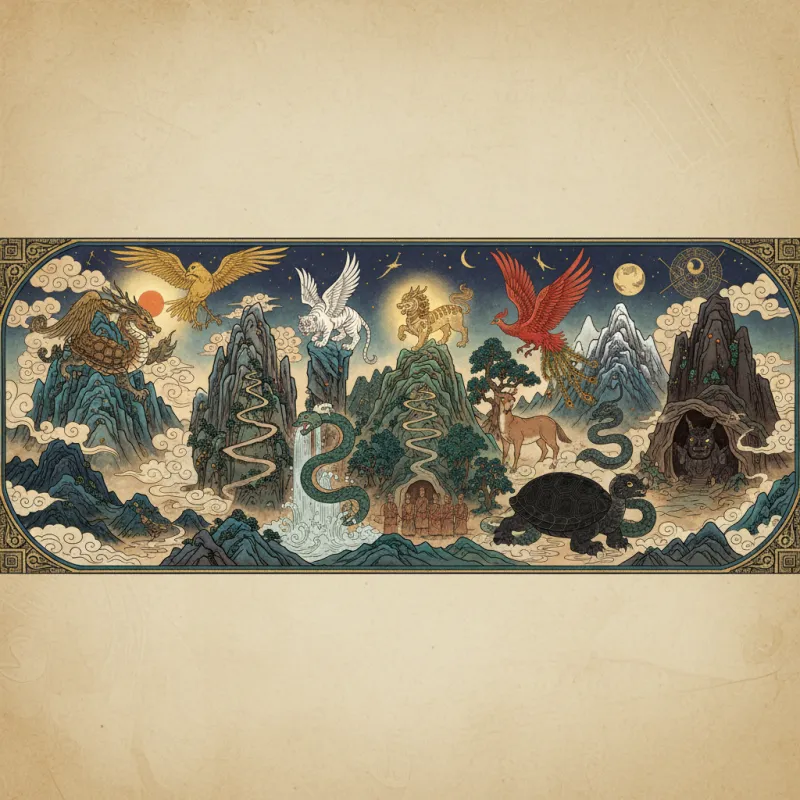
Stand at the summit of Mount Tai before dawn, surrounded by thousands of pilgrims who've climbed through the night, and you'll understand something the emperors of China knew: some mountains aren't just geology. They're arguments. They're proof. They're the places where you go to make deals with heaven itself.
The Five Great Mountains (五岳, Wǔ Yuè) have anchored Chinese cosmology for over two millennia, but here's what makes them strange: they're not particularly tall. Mount Tai, the most revered, barely breaks 1,500 meters. You could fit three of them inside a single Colorado fourteener. Mount Everest, sitting in China's backyard, towers over all five combined. Yet no emperor ever climbed Everest to prove his mandate from heaven. They climbed Tai. The height that matters isn't measured in meters.
These mountains earned their status through location, not elevation. Arranged across China's heartland like cosmic compass points, they mark the boundaries of the civilized world as ancient Chinese saw it. East, west, south, north, and center — each peak guards a cardinal direction and embodies one of the five elements that govern all existence. This isn't metaphor. For the better part of Chinese history, these correspondences were considered as real as gravity.
The Eastern Peak: Where Emperors Meet Dawn
Mount Tai (泰山, Tài Shān) in Shandong Province stands 1,545 meters tall and carries the weight of three thousand years of imperial ritual. Seventy-two emperors made the pilgrimage to its summit to perform the Feng and Shan sacrifices — ceremonies so sacred that the details were kept secret even from court historians. The logic was simple and terrifying: if heaven approved of your rule, you'd survive the climb and the ritual. If not, well, mountains have a way of making their judgments clear.
Confucius climbed Tai and declared that "the world is small." Mao Zedong climbed it and wrote that "the east is red." The mountain collects these pronouncements like other peaks collect snow. Every switchback on the 6,000 stone steps to the summit passes another inscription, another poem, another emperor's attempt to leave his mark on eternity. The stone remembers everything.
The peak governs the east and corresponds to wood — the element of spring, growth, and beginnings. Appropriately, it's where the sun rises first over China. Watching dawn from the summit remains one of Chinese culture's essential experiences, a pilgrimage that predates Buddhism, predates Daoism, predates everything except the human need to stand somewhere high and watch light return to the world.
The Western Peak: The险 Mountain
Mount Hua (华山, Huà Shān) in Shaanxi Province has a reputation: it kills people. Not metaphorically. The plank walk along its cliffside, where you shuffle along boards bolted to vertical granite while wearing a safety harness (a modern addition), has become internet-famous for obvious reasons. But Hua was terrifying long before social media discovered it.
At 2,154 meters, it's the tallest of the five peaks, and the most vertical. Ancient Daoists built temples in impossible locations on its faces, accessible only by chains bolted into rock. The mountain corresponds to metal — sharp, hard, unyielding. It cuts. The west in Chinese cosmology is the direction of autumn, of harvest, of things coming to their end. Hua embodies this perfectly. It's where you go to test yourself, to see what you're made of when the ground drops away.
The mountain appears throughout martial arts fiction as the home of various sword sects, which makes perfect sense. If you're going to master the blade, you should probably train somewhere that might kill you if you lose focus. The divine weapons of Chinese mythology often have origin stories connected to Hua's peaks, forged in the mountain's metal essence.
The Southern Peak: The Fire Mountain
Mount Heng (衡山, Héng Shān) in Hunan Province sits at 1,300 meters and governs the south. Its element is fire, its season summer, its energy yang at maximum intensity. The mountain is green, lush, often wrapped in mist — not what you'd expect from a fire peak. But Chinese elemental theory isn't literal. Fire here means transformation, visibility, the peak of growth before the turn toward autumn.
Seventy-two peaks comprise the Heng range, a number that echoes throughout Chinese mysticism. The mountain has been a Buddhist center since the Tang Dynasty, its temples built into the landscape with the kind of architectural confidence that comes from believing your religion and your mountain are both eternal. The Great Temple at the mountain's base has been rebuilt dozens of times after fires, floods, and wars, but it's always rebuilt in the same spot. The mountain demands it.
What strikes you about Heng is how lived-in it feels. Unlike Tai with its imperial grandeur or Hua with its death-defying drama, Heng is a working mountain. Monks actually live here. Pilgrims come for healing, for blessings, for the specific intercession of the mountain spirits who've made Heng their home for centuries. It's sacred, but it's also practical. The south is like that.
The Northern Peak: The Dark Water Peak
Mount Heng (恒山, Héng Shān) in Shanxi Province shares a name with the southern peak — same pronunciation, different character — which has confused travelers for millennia. At 2,016 meters, it governs the north and corresponds to water. Not the flowing, nourishing water of rivers, but the deep, still, dark water of winter. The water that waits.
The northern Heng is the least visited of the five peaks, partly because it's remote, partly because the north in Chinese cosmology is the direction of death, endings, and the unknown. The mountain is stark, often snow-covered, its temples built to withstand Mongolian winds. The famous Hanging Temple (悬空寺, Xuánkōng Sì) clings to a cliff face on Heng's flanks, a architectural impossibility that's survived 1,500 years of earthquakes, wars, and gravity.
This is the mountain of hermits and mystics, the ones who go to mountains not to prove anything but to disappear. The Daoist tradition of mountain reclusion finds its purest expression here, in temples where the wind never stops and winter lasts half the year. If you want to understand why Chinese philosophy values emptiness, stillness, and the void, spend a winter on the northern Heng. The mountain will teach you.
The Central Peak: The Axis
Mount Song (嵩山, Sōng Shān) in Henan Province stands at 1,491 meters and holds the center. Its element is earth — not as dirt, but as the stable ground that allows the other four elements to exist. The axis around which everything turns. The mountain that doesn't move.
Song is home to the Shaolin Temple, which means it's the most famous of the five peaks to modern audiences, though for entirely non-cosmological reasons. Kung fu movies have made Shaolin synonymous with martial arts mastery, but the temple's location on Song isn't accidental. The center is where you build things that last. The earth element is about foundation, stability, the long view.
The mountain itself is geologically ancient, its rocks dating back 3.5 billion years — some of the oldest exposed stone on Earth. Chinese geologists study Song the way other scientists study the cosmic microwave background: it's a window into the beginning of everything. The mountain has been the center for so long that it's forgotten how to be anything else.
The Cosmological Machine
Here's what makes the Five Great Mountains more than just a list: they form a system. Each peak doesn't just represent its element and direction — it actively generates and controls those forces. In traditional Chinese thought, the mountains are cosmic machinery, the physical infrastructure that keeps reality running.
This is why emperors had to visit them. You don't just rule China by sitting in a palace issuing decrees. You have to go to the mountains, perform the rituals, maintain the relationship between heaven and earth. The Feng and Shan sacrifices on Mount Tai weren't symbolic. They were maintenance. They were the emperor doing his actual job, which was keeping the cosmos functioning.
The system works through the cycle of the five elements: wood feeds fire, fire creates earth (ash), earth bears metal, metal collects water, water nourishes wood. The mountains embody this cycle geographically. Stand at Song in the center and you can feel the other four peaks pulling at the edges of the world, holding it in place through their elemental tensions.
What the Mountains Remember
I've climbed all five peaks over the course of a decade, and what strikes me most isn't their sanctity — though that's real and palpable — but their patience. These mountains have watched dynasties rise and fall like seasons. They've seen emperors come to prove their legitimacy and rebels come to challenge heaven itself. They've absorbed three thousand years of prayers, poems, and blood.
The stone steps on Mount Tai are worn smooth by millions of feet. The chains on Mount Hua are polished by millions of hands. Every surface that humans can touch has been touched, and the mountains have recorded it all. They're not just sacred spaces. They're archives. They're the physical memory of Chinese civilization.
Modern China has complicated feelings about the Five Great Mountains. They're tourist destinations now, complete with cable cars and souvenir shops. You can ride to the summit of Tai instead of climbing the traditional route. The Hanging Temple on northern Heng has a ticket booth and a gift shop. Some purists see this as desecration. I'm not sure the mountains care. They've seen worse. They've seen the Mongols, the Japanese, the Cultural Revolution. They're still here.
The Sixth Peak
There's a question that occasionally surfaces in Chinese forums and academic papers: should there be a sixth peak? The five-peak system is ancient, but China is vast. What about the mountains in the west, the real giants of the Himalayas? What about the sacred peaks of Tibet, of Xinjiang, of the regions that weren't part of China when the five-peak system was established?
The question reveals something about how cosmological systems work. They're not descriptions of reality — they're frameworks for understanding it. The Five Great Mountains don't need to include every important mountain in China. They need to form a complete system, and five is complete. Five elements, five directions, five peaks. Adding a sixth would break the pattern, and the pattern is the point.
But the question persists because China has changed. The "civilized world" that the five peaks once bounded now extends far beyond them. The cosmological map no longer matches the political one. This tension — between ancient systems and modern realities — is something China navigates constantly. The mountains just watch.
Climbing Your Own Peak
You don't have to believe in the five elements or the mandate of heaven to feel something on these mountains. The sacred has a way of persisting even when the theology fades. Stand on Tai at dawn, cling to the chains on Hua's cliffside, sit in the silence of northern Heng's winter temples — these experiences change you regardless of your metaphysics.
The Five Great Mountains have survived because they offer something beyond religion: they offer perspective. They're places where you can see farther, both literally and figuratively. Where the scale of human concerns shrinks against geological time. Where you remember that you're small, temporary, and part of something much larger.
The emperors knew this. That's why they climbed. Not just to prove their legitimacy to heaven, but to remember their place in the order of things. To stand somewhere high and feel the weight of responsibility, the burden of time, the reality that mountains outlast dynasties.
You can visit all five peaks in a few weeks if you're determined. The infrastructure is good, the trails are maintained, and yes, there are cable cars if you need them. But I'd recommend taking your time. These mountains have been waiting for three thousand years. They'll wait a little longer. And they'll still be here long after we're gone, holding their positions, maintaining the cosmic order, remembering everything.
Related Reading
- Mountain Spirits and Local Worship
- The Mountain Gods of Ancient China
- Kunlun Mountain: Home of the Immortals
- Mountain Spirits of the Shanhaijing: The Gods Who Live in Peaks
- The Feathered People: Winged Humans of the Shanhai Jing
- The Great Flood: Why Every Civilization Has a Flood Myth
- Unraveling the Mysteries of Shanhaijing: Myths, Creatures, and Fantastic Realms